

<">
<">
10.1 Ordinary Income
This chapter contains the following sections:
In this chapter
This chapter contains the following section:
Note: Sections 4 and 5 have been developed as a priority. Other procedures relating to Ordinary Income will be provided later.
<">
10.1.4 Income from Employment
Last amended: 5 September 2011
This section contains procedures for the assessment of income from employment (earnings).
In this section
This section contains the following topics:
See Also
Income
<">Chapter 9.1 Income and Asset Test Principles
<">Chapter 9.11 Compensation Recovery
<">Chapter 10.1 Ordinary Income
<">Chapter 11.1 Income Support Effective Dates and Pension Periods
<">Chapter 12.1 Recipient Obligations
<">Chapter 12.2 Information Gathering Powers
<">Chapter 12.3 Data Matching
<">Chapter 12.6 Overpayments
<">Chapter 12.7 Specific and Compliance Reviews
Policy information about income from employment can be found in the CLIK Policy Library.
Policy Library – Income from employment
<">
Assessment of Income from Employment
Last amended: 5 September 2011
Specific reviews of earnings
Recipient Obligations
Section 54 VEA
Review pensioners with employment income according to the <">specific review guidelines.
Procedure Library – Earnings reviews
Policy Library – Earnings reviews
10.1.4/Specific (Periodic) Reviews
Policy Library – Date of effect
Employment income is recorded in the Earnings screen in PIPS.
What is employment income
Employment income is income earned, received or derived from remunerative work as an employer/employee relationship. This may include wages, salary, honorarium, commissions and fringe benefits earned by an employee.
Policy Library – Meaning of “employment income”
The following types of income are not considered to be employment income for the work bonus :
- Business income
More →More → (go back)
Policy Library – Meaning of “employment income”
- Self employment – sole traders
More →More → (go back)
Policy Library – Meaning of “employment income”
- Director's fees – where the person has an involvement in the company
More →More → (go back)
Policy Library – Director's fees are generally excluded
Policy Library – Allowed director's fees
- Royalty payments
More →More → (go back)
Policy Library – Royalty payments
- Workers compensation, salary continuance and income protection payments.
More →More → (go back)
Policy Library – Amounts not employment income
Policy Library – Overview of Compensation Recovery
Policy Library – Income from Personal Injury Schemes
Annual rate of income converted to fortnightly figure for PIPS
For the purposes of applying the <">income test, the policy refers to calculating an annual rate of income. When recording income from employment in the pension assessment via <">[glossary:PIPS:], convert the annual rate of income to a fortnightly figure.
Policy Library – Definition of annual rate of income
Procedure Library – How to convert income for PIPS
Reviewing a pensioner notification of income from employment
The six steps below summarise the process for assessing income from employment.
|
Step |
Action |
|
1 |
When notification received that a pensioner or their partner has commenced or changed employment, request verification of employment income, including salary sacrifice and details, eg part time, hours worked, employer details, if not already provided. More →
Procedure Library – Evidence of income earned |
|
2 |
Decide whether the earnings will be/continue to be regular, variable or one-off. More →
Procedure Library – Types of employment income 10.1.4/Establishing if Employment is Regular, Variable, or One-off |
|
3 |
Calculate the annual rate, which reflects the income, expected for next 12 months. More →
Procedure Library –Regular income 10.1.4/Calculating Income – Regular Earnings Procedure Library – Variable income 10.1.4/Calculating Income – Variable Earnings Procedure Library – One-off income Policy Library – Definition of annual rate of income
This may be:
|
|
4 |
Set up a review cycle in <">[glossary:DRS:] using the date for the end of the review cycle: More →
Departmental Review System – DRS User Guide Procedure Library – Earnings reviews Chapter 12.7 Specific and Compliance reviews Procedure Library - Variable earnings review cycle
|
|
5 |
Convert annual rate of income to a fortnightly rate and record via <">[glossary:PIPS:]. More →
Procedure Library – Date of Effect and Obligations for Earnings Reviews 10.1.4/Date of Ef — fect and Obligations for Earnings Reviews |
|
6 |
Advise pensioner in <">[glossary:PIPS:] advice text of:
Note: Even though the income appears in 'Income and Assets' list of the PIPS advice, it is repeated at the beginning of the advice, with specific instructions for the next review period. |
<">
Invalidity, Income Protection Insurance, Salary Sacrifice, Fringe Benefits and Purchased Leave
Invalidity service pension or ISS and earnings
If a <">veteran, (not their partner) or <">war widow/widower, who has been granted <">[glossary:service pension:] or <">[glossary:ISS:] of the grounds of <">[glossary:permanent incapacity:] advises that they have commenced employment, investigate their continuing eligibility to an <">income support pension on the grounds of invalidity. Examine the nature of their employment, duration and the number of hours worked per week and consider whether they continue to be permanently incapacitated under the eligibility criteria. Earnings of the partner continue to be assessable as <">ordinary income.
Policy Library – Assessment of permanent incapacity and VVRS
Income protection insurance
Personal income protection insurance policies are designed to provide regular income, in the event of inability to work through illness or injury. Gross payments from an income protection policy are usually paid on a monthly or periodic basis and may be regarded as either <">compensation or <">ordinary income under <">section 5NB VEA, depending on whether a <">[glossary:CAP:] is being paid and the specific terms of the policy. Do not deduct the cost of premiums as an expense from a person's ordinary income. Unlike salary continuance schemes, which are purchased through the employer, the person purchases these policies, directly from the insurance provider.
Policy Library - Definition of life insurance policies
10.2.4/Assessing Life Insurance Policies
Policy Library - Income protection treated as compensation
10.1.7/Income from Personal Injury Schemes
Policy Library – Income protection sickness/accident policy treated as compensation
Salary continuance payments
Salary continuance payments are a form of insurance where the employer pays the insurance premium on a person's behalf, as part of a salary package, or the employee purchases the policy from the employer. Unlike income protection insurance, where the person purchases the policies, directly from the insurance provider, salary continuance arrangements are between the person and their employer.
Policy Library – Assessment of salary continuance payments
Salary sacrifice impact on the calculation of annual rate
Include the cash value of salary sacrifice when calculating the annual rate of income. Amounts in respect of salary sacrifice will not usually be evident on pay-slips, you will need to ask the question whether there has been any salary sacrifice. If the value of salary sacrifice has not been included in the annual rate of income calculated, add the figure to the regular salary to obtain the annual rate of income. Note: Treatment of salary sacrifice is different for age pensioners.
Policy Library – Salary sacrifice is assessed as income
Guide to Social Security Law –Deferred Income, Salary Sacrifice, Valuable Consideration & Fringe Benefits
http://www.fahcsia.gov.au/guides_acts/ssg/ssguide-4/ssguide-4.3/ssguide-4.3.3/ssguide-4.3.3.60.html
Salary sacrifice benefits
The following are examples of benefits, which can be received in exchange for salary:
- school fees
- parking
- vehicle and expenses
- superannuation
- fringe benefits
- accommodation, mortgage repayments
- health insurance premiums
- membership fees for professional associations
- education expenses
Fringe benefits assessment
Fringe benefits are made by employers to employees in connection with their employment. They represent valuable consideration and therefore are considered to be <">ordinary income for <">income support purposes. The assessment of income in respect of fringe benefits for DVA income support payments is the same formula as used for age pensioners.
Guide to Social Security Law –Deferred Income, Salary Sacrifice, Valuable Consideration & Fringe Benefits
http://www.fahcsia.gov.au/guides_acts/ssg/ssguide-4/ssguide-4.3/ssguide-4.3.3/ssguide-4.3.3.60.html
Fringe benefits examples
The following are examples of fringe benefits provided by employers in lieu of salary:
- cars
- loans
- expense payments
- housing
- debt waiver
- living away from home allowances
- airline transport
- meals and entertainment
- car parking
Purchased leave and impact on the annual rate
Do not include the value of purchased leave when calculating the annual rate of income.
Policy Library – Salary sacrifice for purchased leave is exempt
<">
Verification of Income
Requesting evidence of income from employment
Request evidence of income, as applicable, from the following options:
Policy Library – Gross amount and salary sacrifice is assessed as income
10.1.4/Asse — ssment of Salary Sacrifice Amounts
Policy Library – Review period and supporting documentation
- pay slips, including details of any allowances paid
- payment summaries, including details of any allowances paid, or fringe benefits provided
- employment contract, including details of salary sacrifice, allowances or fringe benefits provided
What information is required in the evidence
The evidence should provide sufficient information to enable the calculation of an annual rate of income. Check that, where applicable, details of the following are confirmed:
Policy Library – Gross amount, salary sacrifice and allowances
Policy Library – Review period and supporting documentation
- gross annual salary, before any salary sacrifice
- details of fringe benefits provided
- value of any salary sacrifice which has been made, if not included in gross annual salary
- the dates of employment represented by the earnings
- the types, amounts and frequency of allowances paid (the type is needed in order to decide if it is or is not included in the assessment of income)
- hourly rate, details of overtime, number of hours worked
Request evidence of salary sacrifice
Where there has been salary sacrifice, request a letter from the employer/s stating the total gross amount, including allowances and details of the amount and type of salary sacrifice made. Contact the person's employer directly to request information as the employer is not lawfully required to provide a letter to the pensioner. The employer is required to respond to any lawful request made by the department for information. Letters are available for this purpose in DRS.
Departmental Review System – DRS User Guide
Policy Library – Power to request information
Policy Library – Gross amount and salary sacrifice is assessed as income
Request evidence of fringe benefits
Where the employer has provided the person with fringe benefits in connection with their employment, request their payment summaries. Pay slips do not provide details of fringe benefits provided.
<">
Work Bonus
Last amended: 5 September 2011
Work Bonus
Where a person has reached qualifying age and they receive employment income arising from remunerative work undertaken as an employee in an employer/employee relationship, an income test concession (known as Work Bonus) applies.
Policy Library – Income test concession applies to employment income
Under this income test concession, all of the first $250 of the person's fortnightly employment income is disregarded from the income test.
Policy Library – Income test concession examples
Any unused Work Bonus income concession (where employment income is under $250 per fortnight) will accrue to a Work bonus Bank up to a limit of $6,500.
To ensure the correct application of the work bonus, only employment income should be recorded on the PIPS Earnings screen.
Definition of employment income
Employment income for the purpose of the Work Bonus is defined as income from remunerative work earned as an employee in an employer/employee relationship. This may include wages, salary, commissions and fringe benefits earned by an employee.
It is important that only income that meets this definition is recorded in the PIPS Earnings screen. This will ensure that only eligible employment income attracts the Work Bonus income concession and Work Bonus Bank records are correctly maintained.
Business income is not employment income
Profits, and any other income earned by a business, are not employment income for purposes of the Work Bonus. Pensioners involved in a business have the advantage of being able to offset expenses against their gross income for pension income test purposes, an advantage not available to wage or salary earners.
Income related to a pensioner's business is only “employment income” if it is paid by the business to the individual pensioner in the form of a wage or salary. To satisfy this requirement it must be shown as an Expense (salary or wages) on the business profit and loss statement and as “Salary or Wages” or “Allowances, Earnings, Tips etc” on the individual's income tax return.
Self employment – sole traders
Self employed pensioners are operating a sole trader business and do not receive employment income for Work Bonus purposes. The income and assets of a sole trader business should be assessed on the basis of annual income tax returns and recorded in the PIPS Business screen.
Where an individual's employment situation is unclear (ie they don't receive PAYG pay slips or Payment Summaries indicating they are in employment), the deciding factor in whether an individual is considered to be receiving employment income or is self employed, is how income is declared on the individual's income tax return:
- Employment income would be recorded at its gross value in the Income section at the beginning of the tax return, under “Salary or wages” or “Allowances, earnings, tips etc”.
- Sole trader business income is recorded in the Supplementary section which allows for deduction of related expenses from gross income. The net income figure is transferred from the Supplementary section into the Income section of the individual's income tax return.
Where an individual does not lodge income tax returns and their employment situation is unclear:
- If the gross income from employment is assessed for pension purposes, the pensioner should be considered to receive employment income for Work Bonus purposes, and recorded on the PIPS Earnings screen
- If expenses are deducted from income received and net income assessed for pension purposes, the person is a sole trader and their income should be recorded on the PIPS Business screen and not attract the Work Bonus.
Directors Fees
Whether Directors fees received by company directors are considered employment income will depend on the relationship of the pensioner receiving the directors fees to the company which is paying the fees.
A person receiving directors fees who has an involvement in the company which is paying the fees is unlikely to be engaging in remunerative work in an employer / employee relationship with the company. They are therefore considered not to be receiving employment income for Work Bonus purposes.
Where the person receiving directors fees has no involvement in the company which is paying them the fees, they are likely to be engaging in remunerative work in an employer /employee relationship with the company. They are therefore considered to be receiving employment income for Work Bonus purposes.
As set out above, wages and salaries paid by a business to a person will be considered employment income.
Other employment income types
- Honorarium
An honorarium is an honorary reward for voluntary services or a fee for professional services voluntarily rendered. This income is considered to meet the definition of employment income. Although there would presumably be no employment contract, there are two parties in the arrangement who can clearly be identified as the employer and employee. Although the work may not have been done in the expectation of being paid, remuneration was received for the work.
Other employment related income that is not Employment Income
The following types of income, which may be employment related, are not employment income for Work Bonus purposes:
- Workers' compensation, income protection or salary continuance payments
These types of payments are specifically excluded from the definition of employment income and in no circumstances should be recorded in the PIPS Earnings screen. Periodic compensation payments received by age pensioners, service pensioners under pension age or ISS recipients under qualifying age may be subject to the compensation recovery provisions. Periodic compensation payments that are assessed as ordinary income should be recorded in the PIPS Other Direct Income screen. - Royalties
Royalties are not earned as part of an employer / employee relationship and cannot be regarded as employment income. Royalties received by an individual who does not operate a business should be assessed as an amount taken to be received over 12 months and recorded in the PIPS Other Direct Income screen. Royalties received by a business are part of the business income. - Termination payment
A lump sum termination payment made to a former employee on termination is not employment income for Work Bonus purposes. Where assessed as income, such a payment should be recorded in the PIPS Other Direct Income screen. - Leave payments to persons no longer involved in remunerative work
Where a person has ceased working for an employer, but is continuing to be paid outstanding leave entitlements leading up to cessation of employment, they are not receiving employment income for Work Bonus purposes. Leave payments received by persons who are not returning to remunerative work with the employer should be recorded in the PIPS Other Direct Income screen.
<">
Work Bonus Bank
Last amended: 5 September 2011
Assessed employment income for Work Bonus eligible pensioners
Following the introduction of the Work Bonus changes from 28 June 2011, Work Bonus eligible pensioners will have the following advantages in the assessment of their employment income.
- All employment income up to $250.00 per fortnight will be disregarded.
- Where a pensioner:
- Has accrued a balance in their Work Bonus Bank; and
- Employment income increases to, or commences at, over $250.00 per fortnight
All employment income above $250.00 per fortnight will be offset by the available Work Bonus Bank balance and disregarded until the Work Bonus Bank balance runs out.
Work Bonus Bank Accrual
Income Support pensioners eligible for the Work Bonus will be able to accrue their unused Work Bonus income concession to a Work Bonus Bank.
Policy Library – Work Bonus Bank
Amounts will accrue to the Work Bonus Bank as follows.
|
If employment income is ... |
Work Bonus Bank accrues at ... |
|
Nil |
$250.00 per fortnight |
|
Less than $250.00 per fortnight |
$250.00 minus gross rate of employment income received eg if employment income is $200.00 per fortnight – Work Bonus Bank accrues at $50.00 per fortnight |
|
$250.00 per fortnight or greater |
no Work Bonus Bank accrual |
Work Bonus Bank depletion
The Work Bonus Bank balance accrued will be used to offset employment income over $250.00 per fortnight when employment income:
- commences at greater than $250.00 per fortnight
- increases to greater than $250.00 per fortnight
Employment income over $250.00 per fortnight will be offset by any available Work Bonus Bank balance and disregarded under the income test. The Work Bonus Bank balance will deplete as it is used to offset employment income over $250.00 per fortnight. This process will continue until the balance is completely used up.
As a result, if a pensioner has a balance in their Work Bonus Bank, and their employment income increases to above $250.00 per fortnight , or commences at above $250.00 per fortnight, no employment income will be assessed under the income test until the Work Bonus Bank is depleted to nil.
Policy Library – Work Bonus Bank depletion
Example 1 – Commence employment
A pensioner who is eligible for the Work Bonus and is not receiving employment income accrues the full Work Bonus income concession to their Work Bonus Bank at $250.00 per fortnight. The pensioner commences employment more than 12 months after the commencement of accrual, having accrued the maximum balance of $6,500.00.
15 July 2012
- Work Bonus Bank balance $6,500.00
- Commence Employment Income at $2,000.00 per fortnight
From15 July 2012, all employment income is disregarded under the income test. The first $250.00 per fortnight is disregarded due to the ongoing fortnightly Work Bonus discount and the remaining $1,750.00 per fortnight is offset by the Work Bonus Bank balance.
Gross Income $2000.00
Less Work Bonus Discount$ 250.00
Less Work Bonus Bank depletion $1,750.00 $2000.00
Assessed Employment Income — NIL
The above assessment of employment income will continue until the Work Bonus Bank balance is fully depleted on 5 September 2012 (about 3.7 fortnights at a rate of $1750.00 per fortnight). When the Work Bonus Bank balance is fully depleted, employment income above the ongoing fortnightly Work Bonus discount of $250.00 per fortnight will be assessed under the income test.
Gross Income$2000.00
Less Work Bonus Discount$ 250.00
Less Work Bonus Bank depletionNil$ 250.00
Assessed Employment Income$1,750.00
The pensioner will not suffer any reduction in pension due to the increase in income until 5 September 2012 when the Work Bonus Bank balance is fully depleted.
Example 2 – Increased income
The pensioner is earning employment income of $200.00 per fortnight as of 28 June 2011 and is eligible for the Work Bonus. As their employment income is under $250.00 per fortnight, their entire employment income of $200.00 per fortnight is disregarded and $50 accrues to the Work Bonus Bank each fortnight.
Gross Income$200.00
Less Work Bonus discount$200.00
Assessed Employment Income — Nil
Work Bonus Bank accrual$ 50.00($250.00 – $200.00)
The rate of employment income of $200 per fortnight continues for 10 fortnights, during which time the pensioner accrues a Work Bonus bank balance of $500.00. Employment income then increases to $300.00 per fortnight as of 15 November 2011.
- Work Bonus bank Balance; $500.00
- Employment Income increases from $200.00 per fortnight to $300.00 per fortnight
From 15 November 2011, the first $250.00 of the $300.00 per fortnight employment income will be disregarded due to the ongoing fortnightly Work Bonus discount and the remaining $50.00 per fortnight is offset by the Work Bonus Bank balance.
Gross Income$300.00
Less Work Bonus discount$250.00
Less Work Bonus Bank depletion$ 50.00$300.00
Assessed Employment Income — Nil
The above assessment of employment income will continue until the Work Bonus Bank is fully depleted on 3 April 2012 (10 fortnights at $50.00 per fortnight). Then the employment income above the ongoing fortnightly Work Bonus discount will be assessed under the income test and pension may reduce.
Gross Income$300.00
Less Work Bonus discount$250.00
Less Work Bonus Bank depletion$ 0.00$250.00
Assessed Employment Income$ 50.00
Work Bonus Bank and transitional cases
Although the Work Bonus does not apply in the pension calculation for pensioners paid under the Transitional rules, a Work Bonus Bank will be maintained for Transitional pensioners. Eligible Transitional pensioners will accrue amounts to the Work Bonus Bank if their employment income is under $250.00 per fortnight, and the Work Bonus Bank will be depleted if employment income increases to over $250.00 per fortnight.
Policy Library – Transitional Assessments
This allows the comparative calculations between the Transitional and Non-transitional rates to continue to be carried out, to ascertain whether the pensioner continues to be advantaged by the Transitional rules.
The Work Bonus Bank and related deductions will only be applied to the calculation of the person's pension once they are advantaged by the Non-transitional calculation.
<">
Work Bonus Bank Depletion Processing
Last amended: 5 September 2011
Work Bonus Bank Depletion – Processing
Where an eligible pensioner has accrued a Work Bonus Bank balance and their employment income commences at, or increases to, over $250.00 per fortnight, Their Work Bonus Bank balance will deplete to offset the employment income over $250.00 per fortnight.
This depletion process, and the disregarding of the employment income over $250.00 per fortnight, will be set up by the PIPS Worksheet that inserts or increases the rate of Earnings.
Work Bonus Bank fully depleted by PIPS Worksheet
Where the PIPS Worksheet is retrospective and the Work Bonus Bank depletion process ends on a day up to and including the current pension period ie the Work Bonus Bank balance is depleted to nil and employment income over $250.00 per fortnight is no longer disregarded, the process will be completed by the PIPS Worksheet.
The PIPS Worksheet will update Earnings from the Effective Date of the Worksheet. This will result in nil variation from the Effective Date of the Worksheet due to the Work Bonus Bank balance offsetting earnings above $250.00 per fortnight.
Later assessments will then be created when the Work Bonus Bank balance reduces to nil, to assess Earnings above $250.00 per fortnight and reduce pension if appropriate from the applicable date.
Work Bonus Bank depletion continuing following PIPS Worksheet
Where the Work Bonus Bank balance is not depleted to nil by the PIPS Worksheet, and employment income over $250.00 per fortnight continues to be disregarded after the current pension period, the Fortnightly Batch program will identify when the Work Bonus Bank balance will run out and assess Earnings above $250.00 per fortnight and reduce pension if appropriate from the applicable date.
In cases where a PIPS Worksheet is processed to increase employment income over $250.00 per fortnight, but no pension reduction occurs due to the balance in the Work Bonus Bank continuing to offset employment income in full, a paragraph will be included in the automatic advice notifying the pensioner that:
- income from employment is not currently being taken into account to assess pension under the income test,
- employment income is being offset by the credit in the Work Bonus Bank,
- when the Work Bonus Bank credit is used up, employment income above the fortnightly work bonus discount amount of $250.00 will be assessed under the income test and pension may reduce,
- at your current rate of gross employment, the Work Bonus Bank credit is likely to be used up on [depletion end date],
- if there is any change to the rate of employment income, this will change the date on which the Work Bonus Bank credit will be used up.
Work Bonus Bank fully depleted by PIPS Worksheet
Where a retrospective PIPS case reduces pension due to the commencement or increase of employment income above $250.00 per fortnight, but the reduction is processed by the PIPS case but from a date later than the Worksheet Effective Date due to a Work Bonus Bank balance, the automated advice will provide details of the deferral of the reduction.
Work Bonus Bank depletion end – pension reductions
Where employment income over $250.00 per fortnight is being offset by a balance in the Work Bonus Bank, the person's Work Bonus Bank balance will effectively be depleting at a daily rate equal to:
- (Gross employment income per fortnight minus $250) divided by 14
This daily rate of depletion is unlikely to divide evenly into the Work Bonus Bank balance. This creates a situation where the rate of depletion on the final day of depletion will be smaller, as the residual balance on the final day is smaller than the daily rate of depletion.
Policy Library – Work bonus bank depletion example – complex case
This means that in most cases where the depletion of the Work Bonus Bank ends, the pensioner will receive two pension reductions on successive days:
- the first reduction will occur when the balance in the Work Bonus Bank falls to less than the daily rate of depletion and part of the Earnings over $250.00 per fortnight are assessed
- the second reduction will occur the following day, when the Work Bonus Bank balance is nil and all of the Earnings over $250.00 per fortnight are assessed.
This will be reflected in two pension assessments on consecutive days in the Pension Assessment tab in VIEW.
<">
Establishing if Employment is Regular, Variable, or One-off
No previous pattern of employment has been established
Ask the following questions to assist your determination of whether earnings will be regular, variable or one-off:
Policy Library – Earnings types
- will your/your partner's hours be regular?
- what are the hours expected to be worked per week/fortnight/month?
- is your/your partner's rate of pay regular?
- how much do you expect to earn per week/fortnight/month?
- is employment for a fixed period?
- if employment is for a fixed period, are you/your partner likely to obtain more employment within the next 3/12 months of previous job finishing?
- are there any breaks in employment expected that will be unpaid?
Previous pattern of employment has been established
Ask the following questions to assist your determination of whether the current pattern of earnings will continue to be regular, variable or one-off:
Policy Library – Earnings types
- how long have you/your partner been employed?
- have your/your partner's hours of work been regular or irregular?
- is this likely to continue?
- what was the total gross amount you/your partner earned for the last 3 / 6 / 12 months?
- are your/your partner's hours or pay rate likely to increase or reduce over the next 3 months?
- will there be any breaks in employment that will be unpaid?
How to decide whether earnings are assessed as regular, variable or one-off
Use the information obtained from the questions above to decide whether the pattern of earnings is to be assessed as regular, variable or one-off as follows:
Policy Library – Earnings types
|
If... |
Then assess and review the income as... |
Examples |
|
the hours worked and income do not vary from pay to pay |
regular More →
Procedure Library – Annual rate of income for regular earnings Policy Library – Regular earnings |
a permanent, part-time waiter consistently working 10 hours per week and earning $200 per fortnight |
|
the hours worked and income fluctuate from pay to pay, there is no expectation that work will continue |
variable More →
Procedure Library – Annual rate of income for variable earnings Policy Library – Variable earnings |
casual waiter, on call, penalty rates for weekends, no predictable number of hours worked from week to week, may not work during some periods |
|
the single block of employment is less than 12 months and there is no likelihood of further employment from any source within the next 12 months |
one-off More →
Procedure Library – Annual rate of income for one-off earnings Policy Library – Single period or one-off earnings |
a person whose only employment is 4 weeks as a Santa Claus at Christmas time, or a one-off short contract, such as a fruit picker, or |
Identifying earnings as regular
Assess the following as regular earnings:
Policy Library – Income from regular employment
- full time and contract employees where income from employment does not vary from pay to pay
- part-time or casual work where income from employment is regular and does not vary from pay to pay
Note: If the person's hours or hourly rate start fluctuating, then change from assessing earnings as regular to variable or one-off, depending on their circumstances.
Identifying earnings as variable
Assess earnings that are not predictable from pay to pay as variable earnings:
- contract employees where income may be on a fee for service basis
- persons who have more than one employer and the earnings from at least one employer varies from pay to pay
- part-time or casual employees where hours and income from employment varies from pay to pay
As it may be difficult to forecast what the annual rate of income is going to be, an estimate of earnings will be required initially.
Policy Library – Variable earnings
Identifying earnings as one off
Assess earnings as one-off when there is no likelihood of further employment, from the same or a different source within the next 12 months.
Policy Library – Single period or one-off earnings
When earnings change from variable to regular
A person assessed as having variable earnings, may be assessed as having regular earnings, on a seasonal or predictable basis, for a limited period, (eg an emergency teacher employed for a full school term). In this case, assess as having regular earnings for the period, and revert to a variable assessment at the end of the period. Note: The period should be at least 3 months in duration.
<">
Calculating Income – Regular Earnings
How to calculate the annual rate of income for regular earnings
The annual salary of a person is equivalent to the annual rate of income .If a figure for gross annual salary is not available, convert the gross amount of weekly, fortnightly, or monthly wages into an annual figure to obtain the annual rate of income.
Procedure Library – Annual rate of income is converted to fortnightly figure for PIPS
Policy Library – Definition of annual rate of income
Policy Library – Regular income from employment
Examples of how to convert income for regular earnings for PIPS
For <">[glossary:PIPS:] purposes, convert the annual rate to a fortnightly figure. Examples of the methods of calculating the fortnightly rate of regular earnings income are provided in the following table.
Procedure Library – Annual rate of income is converted to fortnightly figure for PIPS
|
If the income quoted is... |
Then ... |
To obtain the fortnightly figure of income for PIPS... |
|
$120 per week |
multiply weekly wages by 2 |
$240 |
|
$240 per fortnight |
no further calculation required |
|
|
$520 per month |
multiply monthly wages by 12 and divide by 26 |
|
|
total of $1,560 for 3 months work |
multiply the 3 months total by 4 and divide by 26 |
|
|
$6,240 per annum |
divide by 26 |
<">
Calculating Income – Variable Earnings
Variable earnings review cycle
Negotiate with the pensioner to decide on an appropriate review cycle, eg, 13 weekly, 14 weekly, 3 monthly. Establish an interval which will be fair to the pensioner and will be easy to administer and takes into account individual circumstances, such as whether they are paid by calendar month or on a weekly, fortnightly or irregular basis, or whether they have more than one job with different paydays. Advise pensioner with variable earnings of their obligations to notify their earnings for the previous review period within 14 days of the end of the review period or when there is a significant change in the earnings pattern or rates, rather than every time their earnings vary.
Policy Library – Review period
Procedure Library – Examples of suggested free text for PIPS advices
Estimating future variable earnings for new employment
When advice is received that a person has commenced employment and they are unable to predict how many hours they will be working and how much they will earn in a period, calculate an estimate of the fortnightly income and record in the pension assessment for the first 3 months. When estimating earnings the following is to be taken into account:
Policy Library –Definition of annual rate of income
Policy Library – Variable income from employment
- expected breaks in employment
- hourly rate of pay
- penalty rates
- overtime
- irregularity
- known minimum number of hours to be worked
- actual earnings from first two weeks of employment
Example how to calculate an estimate of earnings
Notification is received that veteran's partner has commenced employment as a receptionist, with minimum of 15 hours per week. They are additionally employed on an on-call basis, which may or may not result in extra work. They are paid a fixed rate at $20 per hour. They estimate that they will be working 40 hours per fortnight = $20 x 40 = $800 gross per fortnight. In this case, the earnings will be reviewed at 14 weeks, as the partner is paid fortnightly. At $800 per fortnight, it is expected that $5,600 will be earned over the 14 weeks.
Overview how to calculate income for variable earnings for PIPS
The steps for calculating and applying the fortnightly rate of variable earnings income, based on actual earnings, are provided in the following table.
Procedure Library – Annual rate of income is converted to fortnightly figure for PIPS
Policy Library – Definition of annual rate of income
Policy Library –Variable income from employment
|
Step |
Action |
|
1 |
Following the due date for the end of the review period, add the actual earnings, as confirmed by pay slips etc, for the preceding review period. eg if the review period spans 14 weeks, total the earnings for the full 14 weeks |
|
2 |
Divide the total by the number of weeks represented in the period, eg divide by 14 |
|
3 |
Multiply the result by two to obtain the fortnightly figure for <">[glossary:PIPS:] |
|
4 |
Apply the figure based on the actual earnings for the next review period, eg 14 weeks |
Step 1 - example of when earnings are confirmed
The following table shows the actual earnings, on a fortnightly basis, for the period 31 — st January 2005 to 8 — th May 2005 (14 weeks). Note that there were no earnings for the second and last fortnights.
|
Fortnight |
Gross Earnings |
|
$ 750 |
|
$ nil |
|
$ 850 |
|
$ 700 |
|
$ 700 |
|
$ 780 |
|
$ nil |
|
Total 14 weeks – 31st Jan 2005 to 8th May 2005 |
$ 3,780 |
Step 2 -averaging earnings over the 14 week review period
Follow the two steps below to obtain an average of the variable earnings for a 14 week period of employment.
|
Step |
Action |
|
1 |
Add the earnings, using the example, from weeks 1 to 14 to obtain total = $3, 780 |
|
2 |
Divide total by 7 to obtain the fortnightly rate of income to be recorded in <">[glossary:PIPS:] = $540 |
Converting variable earnings for PIPS according to the review cycle
Examples of the formulae for calculating the fortnightly rate of variable earnings income for <">[glossary:PIPS:], according to the review cycle, are provided in the following table.
Procedure Library – Annual rate of income is converted to fortnightly figure for PIPS
|
If the variable review cycle is... |
Then total the income for the whole period and... |
|
13 weekly |
divide total by 13 and multiply by 2 |
|
14 weekly |
divide total by 7 |
|
3 calendar monthly |
multiply total by 4 and divide by 26 |
Averaging earnings when evidence provided does not match review period
Follow the three steps below to obtain a daily average of the variable earnings, where the period covered by the evidence supplied by the person does not match the review period, eg the person has supplied pay slips from 31 — st January 2005 to 30 — th April 2005 (90 days) and the review period is from 31 — st January 2005 to 8 — th May 2005 (14 weeks).
|
Step |
Action |
|
1 |
Add the earnings for the 90 days to obtain total = $3,780 |
|
2 |
Divide total at $3,780 by 90 to obtain daily income = $42 |
|
3 |
Multiply $42 by 14 to obtain fortnightly rate of income to be recorded in <">[glossary:PIPS:] = $ 588 |
|
4 |
Set the next review period to commences from 1 — st May 2005 for:
|
Revising an estimate of earnings based on actual earnings
As actual earnings for variable income are confirmed up to 14 weeks after they have been earned, rather than every time they vary, it may be necessary to pay arrears of pension if the actual earnings are less than expected. Arrears may be paid at the end of the first review period after a person has newly commenced variable work and has made an estimate which was higher than what the earnings actually were. Arrears may also be paid at subsequent reviews, where the 'estimate' of future earnings was based on the actual earnings for the previous review period and the earnings for the current period, when confirmed, have dropped from previous period.
Policy Library – Review period
Arrears payable for variable earnings
As original estimate of $ 5,600 proved to be too high, following receipt of pay slips confirming the actual earnings, arrears are payable based on annual rate of income of $3,780, provided:
- the pensioner has notified within 14 days of 8 — th May 2005
- notification is regarded as part of a departmental initiated review and not a PIR
Income of $800 per fortnight is to be reassessed via <">[glossary:PIPS:] using an effective date of 31 — st January 2005 and using income of $ 540 per fortnight. This will automatically calculate and pay arrears owing for the review period and $540 will be the income amount per fortnight, to be held until the earnings are next reviewed.
<">
Calculating Income – One-off Bonus
Last amended: 19 April 2011
How to calculate the annual rate of income for one off bonus
The amount of a one-off bonus received in addition to regular earnings is averaged over a 12 month period, from date received, as a separate item. In this way, the one-off payment can be taken into account whilst retaining the existing assessment of the ongoing regular rate of earnings.
One-off bonus payments received by pensioners subject to variable earnings assessment would normally be included in the earnings for the relevant review period. However, if the one-off payment is substantial enough that the pensioner is considered to have been obliged to notify of the payment as a separate event, then the one-off bonus can be assessed as an amount averaged over 12 months in addition to other variable earnings.
Example how to average one-off bonus over 12 months
The following is an example for how to assess income from a one-off, bonus. Notification is received that the pensioner has been paid a gross bonus of $2,000. To average the bonus, divide the gross amount of $2,000 by 26 (to obtain a fortnightly figure equal to the annual rate of income). Record the fortnightly figure in <">[glossary:PIPS:] under the [Earnings] option as a separate amount of $76.92 fortnightly earnings. In the field where the employer details are recorded, also record the word [bonus], to indicate that this is a separate amount. The bonus income is maintained for a period of 12 months, from the date of event, i.e. date bonus received.
Procedure Library – Date of Effect
Policy Library – Date of Effect
Policy Library –Annual Rate of Income & One-off Income
Notification of a one-off bonus
A person is expected to notify of receipt of a bonus within the usual notification period if this payment is in addition to their regular rate of earnings or exceptional in relation to their usual pattern of variable earnings.
Processing one-off bonus and earnings review
Processing of the notification may be held over until a variable earnings review becomes due when:
Procedure Library – When an event ends an established review period
- the notification coincided with the end of the review cycle of the person, or
- the amount of bonus did not impact significantly on the overall annual rate of income from earnings.
Recording income and reviews for one off bonus
To process a notification advising that a person has received a bonus payment from their employer, follow the next five steps.
|
Step |
Action |
|||
|
1 |
Apply the date of effect rules as for a notifiable event, except: More →
Procedure Library – When an event ends an established review period |
|||
|
If the receipt of the bonus... |
Then for date of effect purposes... |
|||
|
coincides with an earnings review period ending |
treat as if part of the earnings review |
|||
|
when taken into account does not impact significantly on the overall rate of income from earnings |
do not process as a notifiable event, and hold over until the earnings review becomes due and treat as if part of the review |
|||
|
Note: If processed as a notifiable event , PIPS will automatically calculate the date of effect of a variation, when the option [Notification Rules Apply] is selected and the date of event and date of notification are recorded in the worksheet. |
||||
|
2 |
Calculate the annual rate of income for the bonus using the following formula: $ A divided by 26 = $ B Note: Where A = gross bonus amount and B = fortnightly average (annual rate of income). |
|||
|
3 |
Record the amount B in PIPS [Earnings] folder, as a separate amount from other earnings which are recorded. |
|||
|
4 |
In the field called [Employer] record the word [bonus] to indicate that this amount is in respect of a bonus only. Finalise PIPS worksheet. |
|||
|
5 |
Set a review in DRS using review reason [Earnings] for 12 months, from date bonus is received. Note: For example, if the bonus was received on the 17/08//06, then income from the bonus is recorded in the pension assessment up to and including the 16/08/07 and the income is deleted from the 17/08/07. |
|||
|
6 |
When review becomes due, delete bonus income from pension assessment via PIPS. |
|||
<">
Calculating Income – One-off Earnings
Last amended: 19 April 2011
How to calculate the annual rate of income for one off earnings
The amount earned for a one off period of employment of 12 months duration or less is averaged over 12 months. Usually, one off employment is short term or seasonal in nature, eg fruit picker or a Santa Claus and does not last more than a few weeks or months. However, there may be instances of one-off employment, which last up to 12 months.
Example of one-off episode of employment lasting up to 12 months
An example of a person being regarded as undertaking one-off employment, where they may be employed for up to 12 months, is one contracted to deliver a service or product such as producing a book or painting a portrait. Payment for the contract may be made in full and up front, as periodic lump sums amounts or as a partial payment at the beginning and at the end of the contract. The person may take as long or as little time as they need, within a deadline and will be paid a fixed price for their service, rather than on an hourly rate. Even if they take up to (but not more than) 12 months to finalise the contract and provided employment is not likely to be repeated within the next 12 months, they may considered to be employed on a one-off basis.
Policy Library –Definition of annual rate of income
Policy Library –Single period or one-off income from employment
Example how to average one-off income over 12 months
The following is an example for how to assess income from a one-off, short-term contract. Notification is received that the pensioner has gained a contract for 3 months and at the completion of the contract will earn $3,000. To average the earnings, divide $3,000 by 26 (to obtain a fortnightly figure) and include the amount of $115.38 per fortnight in the pension assessment for a period of 12 months from the date of event, ie date earnings commenced.
Policy Library – Date of effect
Policy Library –Definition of annual rate of income
Policy Library –Single period or one-off income from employment
One-off employment recurs within 13 weeks of original assessment
When a second period of one-off employment recurs within 13 weeks of the first period of one-off employment, consider whether the person is really employed on a one-off basis, or whether earnings should be assessed as being variable.
Policy Library – Where one-off employment is repeated
Example one-off employment recurs within 13 weeks of original assessment
The following is an example for how to assess income from two periods of one-off employment, which commence within 13 weeks of one another:
- Period one commenced 15 — th March '04 - earned total of $1950 equals $75 per fortnight income
- Period two commenced 20 — th April '04 - earned total of $2340 equals $90 per fortnight income
Add two amounts together and reassess from 15 — th March '04 and income is held for 12 months until 14 — th March '05. The new rate applies from the original effective date and will result in an overpayment of pension. The retrospective reduction is allowed under <">section 56H VEA as the original statement regarding the earnings not being repeated within 12 months was false or misleading, even if the statement was not intentionally so.
One-off employment recurs more than 13 weeks from date of original assessment
When there is a gap of more than 13 weeks between the finish of one instance of one off employment and the commencement of a new period, these are assessed separately. This is regardless of the amounts earned in each period, that is, whether more or less income is earned from the first compared to the second instance of employment is not relevant.
Policy Library – Considerable time between one-off periods of employment
Example one-off employment recurs more than 13 weeks from date of original assessment
The following is an example for how to assess income from a second period of one-off employment which commences more than 13 weeks from the commencement of the first period:
- Period one 15 — th March 2004 - earned total of $1950 equals $75 per fortnight income
- Period two from 20 — th September 2004 - earned total of $2340 equals $90 per fortnight income
Assess $75 fortnightly income from 15 — th March 2004 and income is held until 14 — th March 2005. Assess $90 fortnightly income from 20 — th September 2004 and income is held for 12 months until 19 — th September 2005.
Recording income for multiple one off periods of employment
The following table describes the process of dealing with multiple periods of one-off income (gap >13 weeks).
|
Stage |
Description |
|
1 |
First notification received from pensioner to advise that employment commenced 15 — th March 2004. They advise at this time that this is a one-off contract and that do not expect to work again in the next 12 months and they will be paid $1,950 gross at the end of the contract. |
|
2 |
The income of $1,950 is averaged and assessed as income for the next 12 months at a rate of $75 per fortnight. (1,950 divide by 26 = 75). |
|
3 |
Review is set in <">[glossary:DRS:] for 15 — th March 2005 (12 months from date employment commenced) to delete income from first contract from pension assessment via <">[glossary:PIPS:]. |
|
4 |
Second PIR notification received from pensioner advising they have unexpectedly received a second contract commencing 20 — th September 2004 and to be paid a total of $2,340. The pensioner advises that they will not accept any more work at the end of this contract, as they are going on holidays. |
|
5 |
The income of $2,340 is averaged and assessed as income for the next 12 months from 20 — th September 2004 at a rate of $90 per fortnight, (2,340 divide by 26 = 90), in addition to the previous one-off earnings. |
|
6 |
Another review is set in DRS for 19 — th September 2005 (12 months from date employment commenced) to delete income from second contract from pension assessment. |
|
7 |
When the DRS review becomes due 19 — th September 2005, delete income from assessment via PIPS with an effective date of 20 — th September 2005. |
<">
Recording Employment Income - Work Bonus
Last amended: 5 September 2011
Recording of employment income in PIPS
Regardless of the Work Bonus, employment income should continue to be recorded in the PIPS Earnings screen at its gross value. PIPS will calculate any Work Bonus income concession applicable at the Calculate Pension stage of PIPS Worksheet processing. Any impact on the Work Bonus Bank will also be calculated and applied.
Whether a Work Bonus income concession applies will not be displayed in the PIPS Earnings screen itself. Any Work Bonus income concession calculated will be displayed in the Worksheet Summary of the PIPS Worksheet and should be checked before Authorisation of the PIPS Worksheet.
The calculation of the Work Bonus income concession and Work Bonus Bank accrual and depletion will be performed automatically by Batch and PIPS assessments and applied to income recorded in the PIPS Earnings screen. Therefore it is important that the income information accessed by these assessment processes is correctly recorded.
For the purposes of the correct application of the Work Bonus it is essential when recording employment income in the PIPS Earnings screen that :
- 'Owner' – employment income is attributed to the correct recipient of the income; and
- 'Employment income' – only income that meets the definition of employment income is recorded in the PIPS Earnings screen
Owner of employment income
The introduction of the Work Bonus means that greater care must be taken when recording and reviewing employment income to ensure that income is attributed to the correct “Owner”.
Correct assessment of the Work Bonus requires that a recipient of employment income must individually meet the eligibility criteria, such as age and receipt of a pension. Each member of a couple who individually meets the eligibility criteria will attract a Work Bonus concession on their respective income. This means that there can be up to two Work Bonus concessions in partnered assessments. Each individual will have their own Work Bonus Bank based on their own eligibility and employment income history.
PIPS now prevents the recording of employment income with a joint owner. Where a couple actually receive employment income jointly, the employment income should be halved and each person's half share recorded separately.
PIPS – Work Bonus
The Work Bonus Bank is displayed in PIPS in a screen situated directly below the Earnings screen. The Work Bonus Bank screen will include:
- Balance – as at the end of the day before the Effective Date of the Worksheet,
- Balance Adjustment – a field that allows a manual adjustment to be made to the balance if necessary,
- Adjustment Reason – to record the reason for any adjustment to the balance.
As with the Work Bonus income concession, changes to the accrual or depletion rate from the Work Bonus Bank arising out of changes made in the PIPS Worksheet will not display until Worksheet Summary and should be checked before authorising the PIPS Worksheet. Regardless of any changes made to Earnings in a PIPS Worksheet, the Work Bonus Bank balance displayed in the Work Bonus Bank folder will remain the balance as at the end of the day before the Effective Date of the Worksheet.
Adjustments may be made to the Work Bonus Bank Balance as at the Effective Date of the Worksheet if necessary by inserting a positive or negative adjustment figure in the Balance Adjustment field. When making an Adjustment to a Work Bonus Bank Balance a reason must be recorded in the Adjustment Reason field.
Adjustments to the Work Bonus Bank Balance should not be common and will only be necessary when the balance displayed as at the Effective Date of the Worksheet is incorrect. The most common reason for adjusting a Work Bonus Bank balance is likely to be to record balances previously accrued whilst in payment at Centrelink.
Display of the Work Bonus in VIEW
The Work Bonus income concession/s and Work Bonus Bank depletion/s applicable to a pension assessment will display as separate negative amounts in VIEW Pension Assessment and Pension Outcomes tabs in the Work Bonus folder. The Work Bonus income concession is shown under the heading Work Bonus Discount. Any depletion from the Work Bonus Bank is shown as Work Bonus Depletion.
The Work Bonus Bank folder in the Pension assessment tab provides a full history of the client's Work Bonus Bank and is independent of the date of the Pension Assessment being displayed on the tab. The “Current Work Bonus Bank Balance” displayed is today's balance, regardless of the date of the Pension Assessment.
The “Current Work Bonus Bank Balance” is also displayed in the Summary tab.
Veterans Vocational Rehabilitation Scheme
An invalidity service pensioner VVRS participant can be entitled to the work bonus concession if they meet the eligibility requirements for the work bonus and the work bonus income concession amount deduction from their gross income is greater than the VVRS excluded income amount.
Procedure Library – Veterans' Vocational Rehabilitation Scheme (VVRS)
<">
Partnered ISS Assessments with Employment Income
Last amended: 5 September 2011
What is the issue with partnered ISS assessments
Because the personal details of the partner of a war widow/er with ISS cannot be recorded in the war widow/er's ISS assessment, the Work Bonus may not be applied correctly where the partner of a war widow/er has employment income and the income is recorded in the PIPS earnings screen. Information regarding the correct owner of employment income and the date of birth of the partner is not available for assessment processes to check eligibility for the Work Bonus.
When is the partner of an ISS recipient eligible for the Work Bonus
The following outlines eligibility for the Work Bonus in regard to the employment income of the partner of a war widow/er receiving ISS.
If the partner of an ISS recipient with the employment income :
- does not receive SP, ISS or Centrelink payment – no work bonus applies;
- receives SP or ISS – the Work Bonus applies if the partner is qualifying age (veteran pension age);
- receives Centrelink payment – the Work Bonus applies if the partner is Social Security age pension age.
Recording employment income in ISS partnered assessments
Special care must be taken with partnered ISS assessments which involve employment income to ensure that the income is not recorded in a way that will incorrectly apply, or fail to apply, the Work Bonus. The following procedures apply when recording employment income in partnered ISS assessments :
|
1. If the recipient of the employment income is the war widow/er : |
|
|
2. If the recipient of the employment income is the partner of the war widow/er : |
|
|
Note: Prior to the introduction of the Work Bonus Bank, employment income of the partner of an ISS recipient could be recorded on the Earnings screen in cases where both the ISS recipient and their partner qualified for the Work Bonus and only the partner had employment income. Following the introduction of the Work Bonus Bank only employment income of the ISS recipient can be recorded in the Earnings screen to ensure that the ISS recipient's Work Bonus Bank is correctly calculated. |
|
If the partner of the ISS recipient is eligible for the Work Bonus:
|
Format for recording employment income in partnered ISS assessments
Employment income for partners of ISS recipients should be recorded in the PIPS Other Direct Income screen. Record in the following format, indicating that this is employment income or that the Work Bonus is applied.
Examples
- David Jones (Mr C D Smith – Employment)
- Dept of Education (Mr A E Jones – Work Bonus)
Where employment income of the ISS recipient is recorded in the Earnings screen, it should be made clear that the ISS recipient is the Owner.
Examples
- David Jones (Mrs I E Smith)
- Dept of Education (Mrs D C Jones)
Partnered ISS assessments and the Work Bonus Bank
Manual record of Work Bonus Bank
It is important to remember when dealing with the employment income of partners of ISS recipients that the Work Bonus Bank may apply. The Work Bonus Bank will not automatically be calculated or applied to the assessment of employment income in these cases. In all cases where a partner of an ISS recipient has employment income, and is eligible for the Work Bonus, their Work Bonus Bank will need to be maintained manually.
Employment income under $250.00 per fortnight
Where the employment income of the partner of an ISS recipient who is eligible for the Work Bonus is under $250.00 per fortnight, a record of accrual to the Work Bonus Bank must be maintained.
Employment income increasing to over $250.00 per fortnight
Where employment income of the partner of an ISS recipient who is eligible for the Work Bonus increases to over $250.00 per fortnight, their Work Bonus Bank Balance will need to be calculated based on previous accrual and depletion of the Bank from the time of the commencement or increase in employment income.
If the partner is entitled to disregarding of employment income over $250.00 per fortnight because of their Work Bonus Bank Balance, the adjustment to employment income must be applied manually and the depletion to the Work Bonus Bank Balance calculated manually.
Employment income commences at over $250.00 per fortnight
Where the partner of an ISS recipient commences to receive employment income at over $250.00 per fortnight, whether the partner has accrued a Work Bonus Bank Balance prior to commencing employment must be considered. The Work Bonus Bank Balance due to previous accrual will need to be manually calculated.
If the partner is entitled to disregarding of employment income over $250.00 per fortnight because of their Work Bonus Bank Balance, the adjustment to employment income must be applied manually and the depletion of the Work Bonus Bank calculated manually.
Partnered ISS assessments – maintaining the Work Bonus Bank
A spreadsheet has been created titled “Work Bonus Bank Calculator” that should be used to keep a record of the Work Bonus Bank for partners of ISS recipients.
Income Support – Work Bonus Bank Calculator
http://sharepoint/servingourcustomers/incomesupport/Documents/11135129E.tr5
A TRIM container has been created with the following details :
- 1103570 : BENEFITS – Eligibility Determination – Work Bonus Bank. This container should be used to store the manual Work Bonus Bank Calculator spreadsheets for ISS partners.
It will only be necessary to create a manual spreadsheet record of the Work Bonus Bank for ISS partners where the partner is eligible for the Work Bonus and has employment income. When an ISS partner who is eligible for the Work Bonus (ie paid a pension by Centrelink and over Social Security pension age) commences employment after 28 June 2011, their Work Bonus Bank Balance will need to be kept calculated up to the commencement of earnings and ongoing record kept.
The manual Work Bonus Bank spreadsheet must be updated every time the rate of Earnings changes, as this may affect the rate of accrual or depletion in the Work Bonus Bank.
Where the ISS partner is paid service pension or age pension by DVA, a correct record of the partner's Work Bonus Bank will be maintained by DVA systems under the person's own file number.
For all ISS partners, as the employment income must be recorded in the Other Direct Income screen in PIPS, the effect of the fortnightly Work Bonus discount and any depletion from the Work Bonus Bank must be manually calculated and applied to the rate of income assessed.
<">
Manual Rates Cases with Employment Income
Last amended: 5 September 2011
Work bonus and manual rates cases
For manual Method of Assessment cases, where a pensioner who receives employment income is eligible for the Work Bonus, the Work Bonus needs to be applied manually in the calculation of the pension rate payable. PIPS will not automatically apply either the fortnightly Work Bonus Discount or depletion from a Work Bonus Bank balance to the assessment of employment income. Any Work Bonus Discount, or Work Bonus Bank Depletion applicable needs to be applied manually in the pension calculation process. This means also that a Work Bonus Discount or Depletion will not display in the Pension Assessment in VIEW, even where it should be used to calculate pension rate.
Procedure Library – Reassessment at pensioner's or department's initiation
However, a Work Bonus Bank will be separately maintained for pensioners who are eligible for the Work Bonus and paid under a manual Method of Assessment.
Where a manual rates pensioner who receives employment income is eligible for the Work Bonus it is important that the gross rate of employment income is recorded in the Earnings screen. This will allow the correct accrual to the Work Bonus Bank to take effect where employment income is less than $250 per fortnight and any depletion from the Work Bonus Bank to be correctly maintained in the Work Bonus Bank record. Work Bonus discounts should be applied in the manual calculation of the pension rate, but the gross rate of employment income must be recorded in PIPS.
In summary, for manual rates cases with employment income you must:
- record the GROSS rate of employment income in the PIPS Earnings screen – even if deductions from employment income are being applied due to the Work Bonus
- manually deduct any fortnightly Work Bonus Discount from the employment income when calculating the pension rate
- manually deduct any Work Bonus Bank Depletion from the employment income when calculating pension rate
- check that the automatically maintained Work Bonus bank record is applying the correct accrual or depletion and matches the manual employment income and pension rate calculation.
Example 1 – Compensation case
Mr Jones is not paid service pension due to his MCRS incapacity compensation payments. Mrs Jones does receive service pension and also has employment income of $450.00 per fortnight. Mrs Jones' service pension is paid under Manual Rates to ensure correct application of the excess compensation after Mr Jones' pension is reduced to nil.
Mrs Jones is over qualifying age and is entitled to the Work Bonus. Her pension rate is calculated under the Non-transitional rules.
In manually calculating Mrs Jones' rate of service pension, the first $250.00 per fortnight of her employment income will be disregarded under the Work Bonus and only $200.00 per fortnight of employment income will be assessed.
However, her gross rate of employment income of $450.00 per fortnight must be recorded in the PIPS Earnings screen to ensure that there is no accrual to her Work Bonus Bank. (If the assessed income of $200.00 per fortnight is recorded in the Earnings screen, $50.00 per fortnight will accrue to the Work Bonus Bank in error.)
Example 2 – Transitional case
Mr Smith is receiving service pension under the Transitional rates. Because he was granted service pension after 20 September 2009 and was entitled to the Transitional assessment on transfer from Centrelink, Mr Smith's rate of pension is calculated using Manual Rates.
Mr Smith has employment income of $200.00 per fortnight and was over qualifying age of 60 on 28 June 2011 when the Work Bonus Bank was introduced.
Because Mr Smith is paid under the Transitional rates, the Work Bonus does not apply in the calculation of his rate of pension, and the gross rate of employment income is taken into account in calculating his rate of pension.
Mr Smith's gross rate of employment income of $200.00 per fortnight is recorded in the PIPS Earnings screen.
Although Mr Smith's pension is calculated under the Transitional rules, his Work Bonus Bank is still maintained to allow ongoing calculations under the Non-transitional rules. As Mr Smith's gross employment income is $200.00 per fortnight, $50.00 per fortnight will accrue to his Work Bonus Bank.
<">
Processing the Earnings Review
Last amended: 19 April 2011
How to decide how often to review earnings
Recipient Obligations
Section 54 VEA
Choose a length of time between reviews as prescribed in the <">Specific Review Guidelines, also consider the following:
- the consistency or fluctuation of hours worked and income earned
- the likelihood of a person failing to comply with their obligations, eg if they have a history of overpayments or failing to notify of changes in circumstances
- multiple employers or employment contracts
- convenience to the pensioner
- convenience to the department
Recording information on DRS – Review Details Screen
To assist with Quality Assurance checking and off file processing, for each earnings review set in <">[glossary:DRS:] record the following information in the free text field:
Departmental Review System – DRS User Guide
- details of earnings assessed as regular, variable or one-off
- dates of the current review where variable earnings
- dates of the next review where variable earnings
- how annual rate calculated
- details of evidence provided
- copy of the free text inserted into the <">[glossary:PIPS:] advice
Example of suggested free text for Review Details Screen in DRS
The following paragraph is an example of the information to record in the free text on the Review Details Screen in DRS:
- reviewed 1 — st Dec 04 to 28 — th Feb 05
- variable earnings - pay slips total = $2,095
- divide by 13 weeks x 2 = $322.30 p/f earnings
- next period 1 — st March 2005 to 31 — st May 2005'
- pensioner advised in latest <">[glossary:PIPS:] advice (insert copy of free text from PIPS advice)
Example of suggested wording for PIPS advices
The following paragraph is an example of how to advise a pensioner of the earnings assessed, their next review period and their obligations. It is intended as a guide to the content required in the advice:
'Your earnings have been assessed at $ 352.96 per fortnight, if this amount changes, please notify us no later than 14 days from the date of the change, or your pension may be overpaid or underpaid. Please confirm details of your earnings for the period from 1st March 2005 to 31st May 2005 by providing copies of your pay slips, within 14 days of 31st May 2005.'
Suggested calculation sheets
The following three checklists have been devised to assist in processing new claims and reviews with earnings income which is:
- regular
More →More → (go back)
Income Support – Specific Reviews Regular Earnings Calculation Sheet
- variable
More →More → (go back)
Income Support – Specific Reviews Variable Earnings Calculation Sheet
- one-off employment
More →More → (go back)
Income Support – Specific Reviews One-off Earnings Calculation Sheet
Earnings related letters available in DRS
All the letters in DRS are named and prefaced with the category of review type to which they are linked.
Departmental Review System – DRS User Guide
|
Name |
Description |
When to use |
|
Earnings Commenced – Pensioner |
Brief questionnaire seeks details and evidence of nature of employment, pay rates and date of commencement. |
Issued to pensioner upon receipt of PIR that they have commenced employment. |
|
Earnings Current – Employer |
Detailed questionnaire seeks evidence and information on allowances, nature of employment, pay rates, hours worked, Workers' Compensation claims, date of commencement/ termination and salary sacrifice. |
When annual review becomes due, or when notification received that employment has ceased, issue to employer to confirm details of current or former employment. |
|
Earnings Current Annual – Pensioner |
Brief questionnaire seeks details and evidence of earnings for previous and current financial years. |
When annual earnings review becomes due. |
|
Earnings Current Quarterly – Pensioner |
Questionnaire seeks details and evidence of earnings for the quarterly period covered by the earnings review. |
Issued to pensioner when the first review for a regular earnings review becomes due or for any quarterly review for a variable earnings review. |
|
Earnings Current Quarterly Abridged – Pensioner |
Brief questionnaire seeks details and evidence of earnings for the quarterly period covered by the earnings review. |
Issued to pensioner when the quarterly review for a variable earnings review becomes dues. |
|
Earnings Previous Years - Pensioner |
Questionnaire seeking details of annual income for a specified financial year/s and current employment, if applicable. |
Issued to pensioner to gather information, to identify if an overpayment may have occurred. |
<">
Date of Effect and Obligations for Earnings Reviews
Last amended: 19 April 2011
Regular earnings
Pensioners receiving regular earnings have an obligation to notify of any changes in their rate of regular earnings that may affect their pension rate.
Reductions of pension due to increases in regular earnings take effect from:
- the date of event where the increase in earnings is not notified within the notification period following the increase in earnings, or
- the day after the notification period where the increase in earnings is notified within the notification period.
Variable earnings
The following table is to assist in determining the date of effect to be used when updating variable earnings.
Policy Library – Date of effect
Policy Library – Specific and Compliance reviews
|
If the pension variation is ... |
and the pension variation is caused by ... |
then the date of effect of variation or termination of pensions is ... |
|
a reduction |
|
|
|
a reduction |
|
|
|
a reduction |
|
|
|
an increase |
|
|
|
an increase |
|
|
One-off earnings
Pensioners have an obligation to notify of any one-off earnings that may affect their pension rate within 14 days of the commencement of employment.
Reductions of pension due to commencement of one-off earnings take effect from:
- the date of event where the commencement of one-off earnings is not notified within the notification period, or
- the day after the notification period where the commencement of one-off earnings is notified within the notification period
One-off earnings amounts assessed over 12 months are always removed from the assessment on the anniversary of the date employment commenced. This means that where a pensioner complies with their obligation to notify of the commencement of one-off earnings within the notification period, one-off earnings are effectively assessed for only 25 fortnights. Where the pensioner fails to comply with their obligation to notify of the commencement of one-off earnings within the notification period, one-off earnings are assessed for 26 fortnights.
When an event ends an established review period
When a significant change in earnings occurs before the end of a variable earnings review period, this event will effectively end the current review period. If earnings remain variable, but with a different pattern, a new review period begins. If earnings have become regular, the ongoing earnings are assessed according to the procedures for regular earnings.
Policy Library – Obligations and date of effect
<">
Assessment of Income from Employment for Age Pension
Processing an earnings case for age pension paid by DVA
In general, the <">DVA approach to the way earnings affect a person's pension rate is consistent with the <">Centrelink approach. That is, the <">income test is the same in respect of limits and the way the test is applied and <">income from employment is assessed as <">ordinary income. However, there may be some exceptions in respect of salary sacrifice and assessing income from seasonal work and other differences not mentioned here. To ensure that the correct policy and methods of calculating income are applied, refer directly to the Guide to Social Security Law. The relevant links are provided for you according to the topic heading.
Calculating income from employment for age pensioners
The policy and procedural information for calculating income from employment for age pensioners can be found in the Guide to Social Security Law.
Guide to Social Security Law: 4.3.3.30 Employment Income for Pensioners of Age Pension Age
Income from Personal Injury Insurance Schemes
The policy information for calculating income from income protection insurance policies can be found in the Guide to Social Security Law.
Guide to Social Security Law: 4.3.9.30 Income from Personal Injury Insurance Schemes
Treatment of salary sacrifice and other matters for age pensioners
The policy and procedural information for calculating income from deferred income, salary sacrifice, valuable consideration and fringe benefits for age pensioners can be found in the Guide to Social Security Law.
Guide to Social Security Law: 4.3.3.60 Deferred Income, salary sacrifice, valuable consideration & fringe benefits
<">
10.1.5 Foreign Income
In this Section
This section contains procedures for recording and adjusting foreign income:
<">
Recording and Updating Foreign Income
Recording foreign income in PIPS
For these procedures, foreign income may include pensions, annuities or superannuation, but not d — isability pension paid by foreign governments, as defined by <">section 5Q(1) VEA, or British income. Record the amount in PIPS in the foreign currency. PIPS automatically updates the exchange rate and converts the figure into Australian dollars. For more information access this link.
How to record foreign income (except British) or annuity in PIPS
Follow the next ten steps to record foreign income, which is assessed as <">ordinary income , or a foreign annuity in PIPS.
Policy Library – Overseas Income, Pensions, War Pensions & Restitution Payments
|
Step |
Action |
|||||
|
1 |
If the foreign income is paid on a fortnightly basis go to step 3. Otherwise, calculate the fortnightly rate of income in the foreign currency as follows: |
|||||
|
If the income is paid... |
Then to calculate fortnightly rate... |
|||||
|
annually |
divide by 26 |
|||||
|
monthly |
multiply by 12 and divide result by 26 |
|||||
|
quarterly |
multiply by 4 and divide result by 26 |
|||||
|
2 |
Record details of calculations in either:
|
|||||
|
3 |
Access the [Income Streams] folder in PIPS: |
|||||
|
If the income type is... |
Then select the... |
|||||
|
an annuity |
[Foreign Annuity] tab |
|||||
|
not an annuity |
[Foreign Income] tab |
|||||
|
4 |
For a married assessment, record the owner details, otherwise go to step 5:
|
|||||
|
5 |
Record the currency details:
Note: If currency type is not listed, advise the Investment Database Unit (IDU). More →
OneDVA Intranet – Investment Database Unit http://sharepoint/servingourcustomers/incomesupport/idu/Pages/InvestmentDatabaseUnit.aspx#who |
|||||
|
6 |
Record description of income/annuity in [Product] field, maximum number of characters 40. For example abbreviate Health Management Allowance paid by the Japanese Government to Atomic Bomb survivors to Health Mang't Allow atomic bomb survivor. |
|||||
|
7 |
Record reference number provided by the overseas agency in the [Reference No] field. |
|||||
|
8 |
Record fortnightly amount of income in the [Overseas Income P/F] field and for :
|
|||||
|
9 |
Record purchase price of annuity in the [Overseas Asset] field in the foreign currency, and click on [Add] button and [Save]. |
|||||
|
10 |
Set review in DRS using [Foreign Pension] review reason: More →
Policy Library – Specific Reviews – No Obligation to Notify Procedure Library – Specific Reviews – Review Reason Foreign Pension |
|||||
|
If the income type is... |
Then set the review to update the... |
|||||
|
an annuity |
asset value on anniversary date of commencement of annuity. |
|||||
|
indexed |
fortnightly amount on date of indexation is applied. |
|||||
<">
Recording British Income
Last amended: 24 August 2010
Summary sheet for recording British pensions
A summary sheet is available to assist with recording and reviewing British pensions.
Procedure Library Worksheets: Recording British Pensions Summary Sheet - http://sh — arepoint/Documents/programsandprojects/recording_british_pensions_ — summary — _sheet.trf
How to record British pension income (not war pension) in PIPS
Ina PIPS worksheet, from left hand navigator click on the [Income and Assets] folder. Select and click on the option [Income Streams]. A screen with four income types will be displayed. Select and click on the heading [Foreign Income]. Click on the [Provider] field which is mandatory. A list of foreign income options is displayed. Select the relevant British income option. Complete the other mandatory fields such as [Product] and [Reference Number]. Enter the correct product description preferably from the pension statement. Insert the gross fortnightly overseas rate of pension.
Official public service pension
Record <">British official public service pension as British Official Public Service/Forces on the Foreign Income screen of Income Streams in <">[glossary:PIPS:]. This Foreign Income type is automatically indexed every April by a batch run.
Policy Library – Income from Overseas Pensions
Guide to Advices: British Pension Batch Reassessment
Armed forces pension
Record British armed forces pensions as British Official Public Service/Forces on the Foreign Income screen of Income Streams in PIPS. This Foreign Income type is automatically indexed every April. Armed forces pension is reversionary superannuation (similar to Australian DFRB), paid as a result of service in the:
Policy Library – Income from Overseas Pensions
Guide to Advices: British Pension Batch Reassessment
- Royal Air Force
- British Army
- Royal Navy
British state pension
Record <">British state pension on the Foreign Income screen of Income Streams in PIPS. R — ecord the total pension received as a single entry per client, including all assessable payment components and not as separate entr — ies for each pension component.
UK data match
Following the introduction of data matching with the UK Department for Work and Pensions in mid 2008, the UK provide — s details of pension increases for pension recipients residing in Australia. S — et a specific review in DRS for April indexation, for pensioners residing outside Australia who are likely to receive the indexation increases.
Policy Library – Income from Overseas Pensions
Procedure Library – Initiating a Specific Review
British war pension
Convert UK War Disablement Pension and War Widow/Widower's Pension to an Australian dollar amount and record it on the [Disability Pension] screen of PIPS.
Other British income
Record other British regular income as British Other Income on the Foreign Income screen of Income Streams in PIPS. See the table below which lists types of other British income. Also see the summary sheet of British pensions at this link.
Recording British Pensions Summary Sheet
http://sharepoint/documents/servingourcustomers/recording_british_pensions_cheat_sheet.trf
Set a <">specific review for any pensions recorded here which may be subject to indexation.
Procedure Library – Initiating a Specific Review
|
Other British Income |
Not Other British Income |
|
British Airways superannuation |
Annuity or other purchased income stream (record as Foreign Annuity) |
|
Merchant navy pension |
Armed Forces pension, e.g. Navy (record as British Official Public Service/Forces) |
|
Consignia/Post Office pension |
State Pension (record as British State Pension) |
|
Legal and General |
Spousal maintenance (convert to Australian dollars and record under Spousal Maintenance screen) |
|
Public service pension not on the list of <">[glossary:British official public service pensions:] |
Arrears of comparable foreign pension to be assessed over 12 months – only for arrears received before 7 July 2010 (record in Other Direct Income screen) |
|
ICI superannuation |
Civil Service pension (record as British Official Public Service/Forces) |
|
British Telecom superannuation |
|
|
Industrial Injuries Disablement Benefit |
|
|
Jersey or Guernsey social security pension |
Annuities
Do not record British annuities as Foreign Income in PIPS. If an annuity is purchased overseas, record it on the Foreign Annuity screen, which will require an asset value to be entered.
Policy Library – Income from Overseas Annuities
10.1.7/Income from Overseas Annuities
Policy Library – Assessing Overseas Annuities
DVA Intranet: Investment Database Unit
http://sharepoint/servingourcustomers/incomesupport/idu/Pages/InvestmentDatabaseUnit.aspx
Disability Pension
Record <">disability pension paid by <">[glossary:Britain:] on the Disability Pension screen of PIPS. Examples include:
- UK war disablement pension
- UK war widow's/widower's pension
<">
Obtaining the Correct Rate of Pension
Last amended: Verifying the rate of overseas pension
When a pensioner notifies of a grant or an increase in overseas pension, or if you are reviewing overseas pension, request the pensioner to supply a copy of the overseas pension provider's statement confirming:
Policy Library – Income from Overseas
Policy Library – Recipient Obligations
Policy Library – Information Gathering Powers
- date pensioner notified by overseas authority,
- date of grant of pension or rate increase,
- amount of new rate of pension in the foreign currency, e.g. £35, and
- frequency of payment, e.g. monthly.
Note: For non-indexed British state pensions (formerly known as British social security pensions), the payment rate in pounds Stirling does not change. The UK has not entered into an agreement to index these pensions when the pensioners live in Australia. However, when the person returns to the UK, even for a holiday, they are obliged to apply for indexation of their pension and they may be entitled to receive an increase in the amount paid in pounds. Check the C file before requesting verification as it may already contain a copy of a document verifying the information required.
Pensioner required to provide information
Pensioners are obliged under <">section 54 VEA to provide documentation regarding their overseas payments. There is no authority under the VEA to obtain information from an overseas third party, i.e. requests made under <">section 128 VEA are not valid outside Australia.
Note: A statement provided directly to the pensioner from the Pension and Benefits Board Netherlands may be in Dutch. It is the pensioner's responsibility to provide an authorised translation at their own expense, or to request an English version from the Consulate General of the Netherlands.
Policy Library – Income from Overseas, including Pensions, War Pensions and Restitution Payments
Contacting an overseas agency on the pensioner's behalf
There may be occasions where the pensioner is not in a position to obtain the information themselves. To request information directly from the overseas government or agency, first obtain the pensioner's written consent including the following details:
- a declaration providing consent to release information about their payment to DVA,
- name,
- address,
- date of birth,
- overseas agency's reference number, or other identifying details, and
- the pensioner's signature.
Note: For the UK Department of Work and Pensions, there is a form to be completed by pensioners giving permission to release the relevant information to DVA.
DVA Forms – D2717 Consent to Release Information
http://clientforms.dva.gov.au/clientforms/Documents/D2717.pdf
When information still cannot be obtained
If you are still unable to obtain information from a pensioner and they have not complied with their obligations by forwarding you a statement from their pension provider, you may consider suspending the pension.
Policy Library - Failure to Meet Obligations
Assessing restitution payments made to a Dutch national
Follow the next five steps to determine if a restitution payment to a Dutch national is assessed as ordinary income, or fully or partially exempt from the income test.
|
Step |
Action |
|||||
|
1 |
For policy information on restitution paid by the Netherlands access this link: More →
Policy Library – Income form Overseas, including Pensions, War Pensions and Restitution Payments |
|||||
|
If the payment is... |
Then... |
|||||
|
a WUV payment |
go to step 2 |
|||||
|
not a WUV payment |
go to step 4 |
|||||
|
2 |
Assess the payment according to the grounds on which the pensioner is entitled. |
|||||
|
If pensioner is receiving the payment as a... |
Then assess the full amount as ... |
|||||
|
dependant, widow/widower or next of kin of a victim of Nazi or Japanese persecution |
ordinary income |
|||||
|
victim of Nazi persecution |
|
|||||
|
victim of Japanese persecution |
go to step 3. |
|||||
|
3 |
From the provider's statement, are any amounts included for reimbursement of medical, nursing or similar expenses, or an allowance paid to cover medical costs. |
|||||
|
If ... |
Then... |
|||||
|
yes |
|
|||||
|
no |
record gross amount paid |
|||||
|
Note: Assess the WUV allowance for social activities as ordinary income. |
||||||
|
4 |
Using the provider's statement, assign the overseas payments as follows:
from the drop down box [Dutch Guilder or Euro]. |
|||||
|
5 |
In VIEW, access the [Comments] folder. Record details of decision and the reasons for excluding, exempting or including amounts and the nature of the payment/s made. |
|||||
<">
Date of Effect and Obligations for Changes in Foreign Income
Last amended: 19 April 2011
Changes in exchange rate
Pensioners receiving foreign income are not obliged to notify of changes in the exchange rate that applies to the currency in which they receive that income. Exchange rate changes are applied automatically according to the policies that apply to income received in British pounds and income received in other currencies.
Policy Library – Foreign Income Exchange Rates
Increases in foreign pensions
Pensioners receiving foreign income must notify the Department of all increases in their rate of foreign income that might affect their pension.
British state pensions received by Australian residents are fixed and indexation increases are not applied. Pensioners receiving a British state pension must notify the Department if their British state pension increases for any reason. Eg death of a partner, age increase, temporary or permanent return to Britain.
British Official Public Service/Forces pensions are updated automatically in April each year according to the indexation rate advised by the British government.
Date of Event for Grants and Increases of foreign pensions
Where a pensioner is granted a foreign pension, or receives an increase in foreign pension, the date of event of the change is taken to be the date they received notification of the grant or increase from the foreign pension authority.
Date of Effect for Grants or Increases of Comparable foreign pensions
Debt recovery relating to payment of comparable foreign pension
Section 204 VEA
A comparable foreign pension is any pension paid by another country that is similar in nature to an Australian income support pension, ie what would commonly be called a social security payment, a universal government pension scheme available to residents (or former residents) of the country who have reached retirement age or are unable to work.
Policy Library – Comparable Foreign Pension
The date of effect of a reduction in service pension or income support arising from a grant or increase in comparable foreign pension depends on whether an arrears payment is received in conjunction with the grant or increase.
|
If ... |
and ... |
then the date of effect of reduction of pension is ... |
|
arrears of comparable foreign not received |
the pensioner notified of the grant or increase within the notification period |
the day after the notification period following the event |
|
arrears of comparable foreign pension not received |
the pensioner did NOT notify of the grant or increase within the notification period |
the date of the event |
|
arrears of comparable foreign pension received |
regardless of whether the pensioner did or did not notify of the grant or increase within the notification period |
the commencement date of the period to which the arrears payment refers. This will create a debt which is authorised by <">section 204 of the VEA. VEA →
Debt recovery relating to payment of comparable foreign pension Section 204 VEA |
Processing arrears of Comparable foreign pensions
Retrospective pension reductions and the raising of overpayments due to the receipt of arrears of comparable foreign pension can be processed by recording the new rate of comparable foreign pension in PIPS from the effective date of the grant or increase. Where there are changes in the rate of comparable foreign pension over the period of the arrears payment, a separate PIPS worksheet must be processed for each change in rate.
If the arrears payment covers a longer period over which exchange rates have changed considerably, recording the foreign pension rate from the effective date of the change in PIPS may not reflect the actual value of the arrears payment at the current exchange rate. Where this is the case:
- work out the Australian dollar value of the arrears payment at the current exchange rate,
- work out the period to which the arrears payment applies,
- calculate the fortnightly rate of arrears payment in Australian dollars over the period to which the arrears payment applies,
- record the fortnightly rate of the arrears payment in a closed period PIPS worksheet as Other Direct Income for the period to which the arrears payment applies, and
- record the ongoing rate of comparable foreign pension in a PIPS worksheet from the day after the period to which the arrears payment applies.
Date of Effect – Grants or Increases of other foreign income
For grants or increases of foreign income other than comparable foreign pensions, service pension or income support supplement will reduce from either the date of event or the day after the notification period, depending on whether the grant or increase is notified within the notification period.
Example 1 – grant of comparable with arrears payment
- Jack is a service pensioner who is granted a US Social security Pension with effect from 28 September 2009 at a rate of $US178.05 per fortnight
- Jack receives notification of the grant of the pension along with his first regular payment and arrears payment for the period since 28 September 2009 on 1 August 2010.
Jack's service pension is reduced due to the grant of US Social Security Pension with effect from 28 September 2009, that date from which the arrears payment commenced.
- Example 2 – increase in comparable foreign pension with arrears payment
- Jill is a service pensioner who receives a UK State Pension at a rate of GBP 98.07 per fortnight
- On 10 December 2009 Jill receives notification that her UK State Pension ahs increased to GBP 115.32 per fortnight following the death of her partner. She receives an arrears payment backdated to 11 December 2009.
Jill's service pension will reduce due to the increase of the UK State Pension from the day after the Bereavement Period, the earliest date pension can reduce following the date of increase to which the arrears payment refers.
Example 3 – grant of comparable pension with no arrears payment
- Dirk is a service pensioner who knows he will become eligible for a Dutch age pension when he reaches the required age on 5 August 2010
- Dirk applies early and the efficient Dutch pension authorities process his claim and notify him of the outcome on 25 July 2010. He receives his first regular payment of Dutch age pension on 15 August 2010 and no arrears payment.
- Dirk notifies DVA on 10 August 2010 that he will be entitled to a Dutch age pension from 5 August 2010.
As he has notified within the notification period, and he received no arrears payment, Dirk's service pension will not reduce due to the grant of Dutch age pension until 20 August 2010, the day after the notification period.
Example 4 – increase in NON-comparable foreign pension
- Sabrina is a war widow with ISS who also receives a pension from her former employment with British Petroleum of GBP 55.70 per fortnight
- BP work out that Sabrina should have been paid at a higher rate since her grant in 2005. She receives an increase in her pension to GBP 75.18 per fortnight and an arrears payment of GBP 2,614.30.
- Sabrina receives notification of the increase and arrears payment from BP on 15 July 2010. She notifies DVA of the increase on 5 August 2010, outside the notification period.
Sabrina's ISS will reduce due to the increase in BP pension from 15 July 2010, the date of event.
<">
10.2 Assets
Last amended: This chapter contains procedures regarding AVO valuations and assessing assets that have a loan or encumbrance.
In this chapter
This chapter contains the following sections:
Policy
Policy information about assets can be found in the CLIK Policy Library.
Policy Library – Assets
See also
Assets
<">Chapter 8.4 Post-Bereavement Review
<">Section 9.2.4 In Care Assessment Rules
<">Section 9.2.5 Special Residences – Assessment Rules
<">Section 9.2.8 Aged Care Processing
<">Chapter 11.1 Income Support Effective Dates and Pension Periods
<">Chapter 12.7 Specific and Compliance Reviews
<">
10.2.1 Overview of Assets
Last amended: 7 September 2012
Assessable assets
All <">[glossary:assets:], other than those specified as disregarded, are counted when calculating the value of a person's assets.
Determining the value of an asset
Saleable assets are assessed at their net <">market value. The market value of an asset can only be reduced if there is an encumbrance or unsecured loan against it. A person's estimation of an asset's value is accepted if it is reasonable, however, a valuation is needed in some circumstances. If the asset is owned with another person, the assets value for the person is determined using their proportion of interest in the asset.
Assets that are to be disregarded when calculating assets value
Some <">[glossary:assets:] are to be disregarded when calculating the value of a person's assets. Two main reasons for assets being disregarded are:
- the assets have no value, such as legally irrecoverable loans, or
- it would be unreasonable or discriminatory to assess the asset.
Assessing personal assets and investments
The nature of an asset governs the way it is assessed. Assets can range from personal effects and household contents, through investments of various kinds, to businesses, estates and superannuation products.
<">
10.2.2 Determining the Value of an Asset
Last amended: 13 November 2013
This section contains information on the concept of assets value and assessing the market value of assets.
In this section
This section contains the following topics:
<">
Valuation of Assets
Last amended: 13 November 2013
Valuing Assets
Assets are generally assessed at their net <">market value. The net market value is the amount you would expect to receive if you sold the asset on the open market, less any valid debts or encumbrances.
Procedure Library – Assessing Assets with Encumbrances and Loans
If the asset is owned with another person, the asset value for that pensioner is determined using their proportion of their interest in the asset.
Example: A pensioner purchased a 35% interest in an asset with a market value of $100,000. A few years later the total value of the asset has increased to $220,000, therefore the pensioner's share of the asset becomes $77,000 ($220,000 x 35%).
Valuation & revaluation of managed investments or listed securities
When a pensioner's new claim is determined, all of their managed investments and listed securities (shares) are valued using the most recent unit prices available to DVA. After grant of pension, the asset value of a pensioner's managed investments and listed securities are revalued:
- automatically using the latest prices available to DVA on 20 March and 20 September each year,
- when a customer requests a revaluation of one or more of their managed investments or listed securities, and
- after a notifiable event that affects one or more of the customer's managed investments or listed securities.
Current and past values for managed investments or listed securities are available in <">[glossary:PIPS:] by selecting View from the menu, then selecting the MI History or SH History as appropriate.
Professional valuations provided by the person
A person is not expected to obtain professional valuations for any asset. If a person provides a written valuation this can be used to determine market value if the valuation:
- was done by a professionally qualified valuer, and
- conforms with <">[glossary:Australian Valuation Office:] (AVO) standards (that is, it is based upon the highest and best use of the asset and is supported by evidence of recent comparable sales).
If there is a doubt about correctness of the valuation, or someone other than a professionally qualified valuer provides the valuation, it is treated as though it is a person's estimate.
Council rates notices provided by the person
The use of council rates notices to form the basis of a property valuation is not recommended due to the variance of methods used by different councils. The Unimproved Capital Value (UCV) of the land is often quoted on the council rates notice, which does not take into account the value of the home or other improvements (eg, swimming pool, shed, tennis court, granny flat) on the land.
Valuations of assessable property
Real estate is valued using the person's estimate of the <">market value, unless the:
- person is paid under the <">assets test, or
- the pension is assessed under the income test and the total value of the person's assets falls within $10,000 of the <">[glossary:assets value limit:].
In these cases, or where there are doubts about the valuation, the AVO provides property valuations for <">DVA at no cost to the person
Procedure Library – Obtaining the Value of an Asset Using the AVO Online Valuation Register
Reviewing the value of assessable property
Property values already included in a pensioner's assessment may be reviewed through the annual bulk AVO valuations, targeted compliance reviews, individual reviews and pensioner initiated reviews. Pensioners are generally not required or expected to obtain property valuations, or to notify the Department of the change in asset value of an existing property, as there is not an identifiable 'event'. However, if any changes are made that may impact on the value of the assessable property, a revaluation may be required. For example, an existing assessable property which has been extended, or the creation of an easement that limits the way part of the property can be used, may require a revaluation by the AVO.
Procedure Library – Obtaining the Value of an Asset Using the AVO Online Valuation Register
Valuing as a jointly owned asset
Where an asset is jointly owned, the value of a person's partial interest in the asset can be calculated on the basis of their direct share of the legal title. However, delegates should also consider whether other factors beyond the legal title may affect the value of the person's interest in the asset, such as the beneficial interest of another party. There is no reduction or discount in the assessed market value, for example by assuming that a partial interest in a property is unable to be sold and so should have a lower value than the fixed percentage of the asset's whole value.
The following table describes how jointly owned assets should be treated:
|
If the asset is owned by... |
Then the asset has the following attributes... |
|
joint tenants |
The principle of survivorship applies to assets that are held by joint tenants where, upon the death of one joint tenant, the surviving joint tenant or tenants acquire the asset automatically by operation of law. Assets held in joint tenancy cannot form part of a deceased estate and cannot be left in a will. More →
Procedure Library – Post-Bereavement Review Section 8.4 |
|
tenants in common |
The share of the asset held by a tenant in common who is deceased does form part of the deceased's estate, so can be passed on to their beneficiaries as stipulated in their will, or certain prescribed persons if they die intestate. More →
Procedure Library – Post-Bereavement Review Section 8.4 |
Actuarial valuations
Actuarial valuations are also required for the following:
- a <">life interest created by the person, the person's partner, or on the death of the person's partner (other than a life interest in their <">principal home), or
- a life interest surrendered for disposal purposes, or
- a <">contingent interest, <">remainder interest, or <">reversionary interest created by a person or acquired for <">valuable consideration.
Actuarial valuations must be obtained from the Australian Government Actuary as this organisation has the recognised expertise in undertaking actuarial valuations for government. This also ensures that the same methodology is always used, ensuring consistency in assessment.
Australian Government Actuary Publications
Requests for actuarial valuations of life interests should be referred to the team leader of the DVA Investment Database Unit, in the Sydney Office.
Delegates are required to obtain and forward copies of the following documentation to initiate a request for actuarial valuation;
- last will and testament which created the life interest;
- any additional specific agreement(s) or variations to agreement(s) regarding the life interest; and
- an AVO property valuation for real estate which is subject of the life interest.
Effect of new valuations
A valuation for a non property asset that differs from a previous valuation or estimate from the pensioner must be assessed under the date of effect rules.
Procedure Library – Income Support Effective Dates and Pension Periods
Section 11.1
Information on how to assess variations in the asset value of a property that results in a increase or reduction to pension can be accessed via this link.
Procedure Library – Assessment with property results in a reduction or increase
An exception from this is where evidence that the person providing the estimate deliberately misrepresented details of the asset, then a value may be applied from a date earlier than the date of the valuation.
<">
Assessing Assets with Encumbrances and Loans
Effect of encumbrance or loan on the value of an asset
In calculating a person's rate of <">income support pension the effect of an encumbrance or loan needs to be considered against the value of their <">asset.
Policy Library – Assessing Assets with Encumbrances and Loans
The following table describes how this should be calculated:
|
If the encumbrance or loan is... |
Then the assessable asset value is... |
|
secured |
the current market value of asset – value of encumbrance or loan |
|
unsecured |
the current market value of asset – value of encumbrance or loan Note: The person must provide evidence that the loan was obtained specifically to purchase the asset, as loans obtained for any other purpose cannot offset the asset's value. |
|
an excluded security |
the current market value of asset The value of the encumbrance or loan cannot be deducted from the value of the asset. Note: An excluded security is a loan against a <">collateral security or provided for the benefit of a third party who is not the person's <">partner. |
|
covering an assessable asset and a <">disregarded asset[glossary: :][glossary: :][glossary: :][glossary: :] |
apportioned according to the following formula: (encumbrance or loan x market value of assessable asset) ÷ (assessable asset + disregarded asset) An example of apportionment is:
|
|
covering a principal home situated on an area of land greater than two hectares (curtilage excess) |
apportioned according to the following formula: (encumbrance or loan) x (total value of property – curtilage) ÷ (total value of property) An example of assessing a property where there is curtilage excess is:
|
|
primary production assets |
the total value of production assets – total value of production liabilities An example of aggregating assets for primary producers is:
|
<">
10.2.3 Disregarded Assets
This section contains information on assets that are disregarded when calculating the value of a person's assets.
In this section
This section contains the following topics:
<">
Disregarded Assets Relating to the Principal Home
Assessing the principal home
The value of any right or interest of a person, their <">partner or both of them in the <">principal home, including adjacent land (curtilage), that gives them security of tenure is exempt asset, regardless of its value. Even when an income support recipient is temporarily not living in the home, it may retain the status as an exempt asset for 12 months, or longer, depending on the reasons for vacating the home.
Procedure Library – Basic principles of assessment
Procedure Library – Home owned by a private company or trust
10.3.9/Determining a Homeowner & Non-Homeowner where the Home is owned by a Private Company or Trust
Policy Library – Temporary absence
Curtilage
<">Curtilage is the land adjacent to the exempt principal home. A certain amount of curtilage is disregarded for the <">assets test. The amount of curtilage that is exempt depends on whether the <">private land use test or the <">extended land use test is satisfied. Under the private land use test, up to <">two hectares (nearly 5 acres) of land on the same title as the principal home may be exempt. Under the extended land use test, all land on the same title as the principal home may be exempt.
Procedure Library – Additional Assessment Rules for Certain Types of Residences
Self contained living areas
If a principal home includes a self contained living area (an area with private or separate sleeping, cooking and bathroom facilities), this may not be defined as part of the income support recipient's principal home, as shown in the following table:
|
If the self contained |
Then the area is... |
|
vacant, |
part of the income support recipient's principal home and a <">disregarded asset. |
|
let to a <">near relative, |
part of the income support recipient's principal home and a disregarded asset. |
|
let to a person other than a near relative, |
not part of the income support recipient's principal home and not a disregarded asset. |
If the value of the area that is not exempt is likely to affect the payment rate under the assets test, then a delegate may need to obtain a valuation from the AVO.
Procedure Library - Obtaining the Value of an Asset Using the AVO Online Valuation Register
Multiple residences
A person in receipt of service pension or income support supplement, or their partner who have more than one residence can have their right or interest disregarded for assets test purposes for one residence only. Where members of a couple (including an <">illness separated couple) reside in different homes, the full value of the residences other than the principal home are assessable.
Where residence is shared between multiple homes for recipients of <">[glossary:service pension:] and <">[glossary:income support supplement:], the home of greatest value is generally determined to be the exempt asset. For recipients of Centrelink <">[glossary:age pension:] however, the principal home is:
- the one that they spend the most amount of time in, unless
- they spend the same amount in each of them, in which case the most expensive home is defined as the principal home.
If the pensioner spends a considerable amount of time in a home they do not own, the home they own is considered to be the principal home eg, the pensioner may live in the home they own for 5 months a year and live the rest of the year in holiday rental accommodation. The home they own remains their principal home and the temporary absence provisions only cease to apply after the pensioner has been in the rental accommodation for more than twelve months. Likewise, if a pensioner's principal home is a rental property and also pays for holiday accommodation for part of the year, rent assistance may only be payable in respect of the principal home, but not for the holiday accommodation.
Policy Library – Temporary Absence
Home sale proceeds exemption
Principal home sale proceeds can include:
- funds from the sale of the principal home that are held in a financial investment, which the income support recipient intends to be applied to purchase, build, rebuild, repair or renovate a new principal home, and
- payments that have been applied to build, rebuild, repair or renovate a new principal home.
If the principal home is sold, the net funds received from the sale are an assessed asset, unless the sale proceeds are likely to be used to purchase, build, rebuild, repair or renovate a new principal home within twelve months. Only that portion of home sale proceeds that the person intends to use to purchase build, rebuild, repair or renovate a new principal home can be exempt under the assets test. Procedures for the correct processing of home sale proceeds in <">[glossary:PIPS:] are available at the following link.
Procedure Library – Assessment of Pension following the Sale of a Principal Home
9.2.2/Assessment of Pension Following the Sale of the Principal Home
Procedure Library – Proceeds as a Deductible Asset following Sale of Principal Pome
9.2.2/Proceeds as a Deductible Asset following Sale of Principal Home
Example: Duncan sells his principal home for $480,000. Duncan intends to downsize and purchase a new principal home for $380,000 and spend $100,000 on a new car and caravan. As Duncan only intends to use $380,000 of the sale proceeds for the new principal home, the total amount of sale proceeds that can be exempt from the assets test is $380,000. The other $100,000 is not a disregarded asset, but is recorded in PIPS as a non-financial asset under the Income and Assets folder, Personal Assets subfolder, Vehicles screen.
When the principal home sale proceeds exemption ceases
This asset exemption ceases at the earliest of:
- when the new principal home is acquired,
- when the pensioner no longer intends to acquire a new principal home with the proceeds, or
- twelve months from the home sale settlement date (unless an extension of up to a further twelve months occurs, due to circumstances beyond the control of the pensioner)
More →More → (go back)
Policy Library – Sale or Deprivation of Home
9.2.7/Sale or Deprivation of Home
Policy Library – Extension of Home Proceeds Exemption
Any home sale proceeds, including the portion considered to be a disregarded asset, are subject to deeming under the <">income test. When a progress payment is made for the construction of the new home, both the deductible asset amount and the financial asset amount should be reduced to enable the correct deeming calculations to be done.
Example: Mr and Mrs Piper sold their principal home on 28 February 2011 with the intention of purchasing a new principal home. However, on 27 July 2011 Mr and Mrs Piper decide that they would rather use the sale proceeds to purchase a Winnebago and tour around Australia. The principal home proceeds exemption ceases on 27 July 2011, which is the date they no longer intend to acquire a new principal home with the sale proceeds.
Delayed occupancy
If a person has acquired a new principal residence but is prevented from immediately occupying it, they may continue to have an exemption for a reasonable period beyond the initial 12 months. Some valid scenarios where a further exemption may be appropriate can include:
- the property may have been rented and the tenants are subject to a lease are still yet to move out,
- the vendor remains in the home after the sale date, subject to conditions in the contract of sale,
- repairs or renovations may be required for the property and the purchaser is unable to live in the property while the work is been done, or
- the purchaser may be renting and would incur a financial loss in moving to the new property if they break their lease,
The extension of the home proceeds exemption requires a discretionary determination by a delegate and must not be longer than 24 months from the date of receipt of the home proceeds.
Policy Library – Extension of Home Proceeds Exemption
Compensation and insurance payments for a lost or damaged home
Compensation and insurance payments received by a person for the loss of, or damage to buildings, plant or <">[glossary:personal effects:] are a disregarded asset for 12 months from the date that the payment was received. The period of exemption of compensation and insurance amounts received applies regardless of whether those payments are subsequently applied towards the rebuilding or repairing of the principal home and replacing plant and personal effects.
The exemption applies to the total amount of the compensation or insurance payment received and is not limited to the value of the loss or damage incurred. If the person intends to use the payments received to repair/rebuild their home or acquire a new home within twelve months, the total value of this payment can remain a disregarded asset even when progressively used to repair, rebuild, buy or build the home, such as for land or buildings. The disregarded asset ceases at the earliest of:
- when the home, plant or personal effects is repaired, rebuilt or acquired,
- when they no longer intend to acquire a principal home with the proceeds, or
- 12 months from receipt of the compensation or insurance payment (unless an extension of an additional 12 months applies, due to delays beyond the control of the pensioner).
More →More → (go back)
Policy Library – Extension of Home Proceeds Exemption
Compensation and insurance payments received for damage to property are not recorded in PIPS as they are asset test and deeming exempt and are they treated as income. However, a review should be set in <">[glossary:DRS:] for a date 12 months from the date of payment, so that any funds left over are assessed appropriately, unless there were circumstances beyond the person's control.
Example: Gerald's home was damaged in floods and he receives a payout of $219,000 from his insurance company on 2 March 2010 to enable him to rectify the damage to his home and replace any personal assets that were destroyed as he has a “new for old” replacement policy. He also applied for, and subsequently received the $1,000 Australian Government Disaster Recovery Payment (AGDRP) on the same day as the insurance payout.
As part of the administration of Gerald's pension, a DRS review is set for 12 months after the date of receipt of the payments to prompt the delegate to reassess Gerald's income and assets after the exemption period ceases. The entire $220,000 received is considered to be a disregarded asset and also exempt from the deeming provisions under the income test for 12 months.
While the cost for the repairs amounted to $178,000 and is completed by 25 September 2010, Gerald also spends $40,000 procuring replacements for personal assets, but does not complete all his purchases until 1 April 2011 due to waiting for the discount sales. The $42,000 left in Gerald's bank account after repairs to the home were completed only remains exempt under the income and assets test for 12 months from when the payment is received. It is not exempt for a period longer than 12 months from the date of the insurance payout, as the inability to use the funds to purchase replacement personal assets was not due to circumstances beyond Gerald's control.
<">
Disregarded Assets Relating to Deceased Estates and Funeral Expenses
Last amended: 15 February 2013
Assessing assets relating to deceased estates
Any asset a person inherits from a deceased estate which has not been received and is not able to be received for any reason is considered to be an <">[glossary:exempt asset:].
This exemption also applies to a <">contingent interest, <">remainder interest, or <">reversionary interest which are inherited, with the exemption continuing until such a time as the contingent, remainder or reversionary interest is able to be received. A contingent, remainder or reversionary interest is only immediately assessable if it was created either by that person or their partner.
Policy Library – Assets and beneficial interest
Example: Charles is a veteran receiving service pension and has recently become the executor of an undistributed estate which is a family inheritance. Along with three other siblings, Charles has been left a share in a property. To simplify matters for the sale of the inherited property, his siblings have agreed to transfer the legal title completely to Charles, to assist with the realisation of the property value via sale, in accordance with the will. The expectation is that this will eventually result in a 25% distribution to Charles, which he would notify to DVA in the normal manner. While legal ownership of a property title is normally indicative of a person having asset value, it can be disregarded in cases such as this. This is because the VEA requires that it is the extent to which a person has an interest in an asset, rather than the question of legal ownership. No asset is recorded in the pension assessment for Charles, until the estate is finalised.
It should be noted that this approach may need to be reviewed if there is undue delay in the finalisation of the estate. If the arrangement was to continue for a prolonged period, then a case should be processed to hold some of the estate assets against Charlie, in recognition of his interest.
Deceased estates creating a life interest
A contingent, remainder or reversionary interest may arise where a person other than the legal owner has a life interest. A life interest can be created without recourse to a formal or written agreement such as a will, although for a person residing in what was formerly their principal place of residence, a complete transfer of title is required for there to be a legitimate life interest.
Procedure Library – Deprivation related to Home and Accommodation Transfers
Policy Library – Life Interests and Granny Flat arrangements
Example: Albert is a homeowner with a long term attachment to his principal home and due to a extended period of illness needed a friend to reside with him as a carer. Albert fully transfers the property title to his daughter (a DVA income support recipient) with an understanding that Albert has the right to reside there until his death or choosing to move out. There is also a condition that the carer also has the right to live in the property for life if Albert moves out, or pre-deceases the carer. This means that the property cannot be counted as an asset for the daughter in her DVA pension assessment, although she has legal title to that property. This exemption continues until both of the life interests cease.
Cemetery plot
A cemetery plot is a single plot in which it is intended to bury a person or their partner. A cemetery plot acquired by a person for themselves, or their partner will be an exempt asset. For couples, each member of the couple can have the value of a plot as an exempt asset. While a cemetery plot is not listed as an asset in <">[glossary:PIPS:], the associated reduction in funds available in the person's bank account should be recorded at the time of purchase of the cemetery plot, as this may result in an increase in pension for that person.
Procedure Library – PIPS processing for bank, building society and credit union accounts
10.2.4/Assets Value of Bank, Building Society and Credit Union Accounts
Additionally, the <">[glossary:VIEW:] Comments tab should be updated with details of the location, owner and the amount paid to secure the cemetery plot.
Procedure Library – Assessing Personal Assets and Investments
Prepaid funeral
The amount of an advance payment made by a income support recipient for funeral services in respect of that person or their partner (a <">prepaid funeral) is an exempt asset. In determining if a person or their partner has a prepaid funeral, consider the following:
- that it is a contracted payment, and
- nothing further needs to be done for funeral services to be provided in a — ccordance with the contract, and
- the payment cannot be refunded, unless the income support recipient moves outside the designated funeral service area.
There is no limit to the amount that an income support recipient may invest in a pre — paid funeral and these type of products are not recorded in PIPS. However, if a person has a prepaid funeral, they cannot have another funeral investment as an exempt asset.
The VIEW Comments tab should be updated with details of the contract provider, owner(s) and the amount paid to secure the prepaid funeral plan.
Funeral Investments
A funeral investment is usually referred to as a funeral bond but is also known as a funeral fund or funeral plan depending on the organisation which it is purchased from. These funeral investments are offered by a friendly society or a insurance company to enable a person to set aside funds to cover the funeral costs for themselves and/or their partner and only provide benefits upon the death of the nominated person and cannot be accessed earlier. Depending on whether the requirements to be exempt are met, a funeral investment is assessed as either:
- an exempt funeral investment, disregarded from the assets test and the income test, or
- a non-exempt funeral investment, assessed under the income and assets test as a <">managed investment at its current value under the <">deeming provisions.
More →More → (go back)
Policy Library – Deemed Income from Other Managed Investments
Requirements for a exempt funeral investment
A maximum of two funeral bonds per person can be treated an exempt assets if the combined amount invested does not exceed the funeral investment threshold. The exempt funeral investment threshold has been adjusted each July since 2008, in line with movements in the cost of living.
Current and historical figures for the exempt funeral investment threshold are listed in the CLIK Reference Library under Payment Rates.
Reference Library – Payment Rates
The following table lists the other conditions that must be met for the exemption to apply:
|
To be exempt the funeral bond must meet: |
Conditions |
|
all of these conditions |
|
|
and any of these conditions |
|
If the above conditions for exemption are met, then the funeral investment is disregarded from the income and assets test and any interest the investment accrues over time is also disregarded.
Recording a funeral investment for a pension assessment
The following table shows the 12 steps involved with recording a funeral investment in PIPS:
|
Step |
Action |
|
1 |
Check the following details in <">[glossary:VIEW:] to ensure that the information has not already been added, or there is no other reassessment action that is due for processing:
|
|
2 |
Open PIPS and create a new worksheet. More →
Procedure Library – Creating a worksheet in PIPS for a PIR
Select Pensioner Initiated Review (PIR), SP-ISS-AP Notification Rules Apply, then enter the following details:
After completing the other fields on that screen, click the OK button. |
|
3 |
Select the Financial Assets subfolder and update the financial assets of the person using the Change, Add or Delete function for each financial asset that has varied, then click the save button. Note: if a funeral investment has been purchased, it is probable that the amount held in Financial Institutions will have varied, so a delegate may need contact the pensioner to confirm changes if they are not already noted on the advice. More →
Procedure Library – Updating account balances 10.2.4/Assets Valu — e of Bank, Building Society and Credit Union Accounts |
|
4 |
Select the Managed Investments subfolder and click the Add button, then:
Note: the amount invested refers to the total capital invested and does not include any fees charged or increases in the value of the investment over time. |
|
5 |
Update any other income or assets screens as required. |
|
6 |
Select the Calculate Pension screen, check that the payment rates for the pension and pension supplements are correct, then:
|
|
7 |
If the assessment history after the date of effect needs to be updated in the Review Historical Data screen, the Calculate History screen will be a mandatory screen. If the Calculate History screen is:
|
|
8 |
If the Calculate Arrears screen is mandatory, select the Arrears screen listed under the Calculate Arrears folder, then click Calculate. After the arrears has been calculated click on the Save button then go to Step 9. |
|
9 |
Select the Advices screen – the type of advice and obligations to be sent will automatically default to departmental guidelines for the type of case being processed. If additional text is required, enter it into the text field on the Opening Text tab, then click on the Save button. Note: if proper documentation has not been provided to verify the funeral bond, it should be requested that the person send it to DVA at this stage in the text at the Opening Text tab. The request for additional information should be followed up with the person within 14 days. |
|
10 |
Select the Worksheet Summary screen and review all of the screens that have been accessed and when the data is correct, go to step 11. If any errors are detected return to the screen that contains the incorrect data, key in the correct data repeating Ste — ps 3 to 9 if required. Note the Assessment Number shown on this screen for recording later. |
|
11 |
Once satisfied that the data entered and the rate of pension and pension supplements are correct, the case can be finalised by navigating to the Authorise screen, then:
Note: there is an option to register a new case after finalisation if another PIR or DIA is required. |
|
12 |
Stamp the source document with the green authorisation stamp. In the stamped area, record the Assessment Number (found on the Worksheet Summary Screen or in the VIEW Pension Outcome tab after the case has been authorised) then date and sign your name as delegate. |
Assessment of funeral investments terminated before maturity
If a funeral investment is held in a company that is wound up, the initial proceeds from the termination of the product are not considered as income, as they are deemed to be a return of that person's own capital. Depending on how the returned funds are used, the proceeds may be taken into account under the income and assets test as shown in the following table:
|
If the returned funeral investment funds are... |
Then... |
|
transferred to another funeral investment and the amount of the new purchase (which may be in addition to one other funeral investment) is less than the exempt funeral investment threshold |
the funeral investment is exempt under the income and assets test |
|
transferred to another funeral investment and the amount of the new purchase (which may be in addition to one other funeral investment) is more than the exempt funeral investment threshold |
the funeral investment current balance treated as a financial asset and subject to the <">deeming provisions |
|
invested in a term deposit account, shares, managed investments, etc |
assessed as a financial asset and subject to the deeming provisions |
|
used to purchase an asset, such as a car, boat, etc |
assessed as a non financial asset and considered under the assets test |
Joint funeral investments
For exemption purposes, the total amount invested in a joint funeral bond counts towards the exempt funeral investment threshold of each party and is not halved. Each member of a couple may have up to two funeral investments exempted from the income and assets test if the total of the amount invested in each member's bond does not exceed the funeral bond threshold.
Example: Mr and Mrs Cale have invested $5,500 in a joint funeral bond. Mr Cale has also invested $4,500 in an individual funeral bond and Mrs Cale has invested $3,250 in an individual funeral bond.
Their funeral bond assessment is:
- Mr Cale has invested $5,500 + $4,500 = $10,000 towards his funeral, and
- Mrs Cale has invested $5,500 + $3,250 = $8,750 towards her funeral.
Each member of the couple is considered to have two funeral investments each, that is the joint bond and their individual bonds. As the sum of the amounts invested in these bonds does not exceed the funeral investment threshold for either of them, all of the funeral bonds are a disregarded asset.
Multiple funeral investments
If the amount invested in two bonds exceeds the funeral investment threshold, or the person has more than two bonds, a beneficial decision is made regarding the combination of up to two exempt funeral investments to provide the most favourable pension outcome.
Example: Mr & Mrs Williams previously invested $8,000 in a joint funeral bond in 2008 which is now valued at $9,250. Mrs Williams then invested $6,600 in an individual funeral bond on 29 February 2012 which is now valued at $6,850.
Their funeral bond assessment is:
- Mr Williams has invested $8,000 towards his funeral, and
- Mrs Williams has invested $8,000 + $6,600 = $14,600 towards her funeral.
Mr Williams is considered to only have one funeral investment, the joint bond which is under the exempt funeral investment threshold and is therefore assets test exempt.
Mrs Williams is considered to have two funeral investments, the joint bond and her individual bond. The combined value of the amount invested in these bonds is $14,600, which is above the exempt funeral investment threshold ($11,250) for the 2011/2012 financial year. However, as each of the bonds for Mrs Williams are below the exempt funeral investment threshold, she could have one of the bonds exempted.
In this example, the joint funeral bond with the highest current asset value ($9,250) will be the funeral investment that is made exempt, as this is the most beneficial treatment for the pension assessment. When an case is processed in PIPS and multiple funeral bonds are entered, PIPS will automatically choose which funeral bond is exempt and assess the other, non-exempt funeral bond under the income or asset test in order to provide the most favourable pension outcome.
Prepaid funeral involves a funeral bond
Some funeral providers advise the person to purchase a funeral bond from a friendly society or insurance company in payment for the prepaid funeral. The following table describes how to determine the ownership of the funeral bond for this arrangement:
|
If the prepaid funeral involves a funeral bond that has... |
Then... |
|
not been assigned by the pensioner |
the pensioner remains the owner of both the funeral bond and the prepaid funeral, which means
|
|
been assigned by the pensioner to the funeral director |
|
Assignment of a funeral bond to a funeral director
Assignment to transfer ownership of the funeral bond to the funeral director requires the following factors to be met:
- the funeral director is nominated on the funeral bond investment form, and
- there is a contract for a funeral between the pensioner and the funeral director, and
- the funeral bond cannot be refunded, but may be reassigned to another funeral director.
<">
Other Disregarded Assets
Treatment of assets for pension purposes
The following table lists how certain assets should be treated when included in a person's pension assessment:
|
Type of Asset |
Treatment |
|
Fully asset test exempt (100%) income streams. More →
Policy Library – Income Streams |
The value of a fully <">asset test exempt income stream is a <">disregarded asset for <">assets test purposes. While this type of asset may have a Current Account Balance listed on the Centrelink/DVA schedule, it has no impact on the amount of pension paid. Fully asset test exempt income streams are listed in <">[glossary:PIPS:] in the Income and Assets folder, Income Stream subfolder. Data is entered at either the Defined Benefit Income Streams or Purchased Income Streams tab. Types of fully asset test exempt income streams are either:
Defined Benefit income streams are always asset test exempt, regardless of the date of commencement. To be fully (100%) asset test exempt, these income streams must have been purchased prior to 20 September 2004. More →
Policy Library – Assessment of income streams Section 10.5.4 Income and Assets Assessment of Income Streams |
|
Partially asset test exempt (50%) income streams. More →
Policy Library – Income Streams |
Half (50%) of the current account balance of a <">partially asset test exempt income stream is a disregarded asset for assets test purposes. Partially asset test exempt income streams are listed in PIPS in the Income and Assets folder, Income Stream subfolder. Data is entered at the Purchased Income Streams tab. Types of partially asset test exempt income streams can be:
To be partially asset test exempt, these income streams must have been purchased between 20 September 2004 and 19 September 2007 (inclusive). More →
Policy Library – Assessment of income streams Section 10.5.4 Income and Assets Assessment of Income Streams |
|
Foreign superannuation pensions. |
The value of any <">foreign superannuation pension is a disregarded asset for assets test purposes. Foreign superannuation pensions are entered in PIPS at the Income and Assets folder, Income Streams subfolder. More →
Procedure Library – Recording and updating foreign superannuation pensions |
|
Superannuation funds, approved deposit funds and deferred annuities. |
The value of a person's investment in a <">superannuation fund, an <">approved deposit fund or a <">[glossary:deferred annuity:] is a disregarded asset until the person:
Superannuation fund investments (including superannuation funds in the accumulation phase, approved deposit funds and deferred annuities) are recorded in PIPS under the Income and Assets folder, Financial Assets subfolder, Managed Investments screen. More →
Policy Library – Assets value of managed investments |
|
Medals or decorations for valour. |
Provided it is not used for the purposes of investment or as a hobby, the value of any medal or other decoration awarded for valour that is owned by the person is a disregarded asset. This includes medals and other decoration awards awarded to someone else beside the owner. Should they be used for the purpose of an investment or hobby, then they are recorded in PIPS under the Income and Assets folder, Personal Assets subfolder, Collectibles screen. The Description field should contain a description of the asset (eg, “VC medal purchased as an investment”) |
|
Aids for the disabled. |
If a person, their <">partner, or a <">dependant [glossary:child:] of either, is a disabled person, the value of the following is to be disregarded:
Note: Persons that require home modifications may be eligible for financial assistance from the Department under the Rehabilitation Appliances Program's Home Modification Program. More →
Factsheet HSV105 – Home Modifications http://factsheets.dva.gov.au/factsheets/documents/HSV105%20Home%20Modifications.pdf |
|
Amounts paid under a home equity conversion agreement. |
The first $40,000 of an unspent home equity conversion loan is a disregarded asset for ninety days only, with any funds in excess of $40,000 assessed immediately. If a person has not spent the loan within the ninety days the total loan amount left outstanding is assessable under the assets test. Home equity conversion loans are recorded in PIPS at the Income and Assets folder, Home Assets screen. The initial date that the home equity conversion loan is recorded at the Date of HEC field. Note: For the first ninety days, only that portion of the loan in excess of $40,000 is recorded at the Drawdown Amount field, as PIPS does not automatically reduce the total by the $40,000 disregarded amount. If the loan is unspent within ninety days, then another case will be required to adjust the total amount held. More →
Policy Library – Home Equity Conversion Loans |
|
Ex-gratia payment of $25,000 to Australian service personnel and civilians held as prisoners of war by the Japanese between 7 December 1941 and 29 October 1945, or to their surviving partner. More →
Compensation (Japanese Internment) Act 2001 http://www.comlaw.gov.au/comlaw/management.nsf/lookupindexpagesbyid/IP200402661?OpenDocument |
A payment of $25,000 under the Compensation (Japanese Internment) Act 2001 and Veterans' Entitlements (Compensation – Japanese Internment) Regulations 2001 (as of 1 January 2001) was made to surviving:
The value of the recipient's assets is reduced by $25,000 while they are alive. If the recipient remarries, the $25,000 continues to be disregarded and is deducted from the joint assets of the recipient and the partner, during the recipient's lifetime. While the payment is an exempt lump sum under the income test, if the pensioner invested the payment the income for the investment is counted under normal <">income test rules. This payment is recorded in PIPS at the Income and Assets folder, Deductible Assets screen. The Type field must be “POW Payment”, the Description should be “POW (J) ex-gratia payment” and the Asset Amount field will have a value of $25,000. Note: the assets test exemption does not transfer to another person (including their widow/widower) upon the death of the recipient of the payment. |
|
Restitution payments made by Commonwealth and Allied countries for prisoners of war of the Japanese during WWII. |
There is no permanent asset exemption for the one off ex-gratia payments made by United Kingdom, Canada and New Zealand to persons interned by Japan during World War II. While the amount paid is an exempt lump sum under the income test, if the pensioner has invested the payment the income for the investment is counted under normal income test rules. |
|
Ex-gratia payment of $25,000 to Australian service personnel held as prisoners of war by the North Korean military forces between 27 June 1950 and 19 April 1956, or to their surviving partner. More →
Veterans' Entitlements (Clarke Review) Act 2004 http://www.comlaw.gov.au/comlaw/management.nsf/lookupindexpagesbyid/IP200402763?OpenDocument |
A payment of $25,000 under the Veterans' Entitlements (Clarke Review) Act 2004 (as of 1 July 2003) was made to surviving:
The value of the recipient's assets is reduced by $25,000 while they are alive. If the recipient remarries, the $25,000 continues to be disregarded and is deducted from the joint assets of the recipient and the partner, during the recipient's lifetime. While the payment is an exempt lump sum under the income test, if the pensioner invested the payment the income for the investment is counted under normal income test rules. This payment is recorded in PIPS at the Income and Assets folder, Deductible Assets screen. The Type field must be “POW Payment”, the Description should be “POW (K) ex-gratia payment” and the Asset Amount field will have a value of $25,000. Note: the assets test exemption does not transfer to another person (including their widow/widower) upon the death of the recipient of the payment. |
|
Ex-gratia payment of $25,000 to Australian service personnel and civilians held as prisoners of war by in Europe between 3 September 1939 and 11 May 1945, or to their surviving partner More →
Social Security and Veterans' Affairs Legislation Amendment (One-off Payments and Other 2007 Budget Measures) Act 2007 http://www.comlaw.gov.au/comlaw/management.nsf/lookupindexpagesbyid/IP200836520?OpenDocument |
A payment of $25,000 under the Social Security and Veterans' Affairs Legislation Amendment (One-off Payments and Other 2007 Budget Measures) Act 2007 (as of 1 January 2007) was made to surviving:
The value of the recipient's assets is reduced by $25,000 while they are alive. If the recipient remarries, the $25,000 continues to be disregarded and is deducted from the joint assets of the recipient and the partner, during the recipient's lifetime. While the payment is an exempt lump sum under the income test, if the pensioner invested the payment the income for the investment is counted under normal income test rules. This payment is recorded in PIPS at the Income and Assets folder, Deductible Assets screen. The Type field must be “POW Payment”, the Description should be “POW (E) ex-gratia payment” and the Asset Amount field will have a value of $25,000. Note: the assets test exemption does not transfer to another person (including their widow/widow — er) upon the death of the recipient of the payment. |
|
First Home Saver Account VEA →
FHSA as a disregarded asset FHSA as a deeming exempt asset First Home Saver Accounts Act 2008 |
First Home Saver Accounts (FHSA) are savings accounts which provide a simple, tax effective way for Australians to save for their first home through a combination of Government contributions and low taxes. The value of a person's investment in a FHSA is a disregarded asset and not subject to deeming. They will be available from 1 October 2008 and do not need to be coded into PIPS for an income support recipient. Details of the FHSA should not be requested and any withdrawals or actual returns paid on a FHSA are not assessed under the income test. The basic eligibility criteria for a person to have a FHSA are:
More detailed information regarding the eligibility criteria for a FHSA are available on the ATO website at the following link: More →
Eligibility criteria for First Home Saver Account (ATO website) http://www.ato.gov.au/individuals/pathway.aspx?sid=42&pc=001/002/066
Note: while this type of savings account is not recorded in PIPS, a comment should be made in VIEW (in the Comments tab, in Electronic Minutes) stipulating that the pensioner maintains a FHSA. |
<">
10.2.4 Assessing Personal Assets and Investments
Last amended: 7 September 2012
This section contains procedures for the assessment of personal assets and investments.
In this section
This section contains the following topics:
<">
Assets Value of Personal Effects and Household Contents
Value of personal effects and household contents
The net <">market value of the personal effects and household contents of a person or a couple is assumed to be $10,000, unless the person advises that the value of these assets would be different amount.
If the person advises that the net market value of the personal effects and household contents is less than $10,000:
- accept the person's assessment, unless
- there are very strong indications to suggest that the value is significantly understated.
If the person's estimation of the value of their assets appears to be significantly understated:
- ask how they determined the amount of their assets, and
- explain the meaning of net market value.
A person is always required to declare the net market value of their personal effects and household contents if it exceeds $10,000.
Procedure Library – Assessing assets with encumbrances and loans
The value of these assets will only produce a change to the amount of pension received if the net market value of the personal effects and household contents is either above the assets value limit or close to it.
Reference: Library – Assets Value Limit
Entering the value of personal effects and household contents in PIPS
The following table shows the 11 steps that describe how the value of personal effects and household contents are recorded in <">[glossary:PIPS:]:
|
Step |
Action |
|
1 |
Check the following details in <">[glossary:VIEW:] to ensure that the information has not already been added, or there is no other reassessment action that is due for processing:
|
|
2 |
Open PIPS and create a new worksheet. More →
Procedure Library – Creating a worksheet in PIPS for a PIR
Select Pensioner Initiated Review (PIR), SP-ISS-AP Notification Rules Apply, then enter the following details:
After completing the other fields on that screen that require updating, click the OK button. |
|
3 |
The value of personal effects and household contents is able to be updated in two locations within PIPS, either:
Once the new value has been entered, click on the Save button. |
|
4 |
Update any other income or assets screens as required. |
|
5 |
Select the Calculate Pension screen, check that the payment rates for the pension and pension supplements are correct, then:
|
|
6 |
If the assessment history after the date of effect needs to be updated in the Review Historical Data screen, the Calculate History screen will be a mandatory screen. If the Calculate History screen is:
|
|
7 |
If the Calculate Arrears screen is mandatory, select the Arrears screen listed under the Calculate Arrears folder, then click Calculate. After the arrears has been calculated click on the Save button then go to Step 8. |
|
8 |
Select the Advices screen – the type of advice and obligations to be sent will automatically default to departmental guidelines for the type of case being processed. If additional text is required, enter it into the text field on the Opening Text tab, then click on the Save button. |
|
9 |
Select the Worksheet Summary screen and review all of the screens that have been accessed and when the data is correct, go to step 10. If any errors are detected return to the screen that contains the incorrect data, key in the correct data repeating Ste — ps 3 to 8 if required. Note the Assessment Number shown on this screen for recording later. |
|
10 |
Once satisfied that the data entered and the rate of pension and pension supplements are correct, the case can be finalised by navigating to the Authorise screen, then:
Note: there is an option to register a new case after finalisation if another PIR or DIA is required. |
|
11 |
Stamp the source document with the green authorisation stamp. In the stamped area, record the Assessment Number (found on the Worksheet Summary Screen or in the VIEW Pension Outcome tab after the case has been authorised) then date and sign your name as delegate. |
<">
Assets Value of Vehicles
Value of vehicles
A person's estimate of the market value of their vehicle is accepted unless the valuation:
- is significantly over or understated, and
- would affect their payability or rate.
Vehicles include a car, truck, motorcycle, trailer, caravan (unless it is the <">principal home), boat (unless it is the principal home), or other vehicles. Loans taken out against the vehicle will reduce the net market value of the vehicle and must be taken into account when the vehicle value is entered in the pension assessment using <">[glossary:PIPS:].
Vehicles provided via the Vehicle Assistance Scheme (VEA) or Motor Vehicle Compensation Scheme (MRCA) are <">[glossary:disregarded assets:].and are not recorded in PIPS. If a vehicle is purchased under either scheme, then details should only be recorded on <">[glossary:VIEW:] at the Comments tab, Electronic Minutes with a comment that the vehicle is exempt from the assets test.
Policy Library - Vehicle Assistance Scheme (VAS)
Factsheet DP78 - Vehicle Assistance Scheme
http://factsheets.dva.gov.au/factsheets/documents/DP78%20Vehicle%20Assistance%20Scheme.pdf
Factsheet MRC10 – Motor Vehicle Compensation Scheme (MVCS)
http://factsheets.dva.gov.au/factsheets/documents/MRC10%20MVCS.pdf
Entering the value of a vehicle in PIPS
The following table shows the 11 steps that describe how the value of a vehicle is recorded in PIPS:
|
Step |
Action |
|
1 |
Check the following details in <">[glossary:VIEW:] to ensure that the information has not already been added, or there is no other reassessment action that is due for processing:
|
|
2 |
Open PIPS and create a new worksheet. More →
Procedure Library – Creating a worksheet in PIPS for a PIR
Select Pensioner Initiated Review (PIR), SP-ISS-AP Notification Rules Apply, then enter the following details:
After completing the other fields on that screen that require updating, click the OK button. |
|
3 |
The value of a vehicle is updated in the Income and Assets folder, Personal Assets subfolder, Vehicles screen. To record the value of a new vehicle, click the Add button, then:
The details of previously recorded vehicles can also be amended or deleted at this screen. Once the vehicle details have been entered or amended, click on the Save button. |
|
4 |
Update any other income or assets screens as required. In the event that the person has advised that they have purchased a new vehicle, it is likely that the funds held at the Financial Institutions screen should be amended. Seek further information from the person if this has not been recorded. More →
Procedure Library - Assets Value of Bank, Building Society and Credit Union Accounts 10.2.4/Assets Value of Bank, Building Society and Credit Union Accounts |
|
5 |
Select the Calculate Pension screen, check that the payment rates for the pension and pension supplements are correct, then:
|
|
6 |
If the assessment history after the date of effect needs to be updated in the Review Historical Data screen, the Calculate History screen will be a mandatory screen. If the Calculate History screen is:
|
|
7 |
If the Calculate Arrears screen is mandatory, select the Arrears screen listed under the Calculate Arrears folder, then click Calculate. After the arrears has been calculated click on the Save button then go to Step 8. |
|
8 |
Select the Advices screen – the type of advice and obligations to be sent will automatically default to departmental guidelines for the type of case being processed. If additional text is required, enter it into the text field on the Opening Text tab, then click on the Save button. |
|
9 |
Select the Worksheet Summary screen and review all of the screens that have been accessed and when the data is correct, go to step 10. If any errors are detected return to the screen that contains the incorrect data, key in the correct data repeating Ste — ps 3 to 8 if required. Note the Assessment Number shown on this screen for recording later. |
|
10 |
Once satisfied that the data entered and the rate of pension and pension supplements are correct, the case can be finalised by navigating to the Authorise screen, then:
Note: there is an option to register a new case after finalisation if another PIR or DIA is required. |
|
11 |
Stamp the source document with the green authorisation stamp. In the stamped area, record the Assessment Number (found on the Worksheet Summary Screen or in the VIEW Pension Outcome tab after the case has been authorised) then date and sign your name as delegate. |
<">
Assets Value of Cash Held
Value of cash on hand
Pensioners are not required to notify DVA of reasonable amounts of cash that they are holding in order to meet day-to-day living expenses. However, judgment will need to be exercised in determining what is considered reasonable.
Entering the value of cash on hand in PIPS
If the amount of cash on hand is deemed to be excessive, a case should be processed in <">[glossary:PIPS:] to record the available funds. The following table shows the 11 steps describing how this is recorded:
|
Step |
Action |
|
1 |
Check the following details in <">[glossary:VIEW:] to ensure that the information has not already been added, or there is no other reassessment action that is due for processing:
|
|
2 |
Open PIPS and create a new worksheet. More →
Procedure Library – Creating a worksheet in PIPS for a PIR
Select Pensioner Initiated Review (PIR), SP-ISS-AP Notification Rules Apply, then enter the following details:
After completing the other fields on that screen that require updating, click the OK button. |
|
3 |
The amount of cash is updated in the Income and Assets folder, Financial Institutions screen. To record the amount of cash, click the Add button, then:
The details of previously recorded entries on the Financial Institutions screen can also be varied or deleted at this screen. Once the details have been entered or amended, click on the Save button. |
|
4 |
Update any other income or assets screens as required. |
|
5 |
Select the Calculate Pension screen, check that the payment rates for the pension and pension supplements are correct, then:
|
|
6 |
If the assessment history after the date of effect needs to be updated in the Review Historical Data screen, the Calculate History screen will be a mandatory screen. If the Calculate History screen is:
|
|
7 |
If the Calculate Arrears screen is mandatory, select the Arrears screen listed under the Calculate Arrears folder, then click Calculate. After the arrears has been calculated click on the Save button then go to Step 8. |
|
8 |
Select the Advices screen – the type of advice and obligations to be sent will automatically default to departmental guidelines for the type of case being processed. If additional text is required, enter it into the text field on the Opening Text tab, then click on the Save button. |
|
9 |
Select the Worksheet Summary screen and review all of the screens that have been accessed and when the data is correct, go to step 10. If any errors are detected return to the screen that contains the incorrect data, key in the correct data repeating Ste — ps 3 to 8 if required. Note the Assessment Number shown on this screen for recording later. |
|
10 |
Once satisfied that the data entered and the rate of pension and pension supplements are correct, the case can be finalised by navigating to the Authorise screen, then:
Note: there is an option to register a new case after finalisation if another PIR or DIA is required. |
|
11 |
Stamp the source document with the green authorisation stamp. In the stamped area, record the Assessment Number (found on the Worksheet Summary Screen or in the VIEW Pension Outcome tab after the case has been authorised) then date and sign your name as delegate. |
<">
Assets Value of Bank, Building Society and Credit Union Accounts
Value of bank, building society and credit union accounts
The credit balance held in any account with a bank, building society or credit union is an asset for pension purposes and is assessed at full face value. For assessment purposes, a person's assertion as to the balance of an account is generally accepted.
Examples of the types of accounts for which money is held includes:
- savings accounts,
- cheque accounts,
- interest bearing deposits,
- fixed term deposits,
- home loan offset/mortgage saver accounts.
Note: Deeming will apply to home loan offset accounts but not to line of credit accounts. A line of credit is a loan secured against a person's asset, usually the <">principal home. The approved funds that are available for the person will always have a debit amount associated with it and any money deposited into that account will reduce the amount of debit. For income support pension assessment purposes, only accounts with a positive balance can be assessed as an asset, therefore line of credit accounts will not be recorded in <">[glossary:PIPS:].
Entering the value of a bank, building society and credit union account in PIPS
The following table shows the 11 steps that describe how the credit balance of an account with a bank, building society or credit union is recorded in PIPS:
|
Step |
Action |
|
1 |
Check the following details in <">[glossary:VIEW:] to ensure that the information has not already been added, or there is no other reassessment action that is due for processing:
|
|
2 |
Open PIPS and create a new worksheet. More →
Procedure Library – Creating a worksheet in PIPS for a PIR
Select Pensioner Initiated Review (PIR), SP-ISS-AP Notification Rules Apply, then enter the following details:
After completing the other fields on that screen that require updating, click the OK button. |
|
3 |
The credit balance of an account is updated in the Income and Assets folder, Financial Assets subfolder, Financial Institutions screen. To record the credit balance, click the Add button, then:
The details of previously recorded accounts can also be varied or deleted at this screen. Once the details have been fully entered or amended, click on the Save button. |
|
4 |
Update any other income or assets screens as required. |
|
5 |
Select the Calculate Pension screen, check that the payment rates for the pension and pension supplements are correct, then:
|
|
6 |
If the assessment history after the date of effect needs to be updated in the Review Historical Data screen, the Calculate History screen will be a mandatory screen. If the Calculate History screen is:
|
|
7 |
If the Calculate Arrears screen is mandatory, select the Arrears screen listed under the Calculate Arrears folder, then click Calculate. After the arrears has been calculated click on the Save button then go to Step 8. |
|
8 |
Select the Advices screen – the type of advice and obligations to be sent will automatically default to departmental guidelines for the type of case being processed. If additional text is required, enter it into the text field on the Opening Text tab, then click on the Save button. |
|
9 |
Select the Worksheet Summary screen and review all of the screens that have been accessed and when the data is correct, go to step 10. If any errors are detected return to the screen that contains the incorrect data, key in the correct data repeating Ste — ps 3 to 8 if required. Note the Assessment Number shown on this screen for recording later. |
|
10 |
Once satisfied that the data entered and the rate of pension and pension supplements are correct, the case can be finalised by navigating to the Authorise screen, then:
Note: there is an option to register a new case after finalisation if another PIR or DIA is required. |
|
11 |
Stamp the source document with the green authorisation stamp. In the stamped area, record the Assessment Number (found on the Worksheet Summary Screen or in the VIEW Pension Outcome tab after the case has been authorised) then date and sign your name as delegate. |
<">
Assets Value of Bonds, Debentures and Securities
Value of bonds, debentures and securities
The following table shows how the value of fixed term deposits, unlisted bonds, debentures and securities are valued. An alternate value is accepted if a person provides supporting information.
|
If the investment... |
then the assessable value is the... |
|
can be traded, |
<">market value |
|
cannot be traded, |
amount paid by a person for the investment. |
Listed bonds and securities and deferred or reversionary bonds and investments
The asset value is the last sale price quoted in the financial press.
If the sale price is not quoted in the financial press the asset value is the:
- total accrued compound interest, plus
- face value of the bond or investment.
Example of assets value of a deferred interest bond
A 12% deferred interest bond of $100 has a value of:
- $112.00 after 1 year ($100.00+$12.00),
- $125.44 after 2 years ($112.00+$13.44), and
- $140.49 after 3 years ($125.44+$15.05).
Bank bills and commercial bills
The value of bank bills and commercial bills is the:
- amount paid for the bill, plus
- interest owing at the end of the fixed term.
Example: An income support recipient buys a $100.00 bank bill for $80.00 and redeems it for $100.00 on maturity, so will therefore receive a $20.00 profit. In PIPS, $100.00 held as the asset value for the bill from the time it is purchased, although only $80 has been paid.
Treasury bonds and notes, zero coupon bonds and other securities
Treasury b — onds, treasury i — ndexed bonds and treasury notes are issued by the Commonwealth and administered by the Australian Office of Financial Management which lends to investors through the Reserve Bank of Australia.
Australian Office of Financial Management
http://www.aofm.gov.au/default.asp
Buying bonds from the Reserve Bank of Australia
Treasury bonds are medium to long term securities that carry an annual rate of interest fixed over the life of the security, payable every six months and are redeemable at face value on the maturity date.
Treasury indexed bonds are medium to long term securities for which the capital value of the security is adjusted for movements in the <">[glossary:CPI:]. Interest is paid quarterly, at a fixed rate, on the adjusted capital value. At maturity, investors will receive the adjusted capital value of the security, which is the value as adjusted for movement in the CPI over the life of the bond. Treasury notes are a short term security issued to assist with the Australian Government's within year financing task. The terms for these three types of securities range from three months to fifteen years.
The Commonwealth previously issued securities such as Australian saving bonds, Treasury adjustable rate bonds and zero coupon bonds known as diggers or dragons. The acronym DINGO used in relation to these type of bonds represented a bond that is a “Discounted Investment In Negotiable Government Obligations” and is a zero coupon bond stripped of the principal and coupons from an Australian government bond. The tem “stripping” denotes the separate trading of registered interest and principal.
Entering the value of a bond, debenture or other security into PIPS
The following table shows the 11 steps that describe how a bond, debenture or other security is recorded in <">[glossary:PIPS:]:
|
Step |
Action |
|
1 |
Check the following details in <">[glossary:VIEW:] to ensure that the information has not already been added, or there is no other reassessment action that is due for processing:
|
|
2 |
Open PIPS and create a new worksheet. More →
Procedure Library – Creating a worksheet in PIPS for a PIR
Select Pensioner Initiated Review (PIR), SP-ISS-AP Notification Rules Apply, then enter the following details:
After fully completing any other fields on that screen that require updating, click the OK button. |
|
3 |
The asset value of bonds and debentures are recorded in the Income and Assets folder, Financial Assets subfolder, Loans, Bonds + Debentures screen. To add in a new bond or debenture, click the Add button, then:
The details of previously recorded securities can also be varied or deleted at this screen. Once the details have been fully entered or amended, click on the Save button. |
|
4 |
Update any other income or assets screens as required. |
|
5 |
Select the Calculate Pension screen, check that the payment rates for the pension and pension supplements are correct, then:
|
|
6 |
If the assessment history after the date of effect needs to be updated in the Review Historical Data screen, the Calculate History screen will be a mandatory screen. If the Calculate History screen is:
|
|
7 |
If the Calculate Arrears screen is mandatory, select the Arrears screen listed under the Calculate Arrears folder, then click Calculate. After the arrears has been calculated click on the Save button then go to Step 8. |
|
8 |
Select the Advices screen – the type of advice and obligations to be sent will automatically default to departmental guidelines for the type of case being processed. If additional text is required, enter it into the text field on the Opening Text tab, then click on the Save button. |
|
9 |
Select the Worksheet Summary screen and review all of the screens that have been accessed and when the data is correct, go to step 10. If any errors are detected return to the screen that contains the incorrect data, key in the correct data repeating Ste — ps 3 to 8 if required. Note the Assessment Number shown on this screen for recording later. |
|
10 |
Once satisfied that the data entered and the rate of pension and pension supplements are correct, the case can be finalised by navigating to the Authorise screen, then:
Note: there is an option to register a new case after finalisation if another PIR or DIA is required. |
|
11 |
Stamp the source document with the green authorisation stamp. In the stamped area, record the Assessment Number (found on the Worksheet Summary Screen or in the VIEW Pension Outcome tab after the case has been authorised) then date and sign your name as delegate. |
<">
Assets Value of Managed Investments
Types of managed investments
<">[glossary:Managed investments:] include:
- public unit trusts (including property, equity, bond, cash management trusts, mortgage trusts and common funds) offered by unit trust managers,
- insurance bonds (including investment bonds, savings plans, insurance certificates and single premium insurance policies) offered by insurance companies,
- friendly society bonds,
- superannuation fund investments (including public superannuation funds, approved deposit funds, deferred annuities, retirement savings accounts and self managed superannuation funds) offered by a range of institutions,
- non-exempt <">[glossary:funeral bonds:].
Asset value of a managed investment
The asset value of a managed investment will be its current <">market value and is classified as either unitised, or account based. Managed investments are also subject to the deeming provisions under the income test.
Policy Library – Deeming provisions
Unit based managed investments
The asset value of a particular managed investment is its current market value, which is obtained monthly from fund managers and stored on the DVA Managed Investment Database. The per unit buy-back price listed in the DVA Managed Investment Database is updated in the middle of each month and reflects the last sale price for the last working day of the prior calendar month.
Pricing changes for unitised managed investments are only updated:
- at automatic bulk updates of pension statutory increases each March and September, or
More →More → (go back)
Policy Library – Statutory Increases
- when an income support recipient requests a pension re-assessment, or
- when a change is notified for any managed investment or public company shares.
Account based managed investments
The value of account based managed investments is only updated when the person notifies of a change in the value of the investment, or the Department undertakes a revaluation. Income support recipients are required to advise DVA if the value of their account based managed investments vary sufficiently to cause a $1 or more change to pension.
Non-exempt funeral bonds
If a funeral bond does not meet the requirement to be an exempt asset, then the whole funeral bond is counted as an asset at its current value. The current market value of non-exempt funeral bonds are assessed as account based managed investments.
Procedure Library – Funeral bonds
10.2.3/Disregarded Assets Relating to Deceased Estates and Funeral Expenses
Entering the value of a managed investment in PIPS
The following table shows the 11 steps involved with managed investments that are recorded in <">[glossary:PIPS:] for a veteran aged 62 who advised that he had purchased units in a Westpac Property Trust managed investment and also has a updated account balance for his Sunsuper account based managed investment:
|
Step |
Action |
|
1 |
Check the following details in <">[glossary:VIEW:] to ensure that the information has not already been added, or there is no other reassessment action that is due for processing:
|
|
2 |
Open PIPS and create a new worksheet. More →
Procedure Library – Creating a worksheet in PIPS for a PIR
Select Pensioner Initiated Review (PIR), SP-ISS-AP Notification Rules Apply, then enter the following details:
After completing the other fields on that screen that require updating, click the OK button. |
|
3 |
Managed investments are updated in the Income and Assets folder, Financial Assets subfolder, Managed Investments screen. To record a new managed investment, click the Add button, then:
The details of previously managed investments can also be varied or deleted at this screen. Once the details have been fully entered or amended, click on the Save button. Note: some managed investments are labelled identically in the DVA Managed Investment Database but may be appended with EF (entry fee) or NEF (nil entry fee), so care must be taken to select the correct managed investment as there often is a significant difference in the unit values of EF and NEF managed investments. |
|
4 |
Update any other income or assets screens as required. In this example, it would be likely that the veteran has withdrawn money from a bank account in order to purchase the unitised managed investment. The procedure for updating bank accounts is listed here. More →
Procedure Library – Updating bank accounts 10.2.4/Assets Value of Bank, Building Society and Credit Union Accounts |
|
5 |
Select the Calculate Pension screen, check that the payment rates for the pension and pension supplements are correct, then:
|
|
6 |
If the assessment history after the date of effect needs to be updated in the Review Historical Data screen, the Calculate History screen will be a mandatory screen. If the Calculate History screen is:
|
|
7 |
If the Calculate Arrears screen is mandatory, select the Arrears screen listed under the Calculate Arrears folder, then click Calculate. After the arrears has been calculated click on the Save button then go to Step 8. |
|
8 |
Select the Advices screen – the type of advice and obligations to be sent will automatically default to departmental guidelines for the type of case being processed. If additional text is required, enter it into the text field on the Opening Text tab, then click on the Save button. |
|
9 |
Select the Worksheet Summary screen and review all of the screens that have been accessed and when the data is correct, go to step 10. If any errors are detected return to the screen that contains the incorrect data, key in the correct data repeating Ste — ps 3 to 8 if required. Note the Assessment Number shown on this screen for recording later. |
|
10 |
Once satisfied that the data entered and the rate of pension and pension supplements are correct, the case can be finalised by navigating to the Authorise screen, then:
Note: there is an option to register a new case after finalisation if another PIR or DIA is required. |
|
11 |
Stamp the source document with the green authorisation stamp. In the stamped area, record the Assessment Number (found on the Worksheet Summary Screen or in the VIEW Pension Outcome tab after the case has been authorised) then date and sign your name as delegate. |
<">
Assets Value of Shares
Australian public company shares
The asset value of Australian public company shares is the current market value. Australian public company shares can be listed on the Australian Stock Exchange (ASX) or be unlisted.
|
If the investment is... |
then the asset value is worked out by... |
|
listed on the ASX |
multiplying the number of shares by the last sale price of the share stored on the DVA Share Database. |
|
unlisted |
multiplying the number of shares by the last sale price obtained from the company secretary. |
Overseas public company shares
The assets value of overseas public company shares is the current market value. Overseas public company shares can be listed on a variety of international stock exchanges or be unlisted. The international stock exchanges most commonly referenced are the London Stock Exchange, New York Stock Exchange, NASDAQ, Tokyo Stock Exchange and Hong Kong Stock Exchange.
|
If the investment is... |
then the assets value is worked out by... |
|
listed on an overseas stock exchange |
multiplying the number of shares by the last sale price of the share converted into Australian dollars. |
|
unlisted |
multiplying the number of shares by the last sale price provided by the person converted into Australian dollars. |
Company issued options
The assets value of company issued options is the current market value. The assets value is worked out by multiplying the number of options by the last sale price of the option as quoted in the Australian Financial Review.
When the value for shares are updated
The last sale prices of publicly listed company shares listed on the ASX are obtained for every second Wednesday before pension payday and stored on the DVA Share Database.
Pricing changes for public company shares are only updated:
- at automatic bulk updates of pension statutory increases each March and September, or
More →More → (go back)
Policy Library – Statutory Increases
- when an income support recipient requests a pension re-assessment, or
- when a change is notified for any public company shares or managed investment.
The values of unlisted shares, overseas shares and company issued options are only updated when the person notifies of a change in the value or the Department undertakes a revaluation. Income support recipients are required to advise DVA if the value of their unlisted shares, overseas shares and company issued options vary sufficiently to cause a $1 or more change to pension.
Entering the value of a share in PIPS
The following table shows the 11 steps that describe how shares are recorded in <">[glossary:PIPS:]:
|
Step |
Action |
|
1 |
Check the following details in <">[glossary:VIEW:] to ensure that the information has not already been added, or there is no other reassessment action that is due for processing:
|
|
2 |
Open PIPS and create a new worksheet. More →
Procedure Library – Creating a worksheet in PIPS for a PIR
Select Pensioner Initiated Review (PIR), SP-ISS-AP Notification Rules Apply, then enter the following details:
After completing the other fields on that screen that require updating, click the OK button. |
|
3 |
Shares are updated in the Income and Assets folder, Financial Assets subfolder, Shares screen. To record a new share, click the Add button, then:
The details of previously recorded shares can also be varied or deleted at this screen. Once the details have been fully entered or amended, click on the Save button. Note: If the security is listed in a foreign currency, then the Price field must be in Australian dollars. A listing of foreign exchange rates is contained in PIPS under the View menu item, Exchange Rates, View Exchange Rates. The amount of Australian dollars is calculated as the foreign currency amount divided by the listed Effective Rate. Additional information about searching for the correct shareholding is available at the following link: More →
Investment Database Unit – Shares & managed investments search tips http://sharepoint/servingourcustomers/incomesupport/documents/1239292E.tr5 |
|
4 |
Update any other income or assets screens as required. |
|
5 |
Select the Calculate Pension screen, check that the payment rates for the pension and pension supplements are correct, then:
|
|
6 |
If the assessment history after the date of effect needs to be updated in the Review Historical Data screen, the Calculate History screen will be a mandatory screen. If the Calculate History screen is:
|
|
7 |
If the Calculate Arrears screen is mandatory, select the Arrears screen listed under the Calculate Arrears folder, then click Calculate. After the arrears has been calculated click on the Save button then go to Step 8. |
|
8 |
Select the Advices screen – the type of advice and obligations to be sent will automatically default to departmental guidelines for the type of case being processed. If additional text is required, enter it into the text field on the Opening Text tab, then click on the Save button. |
|
9 |
Select the Worksheet Summary screen and review all of the screens that have been accessed and when the data is correct, go to step 10. If any errors are detected return to the screen that contains the incorrect data, key in the correct data repeating Ste — ps 3 to 8 if required. Note the Assessment Number shown on this screen for recording later. |
|
10 |
Once satisfied that the data entered and the rate of pension and pension supplements are correct, the case can be finalised by navigating to the Authorise screen, then:
Note: there is an option to register a new case after finalisation if another PIR or DIA is required. |
|
11 |
Stamp the source document with the green authorisation stamp. In the stamped area, record the Assessment Number (found on the Worksheet Summary Screen or in the VIEW Pension Outcome tab after the case has been authorised) then date and sign your name as delegate. |
<">
Assets Value of Property and Real Estate
Assets value of an interest in property and real estate
The value of a person's interest in any property or real estate is assessable unless it is an interest in their <">principal home.
Procedure Library – Principal Home
Real estate valuations
Real estate is calculated using a person's estimate of the <">market value, unless:
- the person's pension is assessed under the <">assets test,
- the pension is assessed under the <">income test and the total value of the person's assets falls within $10,000 of the <">[glossary:assets value limit:],
- there is evidence that the person is intentionally underestimating the value of the value of the real estate and a more realistic value could affect payment.
Note: If the person's estimate of the market value is not used for the above reasons, DVA engages the <">[glossary:Australian Valuation Office:] (AVO) to provide an official property valuation. DVA pays for the valuation costs, not the person.
Procedure Library – Obtaining the Value of an Asset Using the AVO Online Valuation Register
Assessing a leasehold
If a person holds a lease over a property, the unexpired period of the leasehold may have a market value. A leasehold with a market value is an assessable <">asset. If it appears that pension <">payability or the rate of pension may be affected by the value of the leasehold, DVA can obtain a valuation from the AVO.
Assessing timeshare arrangements
A timeshare generally means that a group of people have bought shares in real estate e.g. a holiday unit, caravan, or a boat. The value of the timeshare needs to be included in the assets test.
There are a number of different ways that timeshares can be structured. Generally, each timeshare owner has purchased a share in the property which allows them to use that property under specific conditions e.g. customer has purchased a timeshare in a holiday resort which entitles them to holiday at that resort for one week every year which may or may not be a specified week.
The timeshare owner is generally able to use their share each year, or rent it out. If a timeshare is rented out, then the gross income received (not two-thirds) also needs to be considered under the income test as usually there is no adjustment necessary for expenses compared to a normal rental property. Pensioners are also able to sell their timeshare (sometimes subject to conditions).
Where a person owns a timeshare in property, the current market value of their timeshare is assessable. A delegate must be reasonably satisfied as to the current market value of the timeshare. The asset value of a timeshare depends on when it was purchased. If purchased:
- in the last 12 months, use the purchase price, or
- more than 12 months ago, use the most recent sale price within that timeshare. Pensioners are usually able to obtain this from the timeshare management.
A valuation from the AVO of the timeshare arrangement may be required in certain circumstances.
Recording timeshare assets for a pension assessment
If a timeshare asset has been purchased, sold or its value has changed, the details are recorded in <">[glossary:PIPS:] under the Income and Assets folder, Property/Business subfolder at the Property screen.
The particular fields that may need to be updated include:
- Owner – either Veteran, Spouse/Defacto, or Joint
- Type – Time Share
- Valuation – enter the total asset amount of the timeshare
- % Owned – show the percentage of ownership e.g. a single veteran that has purchased a timeshare with 3 other people for the weeks per year that they are allocated would have 25% recorded as the percentage owned
- Contents – likely nil as this type of asset is a shared asset and is not usually furnished by the timeshare owners
- Valued By – select the appropriate option from either Agent, AVO, Centrelink, DVA, Pensioner or Tax
- Valuation Date – date of valuation of timeshare
- Address – location of the timeshare asset
- Text – recording miscellaneous information
Sale of property or real estate
When a person enters into a sale of property or real estate, the property or real estate is no longer an assessable asset. Ownership of the property or real estate is only transferred to the purchaser as soon as:
- the legal owner enters into a legally binding and unconditional agreement for the sale of the real estate or property, or
- all conditions are met, the agreement is subject to preconditions.
Legal proof of the transfer of ownership
The legal proof required to confirm the transfer of ownership is:
- a signed and dated contract of sale, and
- any other relevant documents, such as receipts or bank statements relating to the deposit or purchase price and solicitor's statements.
Property sales between family members
Sales between family members need to be examined in more detail to ensure that ownership of the property has been transferred to the purchaser. If the contract is not legally binding, the property or real estate is the person's asset. If the sale is for an amount less than market value, the <">deprivation provisions may apply.
Procedure Library – Deprivation
Proceeds of sale of property
The value of any cash proceeds received by a person from the sale of a property or real estate is assessed as a cash asset. The value of any debt owing to the person is assessable. If the sale price of a property or real estate is below market value, deprivation provisions may apply.
Procedure Library – Deprivation
Assessing entry contributions to retirement villages and for a granny flat interest
If a special resident's entry contribution to a retirement village, or in acquiring a granny flat interest, exceeds the extra allowable amount, they are regarded as a homeowner. The entry contribution amount will be disregarded under the assets test, they will be subject to the lower assets value limit and will be ineligible for rent assistance.
If a special resident's entry contribution to a retirement village or in acquiring a granny flat interest is less than or equal to the extra allowable amount, they are assessed as a non-homeowner. The entry contribution will be assessable under the asset test, they will be subject to the higher assets value limit, and they may receive rent assistance, if otherwise eligible.
Refund of entry contributions on leaving a retirement village
When a person decides to leave a <">retirement village, they may be entitled to a full or partial refund of their <">entry contribution.
The value of the refund owed to the person is:
- Assessed under the special residence basic assessment rules while the person continues to live in the retirement village,
More →More → (go back)
Policy Library – Special Residence – Basic Assessment Rules
- An assessable asset after the person leaves the retirement village and has received the refund.
Delayed refund of entry contribution on leaving retirement village
Refund of the entry contribution may be delayed when a person leaves a retirement village. The delay may typically extend until the vacated unit is sold, or for the time period specified in the Residential Agreement (commonly 12 months), whichever is the shorter period. However, there are some instances where a Residential Agreement stipulates that the refund will be delayed, sometimes for a matter of years.
Where the entry contribution is not refunded for a period of time following departure from the retirement village, for the resident who is a 'homeowner' according to the special residence assessment rules, the entry contribution amount continues to be exempt until such time as it is received. Subject to the two year exemption limit when a person enters care, the un-refunded entry contribution amount continues to represent the person's right to live in the retirement village, and so retains the exempt status of a right or interest in a principal home providing reasonable security of tenure.
If there is a long delay in the person actually receiving the refund, then the amount may be regarded as either a loan or a sale agreement.
Example: On entering the retirement village and paying an entry contribution, a person signs a contract stating that they will not receive the refund due to them immediately. Instead, under the terms of the contract, the refund must be invested in a trust account managed by the retirement village for a period of 8 years. In this case, the outstanding amount will be regarded as either a loan, or a sale agreement, depending on the terms specified in the contract.
Policy Library – Deemed Income from Savings Investments
9.5.4/Deemed Income from Savings Investments
Policy Library –Sale of property
9.5.4/Description – Sale of Principal Home or Other Property
Assessment of entry contribution refund where one member remains a special resident
A refund of entry contribution may still arise where one member of a couple remains in the retirement village. This may occur where the residential contract provides for a full or partial refund where one person leaves. An example is where one person leaves to enter aged care.
The refunded amount may not necessarily be half of the amount originally held as the couple's entry contribution. This may occur, for example, where the individual residence contribution of each member of the couple on entering the retirement village was different. A reassessment of the entry contribution amount for the person remaining in the retirement village may be required.
Policy Library – Entry Contribution
Assessment of insurance or compensation payments for loss or damage to property other than the principal home
Insurance or compensation payments can include:
- funds received due to a loss or damage to a building, plant or personal effects,
- payments that have been applied to build another building to replace the building that was lost, or
- payments that have been applied to rebuild, repair or renovate the building or plant if the building was damaged.
Compensation and insurance payments received by a person for loss of, or damage to buildings, plant or personal effects are a disregarded asset for 12 months from the date the payment was received. The funds received for a compensation or insurance payment in relation to loss or damage to a building, plant or personal effects is also deeming exempt, therefore should not be recorded in a PIPS assessment until the end of the 12 month exemption period.
Similar to the assessment of insurance and compensation payments for damage to the principal home, a review should be set in DRS for a date 12 months from the date of payment, so that any funds left over are assessed appropriately, unless there were circumstances beyond the person's control.
Procedure Library – Disregarded Assets
<">
Assessing Life Insurance Policies
Definition of life insurance policies
The following are assessed as life insurance policies:
- conventional life insurance policies,
- whole of life insurance policies,
- endowment insurance policies, and
- pure endowment insurance policies.
While the main purpose of conventional life insurance policies is to provide death cover, some policies include an investment element which may bonuses to the investor. A person who invests in such a life insurance policy is seen as deriving income from a profit making transaction.
These products have an investment component and may have a surrender value. Whereas, products such as term insurance, trauma insurance, total and permanent disablement insurance, income protection insurance and business insurance cover do not have an investment component or surrender value.
Treatment of life insurance policies under the means test
During the term of the policy:
- bonuses are not assessed as income,
- the surrender value of the policy is assessed as an asset,
- the asset value of the policy is reduced by the amount of the encumbrance if the person borrows against the policy.
Upon withdrawal from a policy, whether by surrender or by the policy reaching the maturity date first specified for the policy:
- the difference between the surrender/maturity value and the sum of the purchase price (if any) and the premiums paid by the investor over the life of the product is held as income over 12 months under the income test with reference to <">s46A VEA or s1073 SSA for age pension purposes,
- the assets test treatment depends on what is done with the money. For example, if it is used to purchase a car, the value of the car will be assessed as an asset of the person. If it is used to pay off a mortgage on the principal home, it will not be assessed as the principal home is an exempt asset. If it is placed in a financial investment it will be assessed as a financial asset and treated under the deeming rules.
The balance remaining with the insurance company is then treated the same way as any other financial asset and is assessable under the income test deeming rules.
Assessing a life insurance policy
A life insurance policy is an assessable asset of a person if the person:
- owns the policy,
- is the policy holder, or
- has access to the value of the policy, even if it is for the benefit of their partner or children.
Assessable value of a life insurance policy
The assessable value of a person's life insurance policy is the surrender value of the policy. If the person or their insurance company cannot provide the value of the policy, the following formula is used to estimate the surrender value of the policy.
Assessable value = number of years that the person has had the policy X annual premiums paid.
If the estimated surrender value will affect or is likely to affect the person's rate of payment, the person must obtain the actual surrender value from their insurer.
Recording the value of a life insurance policy
The particulars of a life insurance policy are recorded as shown in the following table:
|
If the life insurance policy has... |
then it is |
|
no surrender/maturity value |
not recorded in PIPS, but is noted at the Comments tab in VIEW. Noting the existence of a life insurance policy in this way may assist in post bereavement processing if the policy holder had a spouse who was the beneficiary. |
|
a surrender/maturity value |
recorded in PIPS under the Income and Assets folder, Personal Assets subfolder, Life Insurance screen. Note: the surrender/maturity value should never be recorded at the Other Financial Assets or Other Personal Assets screens in PIPS. |
Assessment of life insurance policy when ownership is gifted
For the person making the gift, the asset value less the allowable gifting amount will be assessed as a deprived asset and deemed under the income test for five years from the date of disposal.
For the person receiving the gift, the income assessable upon surrender/maturity will be the difference between the surrender/maturity value and the sum of the surrender value at time of receipt of the gift plus any premiums paid by the recipient of the gift.
Assessment of an insurance death benefit
Life insurance offices commit to paying a specified minimum benefit on the occurrence of particular events such as the death of the insured. A death benefit is not assessed as income for the person nominated to receive the benefit. However, asset test assessment will depend on how the money is used. For example, if it is used to pay out the mortgage on a principal home it becomes part of an exempt asset. If it is placed in a financial investment, it will be assessed as a financial asset and will be assessed according to the deeming rules.
<">
Assessing Home Equity Conversion Loans
Home Equity Conversion
A <">home equity conversion (HEC) loan agreement is a mechanism which allows a homeowner to convert all or part of the equity locked up in their home into cash or a stream of income. A key factor of a home equity conversion agreement is that the loan (including interest) is generally not repayable unless:
- the homeowner moves out of their home,
- the homeowner is deceased, or
- the property falls into significant disrepair.
Pensioners with a home equity conversion loan are still considered to be homeowners for assessment purposes. Home equity conversion loans should not be confused with a sale leaseback agreement, which is a commercial arrangement where a person sells their <">principal home but continues to live in the home for a contracted period, often for life.
Policy Library – Sale Leaseback Agreements
Reverse Mortgages
Generally, a reverse mortgage is a home equity conversion loan product usually available to residential property owners aged over 60, living in their own home. It is possible for the loan to be secured against the person's home or an investment property. The person can typically borrow up to approximately 45 per cent of the value of the property. Borrowers are not required make any repayments until the home is vacated permanently or in some cases when it is sold. All interest (compounding) and fees are rolled into the loan balance, to be paid at the end of the contract. The amount borrowed can be paid to the person either as a lump sum, a series of periodic payments, or a combination of both.
The asset value of the first $40,000 borrowed is exempt from the <">assets test for a maximum of ninety days, or until it is spent, whichever occurs first. All funds received are subject to deeming until they have been spent. Any funds which have not been received yet are not an asset. For income support pension purposes, only an account with a positive balance is assessed. A mortgage has a negative balance and is not an assessable asset.
Note: It is important for the person to supply the documentation relating to their loan to correctly determine the exact type of loan agreement their have taken out, as not all equity loans fulfill the HEC loan provisions.
Reverse Mortgage secured against an investment property
Some institutions also market reverse mortgage products which allow a person to access the equity in their unencumbered investment property, rather than their principal home. Under the present legislation, a reverse mortgage on an investment property cannot be assessed under the HEC rules according to <">s5H(1) VEA. Family and Community Services (FaHCSIA) also disallow the treatment of a reverse mortgage against an investment property for age pension recipients under s8(1) SSA. However, such a mortgage would reduce the asset value of the investment property that it was secured against. The lump sum paid to the person may be an assessable asset, depending on the purpose it was put to. The lump sum paid to the person is not assessed as income as it is a return of capital.
Procedure for applying an asset test exemption for a home equity conversion
When a person notifies that they have taken out a HEC loan, up to $40,000 of that loan is exempt from the assets test for a maximum of ninety days while the person has not spent the loan. This is recorded by holding the unspent portion of the loan where appropriate (e.g. funds in a bank account) under the Income and Assets folder in <">[glossary:PIPS:] and the amount to be disregarded for up to ninety days at the Deductible Assets screen, as shown in the following example:
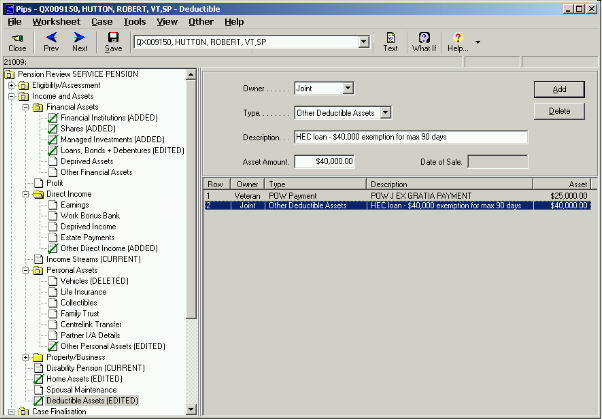
If the unspent amount of the HEC loan is less than $40,000 within ninety days from the initial date of payment, the figure held at the Asset Amount field on the Deductible Assets screen must be reduced accordingly.
Example of a HEC loan spent within ninety days
Joan gets a home equity conversion loan of $40,000 in order to go on an overseas holiday with friends. She spends the loan money progressively over a period of 9 weeks and by the time she returns to Australia, the loan is fully depleted. The loan payment received is recorded at the PIPS Financial Institutions screen and updated over time in accordance with the <">date of effect rules. Whatever funds she has unspent from the loan are disregarded under the assets test for the full sixty days and are progressively reduced at the Deductible Assets screen in step with the reduction in funds available in her bank account.
Example of a HEC loan not spent within ninety days
Fred and Wilma get a home equity conversion loan for $45,000 in order to build an extension on their home. They leave the full HEC loan amount in their joint bank account for longer than ninety days while construction is proceeding and pay the builder ninety five days later upon completion of the work. The funds received are assessed as such:
- a DRS review is set for a date that is ninety days from the receipt of the loan funds,
- the $45,000 initially received is recorded as a change to their bank account in a PIPS assessment, increasing the balance of that account from $14,000 to $59,000,
- $40,000 is recorded at the Asset Amount field of the Deductible Assets screen for a period of ninety days,
- a second PIPS assessment is processed (initiated from DRS) ninety days after the loan funds were received to delete the $40,000 from the Deductible Assets screen so that the total loan amount is assessable under the assets test and any changes to their assets are recorded, then
- a third PIPS assessment is processed once Fred & Wilma notify that they have paid the builder and notify DVA of the new bank account balance.
<">
10.2.5 Obtaining the Value of an Asset Using the AVO Online Valuation Register
Last amended: 7 September 2012
This section contains information about obtaining asset valuations via the AVO Online Valuation Register.
In this section
This section contains the following topics:
<">
Obtaining an AVO Valuation
Overview of the AVO Online Valuation Register
The AVO Online Valuation Register has been set up by the <">[glossary:Australian Valuation Office:] [glossary:(:]<">[glossary:AVO:][glossary:):] to allow DVA staff to request valuations of property owned by DVA clients.
The register is maintained by the AVO and is accessed by following this link:
Link to the AVO Online Valuation Register
The register may also be accessed by taking the following actions:
- click on the Windows Start button,
- go to Departmental,
- locate Reference Tools, and
- click on the AVO Online Valuation Register link
Note. A special personal security AVO password needs to be organised before the register can be accessed. Firstly, approval for access to the register must be sought at the Director level, then an email showing the Director's approval for access should be sent to the “Security IT Operations (Access Requests)” email address. The subject field for the email should state “AVO online valuation register password required”. National IT Security will then email the requisite logon details for accessing the register to you.
The electronic valuation process
The following is a basic description of the steps undertaken in the electronic valuation process.
|
Step |
Action |
|
1 |
The DVA Officer accesses the AVO website to lodge the request for a valuation. |
|
2 |
The AVO website details are completed and the valuation request is sent to the relevant AVO State Office. |
|
3 |
The Valuation request is allocated to an AVO Officer. |
|
4 |
The AVO Officer conducts a valuation, then enters the valuation details on the AVO website. |
|
5 |
An email is sent to the DVA Officer to notify that the valuation has been completed and is available on the website. |
|
6 |
The DVA Officer accesses the AVO website and prints off a copy of the valuation. |
<">
Lodging Requests for Valuations
Opening the AVO website and logging on
To access the AVO Online Valuation Register website, go to the start menu and select:
- “Departmental/Reference Tools/AVO Online Valuation Register”, or open Internet Explorer then enter the address in this link
More →More → (go back)
Link to the AVO Online Valuation Register
- The following screen will be displayed:
- Enter the Logon ID (the same as your normal Logon ID) and Password (AVO Valuation System Specific).
- Click the Submit button.
AVO Online Valuation Register initial navigation page
After you have logged on to the AVO Online Valuation Register website, the following screen is displayed:
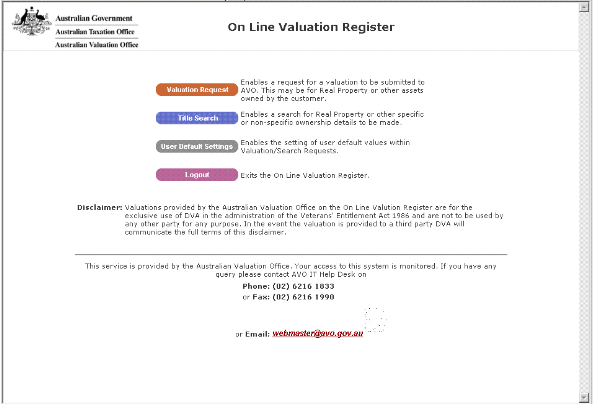
The four options presented are:
- Valuation Request: This is the main option for DVA users and leads to all options regarding valuation requests.
More →More → (go back)
Procedure Library – Valuation Request Page
- Title Search: This option allows for title searches on property.
- User Default Setting: This option allows you to edit your State Office, name, phone contact number and email address.
More →More → (go back)
Procedure Library – User Default Settings
- Logout: Logs the user out of the AVO Online Valuation Register website and closes the Internet Explorer window.
Note: This screen is always active. When you select an option from this screen a new window will open.
<">
AVO Valuation Request Menu Page
Valuation request menu options
Once you have clicked the Valuation Request button on the On Line Valuation Register page, the screen below is the page that appears:
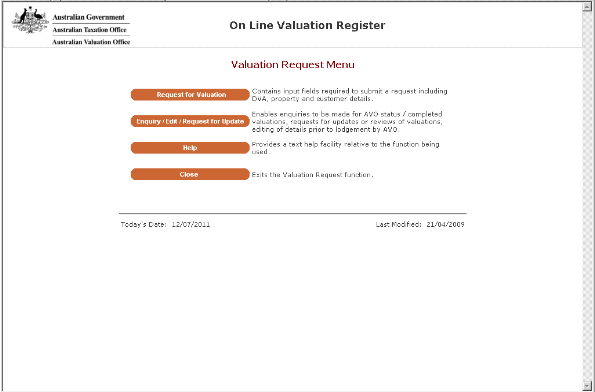
There are four options available on the page, which are:
Request for Valuation
- Select this option to request a new valuation
Enquiry / Edit / Request for Update
- Select this option to make an enquiry
More →More → (go back)
Procedure Library – Retrieving a Valuation Request
- Edit a previously submitted request, or
- Update a previously finalised valuation
Help
- Provides Help information
Close
- Closes the window
Request for valuation page
To start a valuation request, click on the first button on the Valuation Request Menu page listed as “Request for Valuation”. The screens below show the fields that are required to be completed in order to request a valuation from the AVO:
Note: There are several compulsory fields that are marked with a red asterisk, most importantly being the “DVA Office” and “Project” fields, as the costs of the valuations are monitored for auditing purposes across the Department.
Once the requestor has completed all the relevant and compulsory fields, they click the “Next Part” button in order to proceed to the second part of the Request for Valuation screen.
Procedure Library – General AVO requirements
If the user clicks the “Next Part” button without completing one of the compulsory fields (marked by a red asterisk) they will be prompted with an error dialog box and will be taken to the appropriate field that requires completion after clicking on the “OK” button, as in the example shown below:
Once all the required fields are successfully completed and the “Next Part” button is clicked, the second part of the valuation request is displayed, as shown in the screen below:
Once the requestor has completed all the relevant and compulsory fields (marked with a red asterisk) in the valuation request form, the “Submit” button is then clicked in order to lodge the request with the AVO.
An example of the screen showing a submitted request is shown below:

The “Web Ref No.” details should be noted for future reference. Details on the confirmation screen can be printed by clicking on the “Print Page” button, so the paper copy can be retained for reference purposes. This should be held until the AVO sends the confirmation email to notify that the valuation process has been completed.
<">
Retrieving a Valuation Request
Accessing an update from the AVO
To access the Enquiry/Edit/Request for Update page, access the Valuation Request page, then click on the second button, listed as “Enquiry / Edit / Request for Update” highlighted below:
Procedure Library – AVO Valuation Request Menu Page
After the “Enquiry / Edit / Request for Update” button is clicked, the following screen opens in a separate tab as shown below:
This screen allows the user to search the system for any requests that have been lodged in the system. This includes cases that are currently being investigated or those that have been completed.
The most common searches are using the Web Reference Number, however any of the other listed fields can be used, particularly the Customer File Number, Customer Last Name or Business / Trust / Company Name fields.
The screen below shows the result of searching via the Web Reference Number field:
On this results page, there are several details listed
Web Reference Number: This is the reference number used to identify the specific request for a valuation. As this is shown as a link, it can be clicked on to view the full details of the request.
Customer File Number: This is the pensioners file number.
Customer/Business Name: This is the pensioner's name or the name of the business entity that owns the property.
Address: This is the address of the property that is being valued.
Date Submitted: This is the date that the request was lodged by the DVA officer
Received by AVO: This is the date that the AVO commences working on the valuation.
Note: once this field is completed by AVO, co changes can be made to the initial request through the online system.
Date Completed: This is the date that the valuation is completed by the AVO officer.
DVA Acknowledged: This is the date that DVA acknowledges that they have viewed the valuation.
Procedure Library – Acknowledgement of Valuation
<">
On Line Request Enquiry Results Details Listing – Incomplete Valuations
Valuation enquiries not yet received by AVO
The screen listed below shows the results of an enquiry that has not yet been received by the AVO, so may still be edited:
Clicking on the underlined link under Web Reference Number will direct you to the following screen, showing the details of the request not yet received by the AVO:
There are two options available at the bottom of this page, which are:
- More Details: Provides some extra information such as who requested the valuation
- Edit Data: This button will take you to the “Edit Valuation Request” screen
More →More → (go back)
Procedure Library – Edit Valuation Request
<">
On Line Request Enquiry Results Details Listing – Completed Valuations
Enquiry received by AVO
The screen below shows the results of a valuation that has been completed by the AVO:
There are three options available at the bottom of this page, which are:
- More Details: Provides some extra information such as who requested the valuation.
- Update: This allows the user to request another valuation on the same property. This option should be used where there has been a valuation made on the property in previous years and another valuation is subsequently required for that same property.
More →More → (go back)
Procedure Library – Request for Valuation Update
- Review: This allows the user to request another valuation on the same property when the client appeals the original valuation.
More →More → (go back)
Procedure Library – Request for review of an AVO Valuation
<">
Edit Valuation Request
Editing an AVO valuation request
This option is only available for requests that have been “not received by AVO”. This option allows you to update the details that were lodged with the request for valuation
The screen contains the same options as the original request but is contained on one screen instead of two. The example listed below contains only the top and bottom details for the screen:
The options at the bottom of the screen are to either submit the edited data or to reset the edited data so that any newly entered details are removed.
<">
Request for a Valuation Update
Requesting an updated valuation of a property that has been valued previously
This should be used when a valuation has been made on a property in previous years and another valuation is subsequently required for that same property. Clicking on this option displays the following screen:
The options at the bottom of the screen are to either submit the data or to reset the added data so that any newly entered details are removed.
<">
Request for Review of an AVO Valuation
Requesting a review of a property valuation
If the pensioner objects to the amount of the valuation that was determined by the AVO, they must submit a written appeal. This appeal should cite details of why the property has not been properly valued (eg, there is storm, flood, fire or termite damage, or recent sales of comparable properties in close vicinity at a lower price) so a review may be undertaken. Clicking on the Review button from the On Line Request Enquiry Results Details Listing page of a completed AVO valuation will bring up the following page:
The two buttons at the bottom of the screen are there for the user to either submit the data to the AVO, or to reset the form so that any newly entered details are removed.
Note: Property valuation requests for review will only be applicable if the pensioner has completed a proper written authority such as Form D0524 Income Support Pension Claim – Real Estate and the authority to inspect the property has been given.
Form D0524, Income Support Pension Claim – Real Estate
When considering a review, the pensioner should be advised that estimates from a real estate agent (who is not a registered valuer) do not constitute a valid valuation and if a private valuation is undertaken, costs for the private valuation will not be paid for, or reimbursed by the Department.
<">
Notification from AVO of Valuation Completion
Email acknowledgement from the AVO
Once the AVO have finalised their valuation, the DVA officer that requested the valuation will receive an email similar to the screen shown below:
Acknowledging that DVA has viewed the valuation
Once the email notification has been received, the DVA officer should logon to the AVO website and navigate to the relevant request.
Procedure Library – Retrieving a Valuation Request
The valuation should then be printed by clicking the “Print Page” button, then the “DVA Acknowledge” button (highlighted in the screen below) should be clicked to notify the AVO that a DVA officer has received and viewed the completed valuation.
<">
Changing AVO Website User Default Settings
Setting up the AVO website default user options
The default settings for the user of the AVO valuations website are accessed from the initial navigation page. The screen below illustrates the options that can be edited then submitted to the AVO:
In most cases there should not be any need to update any of these fields as they are setup when the initial permissions are granted for access to the AVO valuations website. The most important field is the “DVA Contact Email” field, as this is the email address that the AVO sends the notification confirming that the valuation has been completed.
<">
AVO Valuations Register Website Time Out Screen
Security considerations while AVO website is active
If the computer that the AVO valuations website is active on has not been used for more than 15 minutes, the website will “time out” and if the user subsequently needs to access further information from the website, they are required to log into the system again.
The following screen will be displayed if the user tries to access the system after the AVO website has timed out:
<">
General AVO Requirements when Requesting Valuations
General AVO requirements
In order to aid the AVO, it is necessary to ensure that they are provided with as much information as possible to enable them to determine a fair and accurate valuation of the asset.
Residential Properties
For the bulk of the residential property valuations, the information required by the AVO is found on form D0524, Income Support Pension Claim – Real Estate.
Form D0524, Income Support Pension Claim – Real Estate
If the property is involved as part of a private company or private trust, then the information required is found on Form D0633 Part B Real Estate Details, which is supplemental to the Form D0600 Private Company or Form D0601 Private Trust.
Form D0633, Part B Real Estate Details
http://authoring-internet/dvaforms/Documents/D0633.pdf
Form D0600, Private Company
http://authoring-internet/dvaforms/Documents/D0600.pdf
Form D0601, Private Trust
As well in the information in these forms, the AVO also refers to the information provided in tax returns, depreciation schedules, rates notices, Lands Department Notices or Certificates of Title.
Vital information to aid the valuer in attributing an accurate valuation to a residential property are:
- size
- age
- number of bedrooms
- car accommodation
- conditions of the structures
Also if the property is being rented, information from the tenancy agreement is also of use.
Rural Properties
For the rural property valuations most of the information that is required by AVO can be found on the form - D0526 Income Support Pension Claim - Farm/Hobby Farm.
Form D0526, Income Support Pension Farm/Hobby Farm
In addition to this, for all rural properties, valuers may require a tax return and as — sociated financial statements. The ownership of plant and machinery on the prop — erty should also be ascertained and apportioned as necessary.
Procedure Library – Assessing Assets with Encumbrances and Loans
In some cases the sons/daughters may erect a second dwelling (at their own expense) on the property. DVA needs to notify AVO that this part of the property should not be included in the valuation.
Sugar Cane Farm
The following information is useful:
- Area of assignment
- Peak
To get an accurate assessment of a sugar cane farm the valuer in most cases will need to do a Mill Search. This will require the client to complete an authority to inspect.
Grazing
The following information is useful:
- Water availability
- Stockyards
- Fencing
Stud Farms, Piggeries etc
The following information is useful:
- Breeds
- Number and age of stock
- Fencing
Commercial Property
Flats - commercial or industrial
The following information is useful:
- Rent received
- Tenant
- Lease term and conditions
If the client has difficulty with obtaining this information, ask them who manages the property and obtain the clients permission for the valuer to discuss the property with the Agent.
Licensed premises (hotel, restaurant)
The following information is useful:
- If leased - a copy of the lease is essential.
- Details of liquor purchases and licence fees paid for the last 2 or 3 years if possible.
Businesses
If the client has a business in a premise that they own and you require AVO to assess the business values then AVO requires:
- Tax returns
- Profit & Loss sheet trading figures
- Details of plant, equipment and stock
<">
10.3 Business Structures and Trusts
This chapter contains information on assessing the income and assets of various business structures and trusts.
In this chapter
This chapter contains the following sections:
See Also
Business Structures and Trusts
<">Chapter 10.5 Income Streams
<">
10.3.1 Overview of Business Structures and Trusts
Business structures
<">Income and <">assets are assessed differently for business structures, depending on the nature of the business structure.
Assessing the income and assets of sole traders and partnerships
procedures relating to this topic will be provided later.
26 June 1992 changes to assessment for primary production
On 26 June 1992, a change was introduced to allow primary producers to offset the value of all their primary production liabilities against primary production assets. All assets in primary production and all liabilities relating to primary production are now aggregated, as if they were one asset and one liability. The reason for the change is that many primary producers have individual farm assets with a current <">market value less than the level of the debt secured against them, because the debt has not reduced as quickly as the asset has depreciated. Before 26 June 1992, the asset value for those assets was maintained as nil, and the excess debt could not be offset against positive values assessed for other farm assets.
Procedure Library
Summary of private trusts and companies
For the <">[glossary:assets:] and <">income of a private trust or private company to be attributed to an individual the trust or company must be:
- a <">designated private trust or <">designated private company, and
- a <">controlled private trust or <">controlled private company in relation to the individual, and
- the individual must be an <">attributable stakeholder of the trust or <">company.
Current private trusts and private companies rules
The contents of section 6 to section 18 relate to specific rules that apply to the assessment of income and assets of private trusts and private companies from 1 January 2002. Business structures such as partnerships and sole traders are subject to their own rules and are dealt with separately.
Procedure Library
Pre 1 January 2002 trust and company rules
Whilst these rules take effect from 1 January 2002, they do not replace the trust and <">company rules that applied prior to that date. The pre 1 January 2002 rules should be applied when calculating any assessable <">income or <">[glossary:assets:] of a private trust or private company prior to 1 January 2002. This includes deprivation of an interest in a private trust or private company prior to 1 January 2002.
Procedure Library – Assessing the Income & Assets from Private Companies pre 01/01/2002
Procedure Library – Assessing the Income & Assets from Trusts pre 01/01/2002
Section 10.3.4 Assessing the Income & Assets from Trusts pre 01/01/2002
Trust and business income
A business or trust is not a <">financial assets, and therefore income is not assessed under the deeming provisions. Generally, DVA applies the practices followed and accepted by the Australian Taxation Office in calculating the business income. Exceptions to these practices are detailed in each relevant topic. It is not generally possible to accurately estimate current business <">profit because of the annual nature of assessment by the Australian Taxation Office. A decision-maker usually bases the current rate of income on the most recent taxation statement, unless satisfied otherwise.
Primary sources for verifying business income
The primary sources of verification are the:
- latest available Income Tax Return and Assessment Notice,
- Profit and Loss Statement,
- Balance Sheet, and
- if applicable, Depreciation Schedule.
It is important that the assessment notice also be sighted to confirm the authenticity of the return.
Estimate of income
A decision-maker may estimate current income if the previous taxation return does not represent a reasonable indication of current income. This is done using available evidence, generally the business profit and loss account. A pensioner's accountant should only be approached for this information when the person is unable to provide the information. A pensioner may not have previously kept a record of income and expenses. To help DVA to assess the correct entitlement, they should be asked to do so in future until a taxation statement verifies their income.
Private trusts & private companies post 01/01/2002
Section 6 to section 18 deals with the treatment of private trusts and private companies from 1 January 2002 and contains information on:
- how to determine a designated private trust or private <">company and how to determine a controlled private trust or private company,
More →More → (go back)
Procedure Library – Attribution Guidelines for Private Trusts & Private Companies – From 01/01/2002
- the use of control and source tests and the associates rule when attributing the assets and income of a private trust or private company to an individual,
More →More → (go back)
Procedure Library – Attribution Percentage & Derivation and Attribution Period – From 01/01/2002
- the attribution to individuals of the assets and income of private trusts and private companies,
- associated issues concerning deprivation of income and assets, the treatment of income from different sources and the treatment of various types of assets, and
More →More → (go back)
Procedure Library – Deprivation Provisions for Private Trusts or Companies
- the treatment of primary production assets that are held in private trusts and private companies and information on concessional primary production trusts.
More →More → (go back)
Procedure Library – Assessing the Income & Assets from Primary Production
Reviewing business assets and income
Conduct regular <">[glossary:specific reviews:] of pensioners who are <">[glossary:sole traders:] or involved in a <">partnership, <">designated private trust or <">designated private company.
Procedure Library – Specific Review Reasons: Earnings
Procedure Library – Specific Review Reasons: Trusts and Companies
<">
10.3.2 Assessing the Income and Assets of Sole Traders and Partnerships
Procedures relating to this topic will be provided later.
<">
10.3.3 Assessing the Income & Assets from Private Companies pre 01/01/2002
This section contains information on the assessment of income and assets from private companies prior to 1 January 2002.
In this section
This section contains the following topics:
<">
Assessable Income from Private Companies pre 01/01/2002
Basis of assessment of income
The assessment of income received by a person from a <">company is based on the type and current rate of <">income, if any. Income currently maintained should cease to be assessed, if:
- the person advises that they are no longer receiving any income, or
- a company in which a person has an interest is placed in liquidation.
In this case the shareholders effectively no longer have access to the income.
Assessment of profit from a private company
The <">profit of a private <">company is not the profit of the individual shareholders. The shareholders have no entitlement to any profits until a distribution is made by the directors, in the form of dividends. These dividends are assessable income, as described in the following table.
|
If a person is.... |
Then the |
|
a pensioner |
|
Summary table - assessable income for pensions
The following table summarises the assessable income of a pensioner involved in a private <">company.
|
Type of income |
Treatment |
|
Company profit |
Not assessed under any circumstances. There is no need to check for allowable deductions, and the company profit and loss statement is not adjusted. Income, apart from deeming, is only assessed when the company pays it to the person in some way. |
|
Dividends on shares (including franking credits) |
Hold them as their income for 12 months from the date of distribution. |
|
Wages, salaries, stipends, honoraria and director's fees |
Use the current rate payable from the latest personal income tax return. Assess the current rate received. Discontinue the assessment if salary or wages cease. If received as a lump sum, the normal lump sum provisions apply. |
|
Royalties |
Assess them as <">ordinary income. |
|
Fees, Commissions |
Assess the current rate payable and received from the latest personal income tax return, unless a more recent figure is available. If regular payments are received as an <">employee, assess the current gross income received and do not maintain when the payment ceases. If the payment is received from self-employment, assess the current net profit and maintain it on an annual basis. |
|
Salary packaging and fringe benefits |
Assess them as income. They are <">valuable consideration and the same as income from salary and wages. The non -grossed up amount of the fringe benefit is assessed. More →
Policy Library – Overview of Fringe Benefits |
|
Loans by the person to the company |
Assess them as a financial investment of the person. Assess income under the deeming provisions. Disregard any actual interest income received from the company. No deduction is allowed from the deemed income for investment expenses. |
|
Loans by a company to the person |
Care should be taken that payments characterised as loans are not disguised distributions. If the person can provide evidence that borrowings are bona fide loans do not assess them as income. Example: Bona fide loans will have a loan contract. If evidence is not provided, assess the distribution as income. |
|
Drawing back on loans made to a company |
Do not assess it as income. |
|
Actual interest received on loans made to the company by the person |
Disregard. Assess them as financial investments. They are subject to the assessment of income under deeming provisions. |
|
Deemed income on deprived assets |
Deeming applies to the value of deprived assets. More →
Policy Library – Overview of Deprivation Provisions |
|
Rent paid to the person |
Assess as rental income. Allowable deductions reduce the assessable amount. |
<">
Assessable Assets from Private Companies & Unlisted Public Companies
Method of valuation
While the new rules for trusts and companies have largely replaced methods of valuing shares, an acceptable method is still required where:
- persons have shareholdings in companies that are not covered by the new rules, or
- assessment decisions need to be made in relation to a person's entitlements before the introduction of the new rules on 1 January 2002.
Shares in private companies & unlisted public companies
A share in a private <">company or unlisted public company is an assessable asset and needs to be valued for assets test purposes. The assets owned by the company, however, are not the property of the shareholder and therefore are not assessed as an asset of the person.
Policy Library – The Income and Assets Tests
Valuation of shares
There are three accepted methods of valuing shares in private companies or unlisted public companies:
- where a market exists - the market value,
- where a market for these shares does not exist the 'net asset backing' method, or
- if there is no market for the shares, and it is inappropriate to use the 'net asset backing' method - some other value (see following instructions).
When a market exists
A market exists where there is:
- a willing, but not over anxious buyer,
- a willing, but not over anxious seller, and
- both parties are operating at arms length from one another and not subject to undue influence.
Generally, it will be rare for an effective market to exist for private companies or large unlisted public companies. However, such markets have operated:
- on exempt stock exchanges operating mainly in larger regional centres,
- through a stockbroker willing to 'make' a market in a particular company's shares,
- through the company itself (but note, such a market must be free of restrictions on sale), or
- where 2 individuals meeting the above criteria exist.
The person should provide the necessary evidence that a market exists for a particular company's shares.
The 'net asset backing' method
Where no market exists private <">company and unlisted public company shares are valued by calculating the 'net asset backing' per share if they carry rights to participation in capital distributions, as shown in the company's Articles of Association or Company Constitution. The <">net asset backing method of valuation of shares in a private company is used because it provides a consistent basis for assessment of the value of all private companies. It is also less complex than other methods to administer. The company's Articles of Association outline the special rights or restrictions attached to a particular class of shares issued by the company.
Exception: If the shares do not carry rights to participate in capital distribution, or in certain other cases, other methods of valuing the shares are used (see additional instructions below).
What does the 'net asset backing' method calculate?
The <">net asset backing method of valuation of shares in private companies and unlisted public companies calculates the:
- adjusted net asset position of the <">company, by deducting the company's liabilities from the current <">market value of its assets, and
- assessable value of the shares, by determining the amount of surplus capital that would accrue to each share if the company was wound-up.
This calculation is based on information contained in the company balance sheet and depreciation schedule. Because the balance sheet of a company records the value of fixed assets at their historical cost, adjustments may be needed to reflect the current market value of these assets.
When the adjusted net asset position of a company has been determined:
- capital is first returned to shares which do not carry the right to participate in the distribution of surplus capital on wind-up, and
- then all remaining net capital is divided between the shares which do carry the right to participate in the distribution of excess capital on wind-up.
This calculation is based on information contained in the company balance sheet and depreciation schedule.
When to use 'net asset backing' method for share valuation
Apply the 'net asset backing' method where:
- the person controls the company (either through special rights of their shares or via an outright majority shareholding),
- the person is closely associated with the company controller (ie wife/husband/sister/brother), and could reasonably be expected to have some influence on the controller,
- the person is the majority shareholder, where those shares entitle the person to the equivalent majority of the assets and confer equivalent voting rights on the person,
- the person made a decision to purchase the shares and therefore could reasonably be expected to be aware of the rights or conditions attached to the shares,
- no one would be ascribed with control of that company and where the share register is widespread, and it is reasonably open to the person to either sell the shares at net asset backing or to initiate change in company's articles to allow this to happen, or
- the person is an active director of the company in question.
Explanation: Active Directors are persons actively engaged in the day to day running of a company.
When not to apply the 'net asset backing' method
Circumstances where the application of the <">net asset backing method may not be appropriate include:
- the person inherited the shares,
- the person was 'given' the shares by his/her parents or the controller in circumstances where they could not be reasonably expected to understand what they were being given (ie shares were issued to minors and the children were unaware they had the shares),
- if they were given the shares by the controller and those shares did not, in themselves, confer control etc (see below), or
- the sole or dominant purpose of the person being issued with these shares was to comply with the former corporations law requirement that companies have at least two shareholders.
If one of these conditions is satisfied, and if the person has no influence over the controller or majority shareholder, then also consider whether the following circumstances may apply:
- the person was not an active director of the company, and/or
- the person's shares can be called away from them at any time, and/or
- the company articles, or some other condition, prevents the sale of these shares at will (ie to whomsoever at what ever price).
If at least one of these conditions is also satisfied then an alternative valuation method could be used.
Alternative valuation methods
Alternative methods include (but are not limited to):
- the last sale price, where the last sale was free of undue influence, or
- where the shares could be called away, the amount paid, or potentially could be paid, to the person when the call is made.
The method should be based on the circumstances of each case.
The guiding principle in the value selected
The guiding principle in the value selected would be to choose the method that best reflects the beneficial interest in the assets the person holds as a result of holding the shares at the time the assessment is made. Where the 'net asset backing' method is not used the company accountants should be asked to supply the following information:
- net asset backing per share, and
- where the shares can be called away from the person the amount that would be paid for those shares, and
- the price of any outstanding offer to buy these shares, and
- any recent sales of shares, or
- any other matter that may assist in determining an appropriate value for these shares.
Exceptions: The 'par' value, or valuation method based on the dividends paid (called the capitalisation of dividends) or on the <">company earnings (called the capitalisation of earnings), do not provide an accurate assessment of the person's beneficial interest in their share of the company's assets. The level of private company dividends is often low or non-existent due to the common practice of retaining profits for reinvestment in the company. Basing a value on this factor will generally lead to an unjustifiably low value being given to the shares.
Likewise, a company's accounting policy and method through which returns are distributed to the shareholders can influence the earnings of a company. A valuation based on earnings can also produce an unjustifiably low value for a company's shares. The par value is the issue price of the shares and has no relationship to current assets of the company. Further, under current Corporations Law the 'par' value of a share no longer is recognised as a meaningful term.
If the person is in severe financial hardship an interim assessment based on the person's estimate, can be used. In these circumstances the valuation is reviewed when the person's entitlement to be paid under the hardship provisions is reviewed.
Policy Library – Financial Hardship
When deprivation provisions apply
Deprivation provisions apply if the person influenced a private company's action to:
- issue further shares at their nominal value (normally $1.00) (see explanation), or
- dispose of assets for less than their value and this reduces the value of a person's share(s) in the company.
The person will have engaged in a course of action to reduce the value of their assets by diluting the assessable value of the shares they hold in the company.
A person's influence should be assumed as a matter of course if the person, and/or their partner:
- owns a majority of the issued shares of the company, or
- hold shares with powers such as voting rights, which provide them with the ability to control the company's operation.
Company in receivership
If a <">company is in receivership, the assessable asset value of the shares owned, or loans owed, should continue to be assessed as though the company were still managed by the directors.
Company in liquidation
If a <">company is in liquidation, assets to be maintained should be assessed on the basis of the projected payout to be provided by the liquidator. If a person advises that they have forgone repayment of a loan, or voluntarily agreed to receive a repayment of a lesser proportion of their loan than other unsecured creditors, deprivation provisions may apply. However, consideration should also be given to the circumstances in which a loan no longer exists for income support purposes.
<">
Treatment of Assessable Assets - Private & Unlisted Public Companies - Not Assessed under New T & C Rules
Treatment of assessable assets
The following table describes the treatment of assessable assets and provides references to further information, if appropriate.
Policy Library - Assets
|
Assessable Asset |
Treatment/Further Information |
|
|
Shares in a private or unlisted public company, which carry rights to participate in capital distributions |
Assess using the market value if a market exists. If no market exists, generally the <">net asset backing method is used. |
|
|
Shares in a private or unlisted public company, which do not carry rights to participate in capital distributions |
Assess using the market value if a market exists. If no market exists use the amount paid for the shares or some other valuation. |
|
|
Assets, excluding the principal residence, which are transferred or sold to the company by the person and/or partner |
Deprivation of assets may apply if the person did not receive <">adequate financial consideration. |
|
|
Deprivation of assets may apply unless <">valuable consideration is received, even though the value of a person's interest in their principal residence is exempt from the assessment of the assets test. |
|
|
Partly paid shares |
If partly paid shares are NOT asset backed, the assessable value is:
If the shares are asset backed, ALL shares (both fully paid up and partly paid up) may be valued using the net asset backing method. The assessable value is;
|
|
|
Loans to a private company |
Shareholder loans are the assets of the individual shareholder and must be maintained for assets test purposes. Deeming rules apply to outstanding loan balances. This recognises that a company is a separate legal entity. Shareholders' loans should not be removed from the balance sheet of the company. These loans represent a liability of the company which, if not repaid earlier, will be repaid when the company is wound up. |
|
|
Failed loans |
Loans that No Longer Exist. |
|
|
Governing director's shares |
If the Articles of Association... |
THEN the asset value is... |
|
EXPLICITLY state that the person has the right to participate in capital distribution, |
market value OR if no market exists, the net asset backing method is used. |
|
|
EXPLICITLY state that the person has NO right to participate in capital distribution, |
market value OR if no market exists, the amount paid for the shares or some other valuation. |
|
|
do not give ANY shareholder the right to participate in capital distribution AND do not state how the assets of the company are to be distributed, |
market value OR if no market exists, the <">net asset backing method if appropriate. |
|
|
Distribution of capital when a company is wound-up |
If a company has been, or is being, wound-up, any distribution of assets is not income. |
|
<">
10.3.4 Assessing the Income & Assets from Trusts pre 01/01/2002
This section provides information on assessing the income and assets from trusts not covered under the new 01/01/2002 private trusts and private companies' rules.
In this section
This section contains the following topics:
<">
General Provisions for Trusts pre 01/01/2002
Effect of a trust on payment
The effect of a trust on a person's payment under the income and assets tests depends on whether they:
- are a beneficiary of the trust's assets or income or both,
- have gifted assets or income to the trust,
- have loaned assets to the trust, or
- are a trustee only.
Trustee of trust's assets
A person who is a trustee only, derives no benefit from the trust; therefore, their pension entitlement is not affected. If a trustee receives salary or fees for administering the trust, however, the salary or fees are treated as income.
Gifted assets or income to a trust
Any outstanding loan balances are maintained as an asset. If assets have been gifted or sold to the trust, deprivation will need to be considered if <">adequate financial consideration has not been received.
Loaned assets to a trust
Assets may become part of a trust fund by being:
loaned to the trust, or
sold to the trust at <">market value, with payment of the proceeds deferred.
The amount owing is maintained as a financial asset
Beneficiary of a trust
Loans made by beneficiaries to a trust are financial investments and therefore subject to deeming.
A person who is a beneficiary may be entitled to the income and assets of the trust now or at some time in the future. The document that created the trust (for example will or trust deed) establishes the beneficiary's interest in the income and assets of the trust.
<">
Assessable Income from Discretionary Trusts pre 01/01/2002
Assessment of income
A person who is a beneficiary of a <">discretionary trust, receives income from the trust only when:
- the trustee allocates or distributes a part or all of the trust's income to them,
- trust income that is allocated to them is reinvested in the trust, or
- the trustee makes a payment out of allocated income on their behalf.
Allocations and distributions are assessed as income for 12 months from the date of the resolution to distribute.
Assessment of franking credits
The following table describes the assessment of trust income that includes franking credits (known as imputation credits)
|
If a person is... |
Then the... |
|
a pensioner |
|
Description of income assessment for different roles within trusts
The following table describes the roles of individuals within a trust and the treatment of their trust related income. A person may have more than one role and each needs to be considered separately.
|
Role |
Description |
|
Settlor |
Does not usually receive income from the trust, but the deprivation provisions may apply. |
|
Contributor |
May receive income from interest on loans. The deprivation of income provisions may apply. Deeming applies to the:
|
|
Beneficiary |
May receive distribution of income or capital at the discretion of the trustee. Further information on assessment of income to trust beneficiaries is provided in this topic. |
|
Trustee |
May receive wages, fees, or salary. The current rate payable is held as on-going income. Reimbursement of 'out of pocket' annual expenses is not income. |
Assessment of income to trust beneficiaries
Distribution of income to beneficiaries is maintained for 12 months. A beneficiary who received a trust distribution of an amount in one year may not automatically receive a distribution of the trust's profits in the following year. Distribution of profits from discretionary trusts are treated as non-periodical income.
A person who is a beneficiary of a <">discretionary trust has no rights to the trust's income, even if they are also trustees. A beneficiary receives a distribution solely at the trustee's discretion in accordance with the terms of the trust deed.
Date of effect for trust distributions from discretionary trusts
A beneficiary is entitled to receive an amount under a discretionary trust when the trustee exercises their power under the trust deed and makes a resolution to distribute in favour of the beneficiary. Allocations and distributions are assessed as income for 12 months from the date of the resolution to distribute. There may be instances where a resolution to distribute was made but the trust's tax return has not been lodged at the time of resolution. Where this is the case, the onus is on the person to find out how much they are entitled to receive. Distribution income should still be assessed from the date the resolution was made and not from the date the tax return was lodged. An example would be where a resolution was made on 1 July 2001, but the tax return was done on 1 October 2001. The person, as trustee, may know of the distribution prior to receipt, or may be ignorant of the distribution until it is paid. In either case, assessment is from the date of resolution which is the 1 July 2001.
Distributions from discretionary trusts when a resolution to distribute an amount of profits is made, but the total profit is not yet known
A person is entitled to receive the amount when they have an absolute vested interest in the amount and are legally able to demand payment of the amount. A person cannot demand payment of an unspecified amount and therefore is entitled to receive the amount only when a figure is specified. Where there has been a resolution to distribute an unspecified amount, the distribution only becomes assessable when the person becomes entitled to legally demand a specific amount.
Example: A trustee makes a resolution in July to make a <">profit distribution of $700 to one person, and total profit less $700 to another. In October the accountant has determined the profit of the trust to be $1,000. The first person has a legally enforceable right to $700 from July, and this amount is assessed from then. The other person is assessed when their exact entitlement becomes known, so their $300 is assessed from October.
<">
Assessable Assets from Discretionary Trusts pre 01/01/2002
Assessment of assets
If a person and/or their partner are beneficiaries of a <">discretionary trust, no part of the value of the trust's <">[glossary:assets:] is assessable, until the trustee makes a distribution from the capital of the trust. This is because there is no way of apportioning a share of the assets of the trust to any particular beneficiary until the trustee has exercised their discretionary powers. When the assets of the trust are distributed to its beneficiaries, the amount received is an asset if it is not otherwise exempt. An example is the principal residence.
Assessment of assets from discretionary trust
The following table describes how the assets from a discretionary trust are assessed.
|
If a person is... |
Then they... |
|
a co-beneficiary of the assets of a discretionary trust |
have an asset, however no value is placed on the asset for assessment purposes. The person's interest in the asset is dependent on the trustee deciding in what proportion to distribute the trust's assets. |
|
the sole beneficiary of the assets of a discretionary trust |
are generally considered to have the beneficial ownership of the trust's assets for assessment purposes. The terms of the trust deed must state that the person has an absolute interest in the distribution of the trust's assets before they can be assessed as the person's. |
Married couples
If a married couple are the only beneficiaries of a discretionary trust, and the trust's assets are not exempt:
- they are assessed as the couple's assets, and
- each partner is assigned half of the assets.
Description of asset assessment for different roles within trusts
The following table describes the roles of individuals within a trust and the treatment of their trust related assets. A person may have more than one role and each needs to be considered separately.
|
Role |
Description |
|
Settlor |
Is not usually entitled to a share of the trust assets, but deprivation of assets provisions may apply for gifts to the trust. |
|
Contributor |
Loans made to the trust are assessable assets, and deprivation of assets may apply for gifts to the trust. |
|
Beneficiary |
Has an interest in the assets of the trust at the trustee's discretion, therefore no amount is held as an assessable asset. Exception: Sole beneficiaries or a married couple who are the only 2 beneficiaries. |
|
Trustee |
Is not entitled to a share of the trust assets unless also a beneficiary, although asset(s) may be registered in their name. |
Summary table of assessable assets
The following table summarises the assessment of assets from private discretionary trusts for pensions.
|
Type of Asset |
Description |
|
Interest in the trust's assets |
Do not assess the trust's assets as assets of the person. The person has no entitlement until the assets are distributed by the trustee. |
|
Beneficiary account |
Assess as a financial asset of the person. The money is put in the account by the trust usually as reinvested trust distributions or interest. These may be called beneficiary loan accounts, current accounts or beneficiary current accounts. |
|
Loan to a trust |
Assess as a financial asset of the person. The money has been loaned to the trust by the person. These may also be called beneficiary loan accounts or loans. |
|
Assets gifted to a trust |
Maintain the amount that was disposed of as a deprived asset for 5 years from the date of disposal, less the allowable gifting limit. |
<">
Assessable Income from Non-discretionary Trusts pre 01/01/2002
Assessment of income
Beneficiaries of <">non discretionary trust may have an interest in the trust's income depending on the nature and terms of the trust deed. The share of the trust's income that is allocated or distributed by the trustee(s) to a beneficiary is assessable income. Allocations and distributions are assessed as income for 12 months.
Policy Library – Overview of Ordinary Income
Assessment of franking credits
The following table describes the assessment of trust income that includes franking credits (known as imputation credits).
|
If a person is... |
Then the... |
|
a pensioner |
|
Description of income assessment for different roles within trusts
The following table describes the roles of individuals within the trust and the treatment of their trust related income. A person may have more than one role and each needs to be considered separately.
|
Role |
Description |
|
Settlor |
Does not usually receive income from the trust, but the deprivation of income provisions may apply to loans or gifts. |
|
Contributor |
May receive income from interest on loans. Deeming applies to the:
|
|
Beneficiary |
Is entitled to a fixed proportion of the distribution of income from the trust. This is held as income for 12 months from the date of distribution. |
|
Trustee |
May receive wages, fees, or salary. The current rate payable is held as on-going income. 'Out of pocket' annual basis expenses are not income. |
<">
Assessable Assets from Non-discretionary Trusts pre 01/01/2002
Assessment of assets
The following table describes how the assets from a non-discretionary trust are assessed.
|
If a person is... |
Then they... |
|
a co-beneficiary of the assets of a non-discretionary trust |
have an asset. The value of the asset is determined by the share of the trust held by each beneficiary, as set out in the trust deed. Example: If a person is one of 5 beneficiaries of a trust that has $100,000 in assets and the terms of the trust provide that the beneficiaries have an equal interest, then the value of each beneficiary's interest is $20,000. |
|
the sole beneficiary of the assets of a non-discretionary trust |
have the beneficial ownership of the trust's assets which are considered to be theirs, unless the assets are exempt. |
Description of asset assessment for different roles within trusts
The following table describes the roles of individuals within the trust and the treatment of their trust related assets. A person may have more than one role and each needs to be considered separately.
|
Role |
Description |
|
Settlor |
Is not usually entitled to a share of the trust assets, but deprivation of assets provisions may apply for gifts to the trust. |
|
Contributor |
Loans made to the trust are assessable assets, and deprivation of assets may apply for gifts to the trust. Deeming applies to the balances of outstanding loans to the trust. |
|
Beneficiary |
Assessment is based on the total asset value divided by the person's share of ownership, as specified in the trust deed. |
|
Trustee |
Is not entitled to a share of the trust assets unless they are also a beneficiary, although asset(s) may be registered in their name. |
Summary table of assessable assets
The following table summarises the assessment of assets from non-discretionary trusts, for pensions.
|
Type of Asset |
Description |
|
Interest on the trust's assets |
Assess using the amount or proportion set out in the trust deed. |
|
Beneficiary account |
Assess as a financial asset of the person. The money is put in the account by the trust usually as reinvested trust distributions or interest. These may be called beneficiary loan accounts, current accounts or beneficiary current accounts. |
|
Loan to a trust |
Assess as a financial asset of the person. The person has loaned the money to the trust. These may also be called beneficiary loan accounts or loans. |
|
Gifting to a non-discretionary trust by a beneficiary or unit holder |
The amount of the deprivation is the difference between the value of the asset(s) gifted and any resulting increase in the value of the person's interest in the trust's assets, less the allowable gifting amount. More →
Policy Library – Deprivation of Income and Assets |
|
Assets gifted to a trust |
Maintain the amount that was disposed of as a deprived asset for 5 years from the date of disposal, less the allowable gifting limit. |
|
Managed investments and shares sold/transferred to the trust |
Deprivation provisions may apply if <">adequate financial consideration is not received. |
<">
Summary of Assessable Income from Trusts pre 01/01/2002
Summary table of assessable income for pensions
The following table summarises the assessment of income from <">discretionary trust and <">non discretionary trust. Assessable income from only one or the other kind of trust is covered elsewhere in this section.
|
Assessable Income |
Description |
|
Trust <">profit |
The trust's profit is not assessed. Only income paid to the person and deeming are assessed. |
|
Distributions |
The distributions are maintained as income for 12 months from the date of resolution to distribute. Distributions are shown in the:
Imputation credits paid with distributions are income for the purposes of the pension income test. |
|
Unpaid distributions (Distributions not received by the beneficiary but held in the trust.) |
Not a financial investment, and therefore, not subject to deeming. |
|
Wages or salary |
The trust may pay wages or salary to the person. As with any wages or salary, the amount assessed as income is the current rate of earnings converted to an annual figure. More →
Policy Library – Income from Employment |
|
Loan to trust |
The balance is added to the person's other financial assets and is subject to deeming. |
|
Assets gifted to the trust |
Deeming provisions apply and <">[glossary:deprived assets:] are maintained in the assessment. |
|
Managed investments and shares sold/transferred to the trust |
Deemed income is assessed in respect of any deprivation, if the person has not received <">adequate financial consideration. |
|
Consultant's fees |
Are assessed as the:
|
|
Fees paid for the use of plant or equipment owned by a person |
Are assessed as income. |
|
Rent paid to a person |
Is assessed as rental income. Allowable deductions reduce the assessable amount. More →
Policy Library |
|
Trustee's remuneration |
Is assessed as the amount stated on the most recent:
|
<">
Assessable Income and Assets from Statutory Trusts pre 01/01/2002
Assessment of income
The following table describes the assessment of income from <">statutory trusts.
|
If money is held by a public trustee or similar body... |
Then... |
|
on behalf of an individual person |
the interest generated by its investment is the person's income. This is regardless of whether individual investment accounts are maintained or whether the property is held in a 'common fund'. |
|
and no specific amount is held for the benefit of an individual person Example: The property is held in common for the person and their children. |
any interest credited to the investment account is not assessed as the person's income, until distributed or allocated to them. |
Distribution of capital funds - income assessment
One-off payments made from the capital funds held by the trust are not taken into account as income.
Example: Distributions to enable modifications to be made to the person's principal residence to assist with their disability.
Assessment of assets
The following table describes the assessment of assets from statutory trusts.
|
If money is held by a public trustee or similar body... |
Then... |
|
on behalf of an individual person |
the full value of that money is the person's asset. Explanation: This is regardless of whether individual investment accounts are maintained or whether the property is held in a 'common fund'. |
|
and a payment is made to a person out of the money held by the statutory trust and no specific amount is held for the benefit of an individual person, Example: The property is held in common for the person and their children. |
that payment is the person's interest, the asset in the account is an exempt asset. |
Distribution of capital funds - asset assessment
One-off payments made from the capital funds held by the trust are the person's property and are assessed as an asset. The amount that is assessed as the assets held by the trust must be reduced by the amount of the payment.
Example: Distributions to purchase a vehicle for the person. The vehicle is the person's asset,
Statutory trusts for minors - assessment of income and assets
Payments to minors may be held on their behalf in a statutory trust.
Examples: Payments could include:
third party motor vehicle <">damages,
workers compensation after the death of their sole surviving parent, and
superannuation after the death of their sole surviving parent.
Money held in a statutory trust, on behalf of a minor, is the property of the minor, and interest credited to the account is their income.
<">
Other Trust Matters pre 01/01/2002
Trusts - constructive, resulting, secret or implied
A court may decide that a trust exists due to the conduct of the relevant parties, although no action has been taken to declare a trust in writing.
Example: These trusts include:
constructive trusts,
resulting trusts,
secret trusts, and
implied trusts.
Assessment of constructive, resulting, secret or implied trusts
If one of these trusts exists, determine the role of the person in the trust and assess the trust income and assets according to that role. The following table outlines the 2 roles that a person may play in these trusts and how to assess them.
|
Role |
Assessment |
|
Trustee |
Although the legal owner of assets, they do not have beneficial ownership, therefore no asset is assessable. Deprivation provisions may apply. More →
Policy Library – Deprivation of Income and Assets |
|
Beneficial owner |
Assessment is based on the person's share of the beneficial ownership of the assets. |
Ownership of assets held in trust for others
Any asset held in trust by a person for any other person or child, cannot be regarded as the person's asset. Assets held in trust for children are not treated differently to assets held for any other person. Ownership of the asset belongs to the beneficial owner, not the trustee.
Bank account in trust - assessment of income and assets
A person can establish a trust by opening a bank account as trustee for another person. For example a bank account could be opened on behalf of a child or any other person. The following table describes assessment of bank accounts held in trust.
|
If a person... |
Then... |
|
transfers money to a trust account |
it is the property of the beneficiary(s), along with interest credited to the account. The deprivation of income and assets provisions may apply. |
|
as trustee of the account, is using the account for personal benefit |
the balance of the account is assessed as the trustee's asset, and is subject to deeming. In these cases it cannot be accepted that a trust has been created. |
The person is legally obliged in the same way as other trustees to use the trust's assets for the benefit of the beneficiary(s).
Person loans assets to a trust
A person who loans assets to a trust retains ownership of the assets, which are assessed in the same way as other amounts on loan. The loan will be reflected as a liability in the trust's balance sheet.
Gifting of assets to a trust
Disposal of assets may have occurred if a person gifts assets to a trust within 5 years of becoming qualified to receive a pension. The disposal may be subject to deeming.
<">
10.3.5 Assessing the Income & Assets from Primary Production
This section contains information about the assessable income and assets from primary production.
In this section
This section contains the following topics:
<">
Assessable Income & Assets from Primary Production
26 June 1992 changes to assessment for primary production
On 26 June 1992, a change was introduced to allow primary producers to offset the value of all their primary production liabilities against primary production assets. All assets in primary production and all liabilities relating to primary production are now aggregated, as if they were one asset and one liability. The reason for the change is that many primary producers have individual farm assets with a current <">market value less than the level of the debt secured against them, because the debt has not reduced as quickly as the asset has depreciated. Before 26 June 1992, the asset value for those assets was maintained as nil, and the excess debt could not be offset against positive values assessed for other farm assets.
Policy Library – Determining the Value of an Asset
Treatment of primary production liability
A person's share of a primary production business structure's assets or liabilities is:
- determined by whether they would have a positive or negative balance in their capital account if the business was wound-up, and
- considered to be a 'primary production' asset or liability, and may be aggregated with, or against, the value of the land.
If a couple are the only partners of a primary production enterprise, they are each considered to share half of the net primary production assets and liabilities.
Exempt principal residence and private land
Exempt principal residence and <">private land is not considered to be an asset used in the business of primary production. Therefore, if part of the primary producer's liability relates to their house and private land, that portion of the liability is removed for assessment purposes.
The table below provides an example of how the asset in the business of primary production is assessed.
|
Item |
Value |
|
Whole property |
$200,000 |
|
Principal residence and private land |
$70,000 |
|
Mortgage over the whole property |
$50,000 |
|
The primary production asset |
gross value is $130,000 ($200,000 - $70,000) |
|
The proportion of mortgage liability which is attributable to the primary production asset |
$32,500 ($130,000 X $50,000) ÷ $200,000 |
|
The net primary production asset to be added to other primary production assets for assessment purposes |
$97,500 ($130,000 - $32,500) |
Private companies and primary production
A private <">company is accepted as being a 'primary production' company if its main activity is primary production.
Personal primary production assets and liabilities
The following table describes the circumstances in which a person, who is a shareholder in a private primary production company, is assessed as having personal primary production assets and liabilities.
|
If... |
then the person's personal primary production... |
|
the class of shares held by the person entitles them to participate in capital distribution when the company is wound-up |
asset is the value of their shares, using the net asset backing method. |
|
the private company's liabilities exceeds the value of its assets, that is, it has a 'net liability' |
liability is the value of their share of the deficit, using the net asset backing method. |
Loans and private companies
The following table describes when borrowings from, or loans to, private companies are personal primary production assets and liabilities.
|
If a person... |
then the value is... |
|
borrows money from a primary production company for primary production |
a personal primary production liability. |
|
borrows money from a primary production company for other purposes |
not a personal primary production liability. |
|
loans money to a primary production company |
|
Farm Management Deposits scheme
The Farm Management Deposits scheme was launched on 2 March 1999 and replaces the Income Equalisation Deposits and Farm Management Bonds schemes. The entire amount of farming profit is taken into account as income in the initial year (i.e. including the amount deposited in the scheme). A withdrawal from the scheme is not assessed as income. The deposits are the farmer's personal asset and are subject to the deeming provisions. The purpose of the scheme is to allow primary producers to stabilise before-tax incomes, alleviating tax disadvantages from fluctuating incomes. The Farm Management Deposits page on Agriculture, Fisheries and Forestry – Australia (AFFA)'s website provides more information on this issue.
Agriculture, Fisheries and Forestry – Australia (AFFA)'s website
http://www.affa.gov.au/content/output.cfm?ObjectID=D2C48F86-BA1A-11A1-A2200060B0A05703
Interest rate subsidies
Interest rate subsidies from the Department of Agriculture, Fisheries and Forestry – Australia (AFFA) are exempt income under section5H(8)(j) of the VEA.
Agriculture, Fisheries and Forestry – Australia (AFFA)'s website
http://www.affa.gov.au/content/output.cfm?ObjectID=D2C48F86-BA1A-11A1-A2200060B0A05703
Landcare grants
Landcare grants from AFFA are usually made to Landcare Groups for projects which will benefit the community (eg. improvements to catchment areas). However, some grants are paid to individuals. Only the grants made to individuals, and not Landcare Groups, are considered as income.
The grants are not allowable deductions under <">section 46C of the VEA. Similar conservation measures such as prevention of land degradation are not allowed as deductions under the VEA. A deduction is allowed if the expense was incurred in carrying on a business for the purpose of gaining or producing assessable income. Deductions for activities not essential to the business' operations are not allowed. Section 75D of the Income Tax Assessment Act 1936 provides more information.
Income Tax Assessment Act 1936
Industry based lump sum payments
An industry based lump sum payment, which may be received by a person because of their association with a particular industry, may be conditional upon the person discontinuing any involvement in that industry. These lump sum amounts are treated as income for 52 weeks from the date they are entitled to be received. For example payments under the Pork Producers Exit Payment.
Some industry based lump sum payments are exception
Some industry based lump sum payments are not treated as income as they have a section 5H(12) exemption, usually granted on the basis that a recipient is required to exit an entire industry (for example, a dairy farmer must exit farming, not just dairying).
Note: Both the Commonwealth and State governments may provide payments from schemes with similar names. To avoid incorrect assessments, details of the scheme's full name and the government involved should be obtained.
<">
Primary Production Aggregation Assessment for Sole Traders & Partnerships
When the aggregation rules apply
When the main business activity undertaken by a <">company is primary production activities, the 'aggregation rules' of section 52CA apply. These rules over-ride the general provision of section 52C, concerning deduction of liabilities secured against assets.
Sole traders
If a sole trader runs a farm, the aggregation assessment involves:
- adding all the sole trader's primary production assets (this excludes the person's principal residence)'
- adding all the sole trader's primary production liabilities (this excludes liabilities relating to non-primary production assets such as the principal residence and private land), and
- deducting the value of the total primary production liabilities from the value of the total primary production assets to give the sole trader's net primary production assets.
Calculation of the aggregation assessment
Table below provides an example of the calculation of the aggregation assessment when a sole trader runs a farm.
|
Item |
Value |
|
Whole property ('mixed asset') |
$450,000 |
|
Home & private land |
$150,000 |
|
Primary production asset |
$300,000 ($450,000 - $150,000) |
|
Liability related to the whole farm property |
$240,000 |
The proportion of the liability that is a primary production liability is:
[the liability on the whole property x (the value of the mixed asset - value of home & private land )] divided by the value of the mixed asset,
ie [240,000 x (450,000 - 150,000)] divided by 450,000 = $160,000.
If there are no other primary production assets or liabilities related to them, the net primary production asset is $300,000 minus $160,000, ie $140,000, which would be maintained as the net primary production asset.
Calculation of liabilities in Partnerships
A partner's share of the partnership assets or liabilities is determined by the balance of their <">capital accounts, as described in the following table.
|
If the person's capital account has a... |
Then that value is an assessable primary production... |
|
positive value, |
Asset. |
|
negative value, or deficit, |
Liability. |
Partnership liability
If a partnership liability is secured against mixed assets privately owned by the person, and which are encumbered, the value of the liability which relates to the non-primary production part of that asset is not included in the aggregation assessment. For example an encumbered mixed asset may be mortgaged. The partnership balance sheet is adjusted to arrive at a capital account figure for aggregation assessment.
Adjustment of the partnership balance sheet
The table below describes the action required to adjust the partnership balance sheet for aggregation purposes.
|
Step |
Action |
|
1 |
Calculate the primary production portion of the liability related to the mixed asset, as follows: [total liability related to the mixed asset x (value of mixed asset - value of principal residence & private land)] divide by value of mixed asset. |
|
2 |
Adjust the partnership balance sheet. Result: You have determined the new net primary production asset or liability from the partnership. |
|
3 |
Aggregate the new balance in the person's partnership capital account with any other primary production assets or liabilities they have. |
<">
Primary Production Aggregation Assessment for Companies & Trusts
Primary production aggregation Assessment for private companies
If a person has an interest in a primary production activity that is an assessable asset, the aggregation rules of the VEA must be applied to provide the most favourable result for the person.
This means that if the person has an interest in one or more business structures that are involved in primary production, not only the assets but also the related liabilities need to be brought into account, even if this means an artificial approach to picking up the related liabilities.
The application of the aggregation principles to private companies is at odds with the normal treatment of shares held in non-primary production companies. Generally shares in private companies with excess liabilities are taken to have a nil value. This is because a shareholder's liability for the debts of the company is limited to the nominal value of their shares - unless they make a personal guarantee for the debts. The primary producers' aggregation rules are intended to give favourable assets test treatment to farmers.
Exception: Gifts and loans by a person to a company are not primary production assets.
Primary production aggregation assessment for trusts
If a trust's main business activity is primary production and the person is a beneficiary of the trust, their interest in the assets and liabilities of the trust are their primary production assets and liabilities.
The application of the aggregation principles to trust assets and liabilities is at odds with the normal treatment of interests in non-primary production trusts. The primary producers' aggregation rules are intended to give favourable assets test treatment to farmers.
Exception: Gifts and loans by a person to a trust are not primary production assets.
Example: A trust has net liabilities of $50,000 and the person is a beneficiary of the trust. As there is a net deficiency in the trust, the $50,000 is classed as a primary production liability that can be offset against the person's primary production assets.
<">
10.3.6 Attribution Guidelines for Private Trusts & Private Companies – From 01/01 2002
This section contains information on the general guidelines for the attribution of income and assets of private trusts and private companies from 1 January 2002.
In this section
This section contains the following topics:
<">
Determining a Designated Private Company
Designated private company
A <">company is a <">designated private company if:
- the company satisfies at least two of the following three sub-conditions in relation to the <">financial year ending immediately before the assessment period:
- the consolidated gross operating revenue for the financial year for the company and its subsidiaries is less than $25 million,
- the value of the consolidated gross assets at the end of the financial year of the company and its subsidiaries is less then $12.5 million,
- the company and its subsidiaries have fewer than 50 employees at the end of the financial year; or
- the company is a new company and came into existence after the end of the last financial year, or
- the company is a <">declared private company,
and the company is not an <">excluded company.
Once it has been determined that the company is a designated private company, then the issue of who controls the assets and income of the company and the percentage of control to be attributed to the individual(s) can be decided.
Non-designated private companies
Non-designated private companies are assessed under the pre 1 January 2002 private company rules.
Procedure Library – Assessing the Income & Assets from Private Companies pre 01/01/2002
Legislation Library - Commission Determinations
Means Test Treatment of Private Companies – Excluded Companies – Declaration 2001
<">
Determining a Designated Private Trust
A trust is a designated private trust unless:
- all three of the following sub-conditions are satisfied:
- the trust is a fixed trust,
- the <">units in the trust are held by 50 or more persons, and
- the trust was not created or operated under a <">scheme that was entered into to gain a Veterans' Affairs or Social Security advantage, or
- the trust is a <">complying superannuation fund, or
- the trust is an <">excluded trust.
Once it has been determined that the trust is a designated private trust, then the issue of who controls the assets and income of the trust and the percentage of control to be attributed to the individual(s) can be decided
Legislation Library - Commission Determinations
Means Test Treatment of Private Trusts - Excluded Trusts - Declaration 2001
<">
Determining a Controlled Private Company
Controlled private company
A <">company is a <">controlled private company in relation to an individual if:
- the company is a <">designated private company, and
- the individual passes the private companies <">control test, or
- the individual passes the <">source test.
When deciding whether an individual passes the control or source tests reference must be had to the <">[glossary:associates:] of the individual.
Procedure Library
Control test for a private company
The <">control test, in conjunction with the associates rule, is used to determine the level of <">control a stakeholder exercises in relation to a designated private company. Effective control of a private company generally rests with those persons who hold voting powers or governing director powers. This reflects the absolute power held by these people as they can retain profits within the structure, or reduce or eliminate profits by paying themselves higher wages or directors fees. They can also issue more shares to themselves, thus diluting the voting power of minority shareholdings. Control can rest with one person, a couple, or multiple stakeholders.
Factors for establishing whether a private company is a controlled private company with respect to an individual
Controlled private companies
The legislation includes the following criteria:
- the sum of the <">[glossary:direct voting interests:] in the <">company that the person and the person's associates have is 50% or more,
- the person, alone or with associates, is beneficially entitled to 15% or more of the capital or dividends of the company,
- the company is <">sufficiently influenced by the person, an <">associate of the person or two or more entities covered by the preceding factors, or
- the person (alone or with associates) is in a position to exercise control over the company.
Treatment if no controller established
Where a person fails to pass any of the above criteria, the <">company will not be a controlled private company with respect to that individual. If no individual in respect of a designated private company meets any of the above criteria, no <">attribution percentage can therefore be made to any person (whether receiving Income Support payments or not). The asset and income assessment should then default to the <">net asset backing method of assessment that applied prior to 1 January 2002.
Treatment of non-controlling minority attributable stakeholder
However where one or more individuals is exerting control over a <">company, non-controlling minority shareholders should not be held to be <">[glossary:attributable stakeholders:] of the company. Therefore no asset value should be maintained against them, unless the pensioner qualifies as a <">Genuine Investor in which case these provisions should apply.
Example of a non-controlled private company
A <">company consisting of 100 issued ordinary shares has 10 shareholders holding 10 shares each. None of the shareholders are associates and no individual has governing director type powers, nor are they able to exert control over the company in any other way. In this instance, none of the above factors for establishing whether a private company is a controlled private company with respect to an individual have been satisfied. Therefore if any of these shareholders were to claim payment, the company would not be a controlled private company in respect to any individual and policy would then apply to assess the shareholder under the <">net asset backing method rules.
<">
Determining a Controlled Private Trust
Determining a controlled private trust
A trust is a <">controlled private trust in relation to an individual if:
- the trust is a <">designated private trust, and
- the individual passes the private trust <">control test, or
- the individual passes the <">source test.
When deciding whether an individual passes the control or source tests reference must be had to the <">[glossary:associates:] of the individual.
Procedure Library
Control test for a private trust
The control test, in conjunction with the <">[glossary:associates:] rule, is used to determine the level of <">control a stakeholder exercises in relation to a designated private trust. Although a <">trustee often undertakes the day to day management of a trust, effective control of a trust generally rests with the person(s) who can:
- dismiss and appoint a trustee,
- veto a trustee's decision,
- exercise control over the trustee in another manner, or
- change the trust deed.
Position of control within a private trust
The person with the above power is commonly known as the appointor, or alternatively the principal or guardian. In the event that the trust does not have an appointor, or the trust deed does not provide the appointor with these powers, it may be that the <">trustee has effective control of the trust. Control can rest with one person, a couple, or multiple stakeholders. While being an appointor or trustee is a strong indicator that control of the trust may rest with that person, all factors relating to control should be considered before a decision regarding the <">attribution of assets of a trust is made.
Factors for establishing control of a private trust
Attributable stakeholder, asset and income attribution percentage
Section 52ZZJ VEA
Factors to consider when establishing who has <">control over a private trust when determining the attribution percentages of stakeholder(s) are:
Procedure Library
- if there is a sole appointor, attribution will generally be made to that appointor,
- if the appointor is a professional, attribution will generally be made to the person(s) instructing the professional in relation to the affairs of the trust. If the professional is receiving instructions from an entity, attribution may be made to the controller(s) of that entity,
- If there is no appointor, attribution may be made to the <">trustee (or trustees) of the trust. If the trustee is a <">company, attribution of the trust assets would generally be to the person(s) who control the company,
- if there are multiple trustees but one trustee clearly directs the exercise of the trustees' power, attribution will be made to that trustee,
- if there are multiple trustees but there is a partnered couple acting as trustees who can jointly exercise control, attribution may be made to the members of that couple,
- in any other circumstances, where there are multiple trustees, attribution may be made amongst those stakeholders who jointly exercise control. Attribution will be made in proportion to the capacity of those stakeholders to exercise control,
- whether a person(s) is capable under a <">scheme of gaining control,
- whether the trustee might reasonably be expected to act in accordance with the directions or wishes of the person(s),
- for the purposes of the Guidelines, it is permissible for the delegate to look beyond the presumptions raised under the law of trusts.
Example of controlled private trust
George, aged 59, sets up a discretionary family trust with himself as appointor. The trust's assets consist of a $600,000 investment portfolio and the family home, which is worth $120,000. George appoints his son David as <">trustee, assured that he retains control via his power to unilaterally veto David's decisions or to replace David as trustee. George receives annual distributions from the trust at a level decided by him. Other trust income is officially distributed to children and grandchildren, however in reality George pays any taxation liability on behalf of his family and either unofficially retains the distributions or arranges for the distributions to be officially returned to the trust as a 'loan'. Under the control test, George would be attributed with the trust assets and income and would not have entitlement to an income support payment.
<">
The Source Test
The source test for a private trust and company
The <">source test in relation to a <">controlled private trust and a <">controlled private company is to be applied where:
- an individual transfers assets to a structure after 7.30pm 9 May 2000, and
More →More → (go back)
Policy Library – Overview of Assets
- the individual did not receive <">adequate financial consideration for those assets.
However, a person could refer to the source of capital that was placed in a structure before 7.30pm 9 May 2000, if they wished to demonstrate that <">attribution percentage was unreasonable.
Reason for source test
The source test recognises that persons who transfer assets to a structure generally retain some means of <">control. Taking the origins of the assets into account complements and strengthens the attribution process and circumvents potential avoidance mechanisms.
Factors to consider in the source test
It is not the intention that the source test be absolute. Whether or not a person who has placed assets in an entity is attributed those assets will depend on the circumstances of the case. Where the matter is unclear, issues such as the level of contributions made and whether the person who made the contribution can exhibit control will need to be investigated. If a person can show that a genuine gift or genuine loan has been made to a private trust or private <">company, and that they have no on-going involvement in the structure, attribution would generally not be made to that person.
Procedure Library
Example of source test for a private trust
George, aged 54, has decided to set up a family trust. The assets of the trust will consist of George's investment portfolio and holiday house worth $600,000. The family home worth $150,000 will also be part of the trust assets. He attends an investment seminar in June 2000 and learns that from 1 January 2002 he may be attributed with the assets and income of the trust, which will make him ineligible for a Service Pension when he turns 60. He seeks to circumvent the new rules by setting up the trust with his son David as the appointor.
David undertakes to act in accordance with George's wishes and agrees that George will be the unofficial beneficiary of the trust income. While George trusts his son he decides to keep substantial assets out of the trust. These assets are used as an additional incentive for David to acquiesce ie they will eventually become David's if he abides by their agreement. (In fact George could also be considered to be in control via the "<">[glossary:associates:]" rule). Under the source test, George will still be attributed with the trust assets and income and would not have an entitlement to pension.
Procedure Library
<">
Associate Rule
Associates
Section 52ZQ VEA
Associates rule introduction
Control of the <">[glossary:assets:] and <">income of a <">designated private trust or a <">designated private company may be established by looking at the level of informal control that individuals or <">[glossary:members of a couple:] hold through their <">[glossary:associates:]. An associate is a person(s) or entity(s) who could be expected to act in accordance with the individual's or couple's wishes.
Categories of associates
Associates of an individual may include:
- a <">relative,
- an <">entity,
- an entity that is a <">declared associate of the individual,
- a business partner of the individual or a business partnership in which the individual is a business partner,
- if a business partner of the individual is an individual - the spouse or child of that business partner,
- a trustee of a trust, whether the trustee is an individual or other entity that is an associate of the individual,
- a <">company, where the company is <">sufficiently influenced by the individual or other entities that are associates of the individual,
- a company, in which a <">majority voting interest is held by the individual or other entities that are associates of the individual.
Application of the associates rule
The fact that a person is identified as an associate does not mean that they would automatically be attributed with the assets or income of the entity. If a person was not the source of the structure's funds, or in <">control of the structure, and had never received any benefit from the structure, they would not be attributed with control. If a person can show that a genuine gift or a genuine loan has been made to a private trust or private company, the associates rule will not apply. Nor will the associates rule apply if a person genuinely resigns their involvement in a controlled private trust or private company.
Procedure Library
10.3.10/Non-recognised Liabilities of a Controlled Private Company or Trust
10.3.10/Recognised Liabilities of a Controlled Private Company or Trust
10.3.11/Gifting to a Private Trust or Company
10.3.14/Resignation from a Controlled Private Trust or Company on or after 1 January 2002
<">
10.3.7 Attribution Percentage & Derivation and Attribution Period – From 01/01 2002
This section contains information on determining attribution percentages from 1 January 2002 for individuals who control private trusts or private companies. It also contains information on <">derivation period and <">attribution period.
In this section
This section contains the following topics:
<">
Attribution Percentage
Summary of attribution percentage
<">Attribution of assets and <">income of <">[glossary:controlled private trusts:] and <">[glossary:controlled private companies:] should be determined with reference to the individual(s), or <">[glossary:members of a couple:] who <">control the structure.
When making a decision as to the percentage of a structure to an <">attributable stakeholder, the delegate must refer to the relevant (attribution) decision-making principles.
Legislation Library - Commission Determinations
In summary, the delegate is required to consider:
- circumstances affecting the relationship with the company or trust,
- contribution to the company or trust,
- past benefit from distributions by the trust or company,
- future benefit from distributions by the company or trust,
- other benefit from the assets and income of the company or trust,
- any existing attribution for other companies or trusts.
More →More → (go back)
Legislation Library - Commission Determinations
Attribution of Assets – Principles 2001
Attributable Stakeholders and Attribution Percentages – Principles 05022001
Attribution percentage – different categories of involvement
When determining the attribution percentage to an individual(s) of a controlled private trust or controlled private company the assessor should also have regard to the following:
|
If the individual(s) is/are.... |
then.... |
|
a sole attributable stakeholder of a controlled private company or controlled private trust (other than a concessional primary production trust) VEA →
Direct control interest of a company Section 52ZZF VEA |
attribute 100% of the assets AND income of the structure to the sole attributable stakeholder. |
|
members of a couple who are the only attributable stakeholders of a controlled private company or a controlled private trust (other than a concessional primary production trust) |
attribute 100% of the assets AND income of the structure to the couple (in the percentage determined by the level of <">control exhibited by each member of the couple). |
|
multiple stakeholders of a controlled private company or a controlled private trust (other than a concessional primary production trust) |
attribute the assets AND income of the structure to the stakeholders in the percentage determined by the level of control they exhibit. For example, 2 persons with control powers = 50% each or 3 persons with control powers = 33.33% each. (Although unusual the percentage need not be an equal amount eg 60/40%). |
Delegate discretion to determine lower attribution amount
The delegate, however, may determine that the attribution percentage of an individual may be reduced to any percentage lower than 100%, including 0%, for example, where the trust is a concessional primary production trust. Note that in some rare situations or situations involving primary production concessions, an attributable stakeholder's asset attribution percentage and <">income attribution percentage need not be the same percentage.
<">
Derivation & Attribution Period
Derivation period to be established first
When deciding what periods (of time) to attribute the assets and income of a structure to an individual(s), it is necessary to first establish the <">derivation period and then the <">attribution period.
Derivation period
Derivation periods
Section 52ZZP VEA
A <">derivation period refers to a <">tax year and can be of any length up to and including a full tax year. The derivation period can include a period commencing before 1 January 2002. It is the period on which the amount of assessable <">income to be attributed to an <">attributable stakeholder is based and used in the pension assessment. In most circumstances, a derivation period will be the last financial year for which records are available. It should be noted that a derivation period is only applicable to income to be attributed and not assets.
Example of derivation period
On 1 January 2002, most assessments will be based on the <">derivation period 1 July 1999 to 30 June 2000, as that will be the most recent period for which tax records are available. When a reassessment of a pensioner's circumstances is sought, the derivation period may be the preceding 3 months, if that gives a more accurate reflection of the attributable stakeholder's income than the previous financial year.
Attribution period
Attribution periods
Section 52ZZQ VEA
An <">attribution period is the period for which income is to be attributed to an attributable stakeholder and included in their assessment. An attribution period must relate to a <">derivation period, which can, but does not have to, overlap. An attribution period can be shorter or longer than the derivation period to which it relates. Different attribution periods may be of different duration but in any case an attribution period must end when the specified period expires or when the person ceases to be an attributable stakeholder, whichever is the earlier.
Length of attribution period
Normally an <">attribution period would be for a full tax year, however if a pensioner requested a reassessment of his/her circumstances the attribution period could be determined by the delegate to be a period less than 12 months.
<">
10.3.8 Other Trust Matters – From 01/01 2002
This section contains information on the treatment of various types of controlled private trusts such as protective, testamentary and fixed (non-discretionary) trusts from 1 January 2002. It also includes information on trusts that are excluded under <">Part IIIB, Division 11A of the VEA.
In this section
This section contains the following topics:
<">
Discretionary Trust, Rural Succession Trust, and Fixed Unit Trust
Discretionary trust established before 7.30pm 9 May 2000
If assets have been transferred to a <">discretionary trust before 7.30p.m. 9 May 2000, attribution among the <">[glossary:attributable stakeholders:] of the trust should be determined according to the degree of <">control capable of being exercised in the trust by the stakeholder(s).
Procedure Library
Discretionary trust established at or after 7.30pm 9 May 2000
If a discretionary trust:
- is established after 7.30p.m. 9 May 2000, or
- contributions have been made to a trust after that time,
the determination of <">attribution percentage among attributable stakeholders should be made with regard to the source of the assets of the trust.
If the delegate is satisfied that attributing the assets or income, or both, of the structure to the source would produce an inappropriate result, attribution should be determined according to the degree of <">control capable of being exercised in the trust by the stakeholder(s).
Rural succession trusts
Concessional primary production trusts
Section 52ZZZF VEA
Rural succession trusts vary from a discretionary trust in that they hold land only. They do not trade or lodge tax returns and rarely have an associated balance sheet other than when the original transfer of the property took place. There is usually an appointor (parent) with the child acting as trustee. They are set up to minimise death duties, stamp duties and the effects of relationship breakdowns. The powers of the appointor should be examined and if their only power is the prevention of sale of the land, the trustee will be attributed with the assets, with more potential to effect Centrelink and Family Payments. The concessional treatment of such trusts only applies where the limited appointorship was created prior to 1 April 2002. The appointor must have also ceased involvement in the farm partnership by 31 March 2002.
Fixed (non-discretionary) trust
Under pre-1/1/2002 rules, the <">income and <">[glossary:assets:] generated by fixed <">[glossary:n:] — [glossary:on-discretionary trusts:], including fixed testamentary trusts, are fully assessed against the trust beneficiaries in the fixed proportions laid down by the trust deed. The practice of assessing the asset value based on <">net asset backing method and the income on actual distributions to beneficiaries will continue for fixed trusts established before 7.30p.m. 9 May 2000. Fixed trusts established after 7.30pm 9 May 2000 will be assessed under the current (ie post-1/1/2002) rules.
Changes made after 9 May 2000 to a pre 9 May 2000 fixed trust
Also, if after 7.30pm 9 May 2000:
- a trust is varied or altered in accordance with a trust deed, or
- additional funds are contributed to a trust, or
- there are changes to the beneficiaries entitled under a trust,
the delegate should determine attribution among the <">[glossary:attributable stakeholders:] of the trust as if the trust had been established after that date if, in the circumstances, the delegate considers it appropriate to do so. An exception would be if a beneficiary of the trust passes away and a refixing of the entitlements of the beneficiaries is required.
<">
Testamentary Trust
Fixed testamentary trust activated on or before 31 March 2001
The <">[glossary:assets:] and <">income generated by fixed trusts, including fixed <">[glossary:testamentary trusts:], are fully assessed against the trust beneficiaries in the fixed proportions laid down by the trust deed. The practice of assessing the asset value based on the fixed entitlements of the beneficiaries and the income on actual distributions to beneficiaries will continue only for fixed trusts established before 7.30pm 9 May 2000.
Changes made after 9 May 2000 to a fixed testamentary trust activated before April 2001
However, if after 7.30pm 9 May 2000:
- the trust is varied or altered in accordance with the trust deed, or
- additional funds are contributed to the trust, or
- there are changes to the beneficiaries entitled under the trust,
attribution should be determined among the <">[glossary:attributable stakeholders:] of the trust as if the trust had been established after that date if, in the circumstances, the delegate considers it appropriate to do so.
Procedure Library
Example of attribution applying to a fixed testamentary trust
Janet (66) is the beneficiary of Robert's (her late husband's) will. Robert owned the principal home and $600,000 worth of other assets, and passed away on 20 February 2000. In Robert's will Janet was granted the principal home and $100,000 worth of other assets. Robert's will also specified that their five children each receive roughly $100,000 worth of assets. However the trust deed provides that the trust can be altered with the unanimous agreement of Janet and the five children (who are all trustees of the trust). Janet and her children agree to increase Janet's share of the trust property to $200,000 with them each taking a smaller share (and knowing that they will receive the balance of what they are transferring to Janet on her death). The change to the will takes place on 22 June 2000 and means that the eligibility of Janet and her children to income support payments must be reconsidered as these changes have been made after 7:30pm on 9 May 2000. The reassessment of Janet's entitlement results in a 100% attribution of income and assets to Janet.
Discretionary testamentary trust activated on or before 31 March 2001
If a discretionary testamentary trust is activated by the death of the testator on or before 31 March 2001, the trust assets and income would generally be attributed, via the basic attribution rules, to the formal controller. However, if the trust is being administered for the benefit of the surviving spouse and the surviving spouse is exercising informal <">control, attribution will be to the surviving spouse.
Testamentary trust activated after 31 March 2001
If a testamentary trust is activated by the death of the testator after 31 March 2001, the surviving spouse will be attributed with the assets and income of the trust if:
- the surviving spouse has <">control of the trust (irrespective of whether the surviving spouse is a beneficiary), or
- an <">associate of the surviving spouse has <">control of the trust, and the surviving spouse is a potential beneficiary.
This is because if the surviving spouse directly controls the trust, they can simply appoint themselves as a beneficiary or alternatively exert their powers to obtain benefit informally. Alternatively, if an associate has control and the surviving spouse is a potential beneficiary, a reasonable assessment of the situation is that the surviving spouse will enjoy the benefits of the trust. If the surviving spouse (or an associate of the surviving spouse) does not control the trust, attribution may be made, via the basic attribution rules, to the person(s) or <">[glossary:members of a couple:] who have control of the trust.
Testamentary trust with a commercial trustee
Some testamentary trusts will be established with a commercial <">trustee as the controller of the trust. In these cases the terms of the will need to be examined carefully to determine who the testator intended to benefit under the terms of the will. Where the surviving spouse is not a beneficiary of such a trust, attribution should be made to those who are specifically nominated as beneficiaries of the trust. Generally such trusts are established to benefit specifically named individuals, with the direction in the will that the needs of a particular beneficiary or beneficiaries be considered. It is not possible to attribute to a corporate trustee. In these types of cases it should be considered that the corporate trustee is administering the trust on behalf of the beneficiaries of the trust. Attribution will be made to those beneficiaries on whose behalf the trust is being administered.
<">
Life Interest and Remainder Interest
Life interest
A <">life interest is an <">[glossary:exempt asset:] unless included in one of the exceptions (under <">paragraph 52(1) (c) of the VEA). A life interest does not form part of a trust. A life interest that is granted to a person under a will that also establishes a <">testamentary trust is not an asset of the testamentary trust but rather is an asset of the person to whom the life interest is granted.
Remainder interest
A <">remainder interest is an <">exempt assets unless included in one of the exceptions (under <">paragraph 52(1) (h) of the VEA). A remainder interest is generally established when a <">life interest is created. The remainder interest is the future right the person (or <">entity) has to an asset while the holder of the life interest is alive and the life interest has not been forgone.
Remainder interest that does not form part of a trust
On rare occasions a <">remainder interest may not form part of a trust. If a person creates a <">life interest via their will and provides in that will for the remainder interest to go directly to a third party without creating a trust, the remainder interest will not form part of a trust. In this case, the remainder interest is assessed under the normal rules and the trusts and companies rules do not come into play. The remainder interest in this instance is exempt unless it meets one of the exceptions under <">paragraph 52(1) (h) of the VEA.
Example of life interest and remainder interest not forming part of trust
Clark's will creates a life interest in the farmland he owned to his wife Lois, with the farm to go to their son Lex on Lois's death. Clark's will states 'I give a life interest in the farmland to my wife Lois, and the remainder interest in the farmland to my son Lex'. In this case, Clark's will allows 2 titles to be created in the farmland, one in relation to the life interest granted (to Lois) and one in relation to the remainder interest granted (to Lex). Both these interests are saleable and no trust is created.
However, Clark's will might instead state 'I give a life interest in the farmland to my wife Lois, and once Lois has passed away I give the farmland to those children of mine who are alive at that time'. In this case, no present entitlement exists in the remainder interest in the farmland for Lex and any other children of Clark until Lois has passed away, so the remainder interest is held as part of a trust which will be assessable under the trusts and companies rules.
Remainder interest that forms part of a trust, established after 31/3/01
A <">remainder interest may form part of a trust, especially if the remainder interest is established by a will, which also creates a testamentary trust. If a remainder interest is part of a trust, it is an asset of that trust and may be assessable against the controller of the trust, unless it is an <">[glossary:exempt asset:] for that controller. To determine the value of a remainder interest, an actuarial valuation is required.
Example of life interest and remainder interest forming part of trust, established after 31/3/01
Jennifer (68) is the beneficiary of Reg's (her late husband's) will. Reg left Jennifer a life interest in a $300,000 investment property, which the actuary has valued at $95,000. Reg and Jennifer have one daughter, Sharon, who is to receive the $300,000 investment property absolutely on Jennifer's death. Sharon therefore has a conditional interest in this property that will be realised on Jennifer's death. The remainder interest that remains in the trust until Jennifer's death has a value determined by the actuary to be $180,000. This remainder interest is contained within the testamentary trust and may be attributed to the controller of the trust, depending on who the controller is. If the controller is Jennifer, she will be attributed with the remainder interest. If the controller is Sharon, however, Sharon will not be attributed with the value of the remainder interest, as it is an <">[glossary:exempt asset:] for her, being created by someone other than Sharon or her spouse.
Policy Library – Disregarded Assets
Remainder interest that forms part of a trust, established before 31/3/01
If an individual is the controller of a trust containing a <">remainder interest, and this trust was activated prior to 31 March 2001, that person will not be attributed with the remainder interest even though they are the controller of the trust. This concession was considered appropriate to allow people time to rearrange their financial affairs, and to avoid an <">attribution percentage being applied to those who could not alter the arrangements surrounding their interest in a testamentary trust.
Procedure Library
Example of life interest and remainder interest forming part of trust, established before 31/3/01
David had established a testamentary trust and life interest as part of his will to allow his partner, Winifred, to use an investment property for the remainder of her life (i.e. Winifred has a life interest in this investment property). On Winifred's death this property will pass beneficially to the couple's son, Geoff. David passed away in August 2000, leaving Winifred as trustee of the testamentary trust. As David's death was prior to 31 March 2001, the remainder interest that would generally have been considered an asset of the trust and attributed to Winifred as the trust controller, will not be assessed as an asset of the trust and therefore not attributed to Winifred.
<">
Protective Trust
Protective trust definition
A protective trust is a trust established for a person who is unable to manage their own affairs.
Fixed protective trust established before 9 May 2000
If the trust is a fixed trust established before 9 May 2000, attribution should be determined according to an assessment of the trust <">[glossary:assets:] or <">income, or both, under provisions outlined in the trust deed.
Changes made after 9 May 2000 to a fixed protective trust established before 9 May 2000
However, if after 9 May 2000:
- the trust is varied or altered under the trust deed,
- additional funds are contributed to the trust, or
- there are changes to the beneficiaries entitled under the trust,
the delegate may determine attribution among the <">[glossary:attributable stakeholders:] of the trust as if the trust was established after that date, if the delegate considers it appropriate in the circumstances.
Procedure Library
Discretionary protective trust established before 9 May 2000
If the trust is a <">discretionary trust established before 9 May 2000 and is administered for the exclusive benefit of a person (or persons) who are unable to manage their own financial affairs, attribution should be made to the primary beneficiary of the trust, that is, to the person (or persons) unable to manage their own affairs.
Protective trust established after 9 May 2000 – person who is source of funds retains control
If a trust is administered for the exclusive benefit of a person (or persons) who are unable to manage their own financial affairs, and the person who is the source of the majority of the assets or income, or both, of the trust (or an <">associate of that person) retains <">control of the trust, the assets or income, or both, of the trust would generally be attributed to that person (or members of a couple) who is the source of the funds. For example, a trust set up for a minor where the parents are the source of the funds and the parents retain full control of the assets and income of the trust.
Protective trust established after 9 May 2000 – source of assets cannot be attributed to a person
In the absence of a source, where assets were transferred to a fixed or discretionary trust for the exclusive benefit of a person unable to manage their own financial affairs, the trust assets will generally be attributed to the primary beneficiary of the trust, that is, to the person (or persons) unable to manage their own affairs.
Example of protective trust attributed to primary beneficiary
Sally received severe brain injuries as a result of a motor vehicle accident. Sally received a large compensation settlement, which was placed in a trust.
Sally's mother, Alice, aged 70, looks after Sally. Because Sally is unable to manage her own financial affairs, Alice has official <">control over the money in the trust. Alice conscientiously administers the fund and all trust income is used for Sally's benefit.
Alice is concerned about the effect of the Trust and Company rules on her income support pension. She can't afford to lose her pension, as it is her sole source of income. Alice visits her local VAN office. She is relieved to learn that she will not be attributed because the trust funds originated for, and are used for, Sally's benefit.
Incidental benefits received from protected trust
If a person gains an incidental benefit from managing the affairs of a person who is unable to handle their own affairs, no <">attribution of assets and/or income of the trust will be made to that person. This might include for example, private use of a vehicle that is used to transport the person who is unable to manage their own affairs would be classed as an incidental benefit.
An incidental benefit does not include fees and wages paid to the stakeholder.
<">
Constructive Trust and Implied Trust
Constructive trust
A constructive trust arises where an individual can establish that in spite of being the legal owner of an asset, that they only hold this asset on behalf of someone else. Constructive trusts are not common and in most cases a legal opinion will need to be sought to confirm the existence of such a trust. A constructive trust is imposed on a person by a court whenever the court considers that it would be unconscionable to deny another person's claimed interest in that property. As a constructive trust is always determined by a court, the terms of the court order need to be examined to determine the interests in the property of the parties.
The private trusts <">control test and <">source test (where applicable) are to be applied to constructive trusts. This is irrespective of when the constructive trust was created.
Implied trust
An implied trust (and a resulting trust) arises where an individual can establish that in spite of being the legal owner of an asset, that they only hold this asset on behalf of someone else. These mainly relate to situations where a person has purchased property in the name of another person. Implied trusts are not common and in most cases a legal opinion will need to be sought to confirm the existence of such a trust.
The private trusts <">control test and <">source test (where applicable) are to be applied to implied trusts. This is irrespective of when the implied trust was created.
Special care should be taken to ensure that the implied trust is not a <">testamentary trust or a protective trust.
<">
Excluded Trust
What are excluded trusts
Specified classes of trusts that are excluded from the attribution process in <">Part IIIB, Division 11A of the VEA are:
- community trusts,
- some court ordered (statutory) trusts, and
- indigenous trusts.
More →More → (go back)
Legislation Library - Commission Determinations
Means Test Treatment of Private Trusts – Excluded Trusts – Declaration 2001
Community trust
A community trust is a trust that has the sole or dominant purpose of receiving, managing and distributing:
- money paid directly to it, or to it through an interposed <">entity, by a government body for a community purpose, or
- income earned from the use of indigenous-held land.
Court-ordered (statutory) trust
A court-ordered trust that is an <">excluded trust if it is a trust created by an order of a court that:
- relates to a personal injury matter, and
- provides for the proceeds of the judgement of the court, or of a settlement between parties, to be held in trust for the benefit of the person in whose favour the judgement or settlement was made.
For example, a statutory trust set up by the court to administer a compensation settlement for a person unable to manage their own affairs.
Indigenous trust
An indigenous trust is a trust that has the sole or dominant purpose of receiving, managing and distributing:
- indigenous land held for a community purpose,
- income earned from the use of such land, or
- a service to the community funded directly or indirectly by a government body.
Examples of an indigenous trust would include payments under the Community Development Employment Projects Scheme or grants under the Aboriginal and Torres Strait Islander Commission Act 1989.
Classes of trusts that are not excluded
Trusts that are not excluded from the rules relating to private trusts are:
- a <">testamentary trust created as a result of a grant of probate, or
More →More → (go back)
Procedure Library
- a trust created or declared by order of the Family Court, or
- a trust created or declared by a court, Tribunal or Arbitrator as a result of a property settlement, or
- a trust created as a result of a property settlement, without a court order.
If the trust is not one that is specifically excluded, then the rules in relation to attribution are to apply.
<">
Assessable Income & Assets from a Court-Ordered (Statutory) Trust
Assessment of income from a court-ordered (statutory) trust
The following describes the assessment of income for court-ordered (statutory) trusts.
|
If money is held by a public trustee or similar body.. |
Then the interest.. |
|
on behalf of an individual |
generated by its investment is the person's income. This is regardless of whether individual investment accounts are maintained or whether the property is held in a 'common fund'. |
|
and no specific amount is held for the benefit of an individual For example, the property is held in common for the person and their children |
any interest credited to the investment account is not assessed as the person's income. Income is assessed only when distributed or allocated to them VEA →
Certain amounts taken to be received over 12 months Section 46A VEA |
Distribution of capital funds – income assessment
One-off payments made from the capital funds held by the trust are not taken into account as income. For example, distributions to enable modifications to be made to the person's home to assist with their disability.
Assessment of assets from a court-ordered (statutory) trust
The following table describes the assessment of assets from court-ordered (statutory) trusts.
|
If money is held by a public trustee or similar body.. |
Then the.. |
|
on behalf of an individual |
full value of that money is assessable as the person's asset. This is regardless of whether individual investment accounts are maintained or whether the property is held in a 'common fund'. |
|
and a payment is made to an individual out of the money held by the statutory trust and NO specific amount is held for the benefit of an individual. For example, the property is held in common for the individual and their children. |
The amount held is not an assessable asset of the person. |
Distribution of capital funds – asset assessment
One-off payments made from the capital funds held by the trust are the person's property and are assessed as an <">asset. Any amount that is assessed as the assets held by the trust must be reduced by the amount of the payment. Payments could include distributions to enable modifications to be made to the person's home to assist with their disability.
Court-ordered (statutory) trust for a minor
Payments to minors may be held on their behalf in a court-ordered (statutory) trust.
Payments could include:
- third party motor vehicle damages,
- workers compensation after the death of their sole surviving parent, and
- superannuation after the death of their sole surviving parent.
Money held in a court-ordered trust on behalf of a minor is the property of the minor, and interest credited to the account is their income.
Procedure Library
<">
10.3.9 Assessing the Assets of a Private Trust or Company – From 01/01/2002
This section contains information on the assessment of the <">[glossary:assets:] of <">[glossary:Controlled Private Trusts:] and <">[glossary:Controlled Private Companies:].
In this section
This section contains the following topics:
<">
Valuation of the Assets of a Designated Private Trust & Company
Attributable assets of a designated private trust and company
An <">asset of a fixed (non-discretionary) trust or <">designated private company is any asset (excluding <">exempt assets, whether fixed or <">financial assets that the <">entity owns (wholly or partially). The value of the assets (including shares and <">managed investment) of a <">designated entity is determined by the current <">market value less any allowable liabilities.
A pensioner's estimate may be accepted
A pensioner's estimate of the value of an asset is accepted only where the delegate considers the estimate is commensurate with the current market value. Where there is doubt about its value, the delegate should take all reasonable steps to ascertain the current market value of the asset, such as obtaining an <">[glossary:AVO:] valuation of real estate owned by the company.
Assessing shares in a designated private company
Under the new rules, shares in a designated private company will not be assessed as having any value for pension purposes. This rule also applies to shares held in designated private companies by persons who are not <">[glossary:attributable stakeholders:]. This is to avoid double counting, as the assets of the company are fully attributed to the stakeholder(s) via the attribution process. However the type of company share held by the person may have significance when determining whether a person is an attributable stakeholder of the company, for example whether the shares are 'voting' or 'non-voting' shares.
Policy Library – Determining the Value of an Asset
<">
An Exempt Asset of Controlled Private Trusts & Companies
This topic reserved pending gazettal of its relative disallowable instrument.
Excluded assets
section 52ZZR(2) VEA
<">
Determining Security of Tenure - Home owned by a Private Company or Trust
Principal home owned by a controlled private company or trust
If an individual lives in a home that is owned by a private company or private trust in which they have an interest, the home is assessed as the individual's <">principal home if they have reasonable security of tenure. An individual is a homeowner if they have a right or interest in the place they occupy as their home, and the right or interest gives them reasonable security of tenure.
Reasonable security of tenure
If a formal or written agreement between a company or trust and an individual gives the individual the right of occupancy at will or a long term lease then:
- the individual is a <">[glossary:homeowner:], and
- the home is assessed as the individual's <">principal home.
Issues to consider when determining security of tenure
When assessing whether or not an individual is a homeowner consider:
- the terms of the Trust Deed, Articles of Association and any other relevant documents showing:
- the basis on which the home is occupied, and
- any restrictions on the use or disposal of the property
- the relationship (eg personal, business) of the individual to the Director(s) or Trustee(s)
- whether the individual is a company shareholder or trust beneficiary
- the length of time the individual has occupied the home and the length of time they expect to stay
- whether the individual previously owned or partly owned the home
- the extent to which the individual can influence the Director(s) or Trustee(s) to secure uninterrupted occupancy of the home.
An example of reasonable security of tenure
An individual for example has reasonable security of tenure if they:
- are a trustee and/or beneficiary of the trust,
- live in the home, and
- there is no threat of terminating the occupancy.
Therefore the individual is a <">[glossary:homeowner:] and the home is assessed as their <">principal home.
<">
Determining a Homeowner & Non-Homeowner where the Home is owned by a Private Company or Trust
Individual has an interest in a controlled private company or trust
Situations where an individual is considered to have an interest in a controlled private company or controlled private trust include where they are:
- an <">attributable stakeholder (for example director of a private company, appointor or trustee of a private trust), or
- a non-attributable stakeholder (for example minority shareholder of a private company or beneficiary of a private trust).
Homeownership and a sole attributable stakeholder
If the <">principal home of a sole attributable stakeholder or <">[glossary:members of a couple:] who are the only attributable stakeholders is part of the <">entity assets which they <">control, then the value of their home (and <">curtilage) is an <">[glossary:exempt asset:] (provided the individuals can demonstrate that they have reasonable security of tenure in the home).
Example1 of homeownership and a sole attributable stakeholder
Vince and Fran, a married couple, are the only attributable stakeholders of a private family trust. The assets of the trust are the family farm worth $600,000, including their principal home and curtilage, which is valued at $100,000. Vince and Fran's net asset attribution amount is $500,000 or $250,000 each (total assets less the value of the principal home and curtilage).
Example 2 of homeownership and a sole attributable stakeholder – loan involved
Tran is a veteran who lives in a home owned by a trust of which he is the sole controller and which forms the only asset of the trust. He has an unsecured loan to the trust. The home will be exempted from the trust assessment, however the veteran's unsecured loan to the trust is a personal <">[glossary:financial asset:] of the veteran and included in his pension assessment. Tran has the option to forgive the loan without deprivation occurring if he is still the sole controller and the loan will be deleted as a personal financial asset from his assessment.
Homeownership and multiple attributable stakeholders
If the <">entity assets include the principal homes of multiple attributable stakeholders then the value of the principal home (and curtilage) of each stakeholder is an exempt asset for that stakeholder only(provided the individuals can demonstrate that they have reasonable security of tenure in the home). The formula for calculating the asset attribution amount of an individual (where there are no liabilities against the home) is as follows:
(total entity assets less the value of principal home) x <">asset attribution percentage
However, where liabilities are involved, the value of liabilities secured against the assets and associated allowable income deductions for interest payable are reduced in line with the exemption given for the principal home.
Policy Library – Disregarded Assets
Procedure Library
10.3.10/Non-recognised Liabilities of a Controlled Private Company or Trust
10.3.10/Recognised Liabilities of a Controlled Private Company or Trust
Procedure Library – Allowable & Non-allowable Income Deductions
Example 1 of homeownership and multiple attributable stakeholders
Example 1: Chris and Sue (a married couple) and Debbie are the attributable stakeholders of a private company. They are attributed with one third each of the assets and income of the company. The assets of the company total $600,000 and include the principal home of Chris and Sue which is valued at $100,000. The home is an <">[glossary:exempt asset:] for Chris and Sue only. Chris, Sue and Debbie's asset attribution amounts are as follows:
|
Chris & Sue |
Debbie |
|
|
Entity |
$600,000 |
$600,000 |
|
Less value of home |
$100,000 |
Nil |
|
Total |
$500,000 |
$600,000 |
|
Attribution % |
33.33% each |
33.33% |
|
Net asset attribution amount |
$166,666 each ($500,000x33.33%) |
$200,000 ($600,000x33.3%) |
In the above example it may be that 100% of the assets and income of the entity are attributed to Chris and Sue as, in reality, they may <">control the entity by acting in unison and overriding any decisions Debbie makes. Conversely, Sue and Debbie may act in unison and <">attribution of assets and income may be made to them. Each case must be examined carefully to ascertain the level of control exhibited by potential <">[glossary:attributable stakeholders:].
Procedure Library
Example 2 of homeownership and multiple attributable stakeholders
Example 2: Three brothers, Matt, Tom and Edward are attributable stakeholders of an entity, the assets of which are a farm valued at $1,000,000. Matt is attributed with 60%, Tom with 20% and Edward with 20% of the assets and income of the entity. The principal home of each of the brothers is situated on the farm and is part of the entity assets. Matt's home is valued at $120,000, Tom's home is valued at $90,000 and Edward's home is valued at $60,000. The asset attribution amount for each brother is as follows:
|
Matt |
Tom |
Edward |
|
|
Entity value |
$1,000,000 |
1,000,000 |
1,000,000 |
|
Less value of home |
$120,000 |
$90,000 |
$60,000 |
|
Total |
$880,000 |
$910,000 |
$940,000, |
|
Attribution % |
60% |
20% |
20% |
|
Net asset attribution amount |
$528,000 ($880,000x60%) |
$182,000 ($910,000x20%) |
$188,000 ($940,000x20%) |
As in the previous example the percentage attributed to the brothers may differ depending on the circumstances of the case. It could be that Tom and Edward act in unison and the <">attribution of assets and income would be made to them. Again, each case must be examined carefully before decisions regarding <">control and attribution are made.
Shared equity housing
Some organisations provide accommodation through a company structure for particular groups, such as the elderly or people with a disability, on a shared equity basis. The <">[glossary:homeowner:] status of individuals living in shared equity housing is assessed using the provisions for <">[glossary:special residences:].
Policy Library – Special Residence – Basic Assessment Rules
<">
10.3.10 Liabilities of a Private Trust or Company – From 01/01/2002
This section contains information on the treatment of liabilities of <">[glossary:controlled private trusts:] and <">[glossary:controlled private companies:]. It discusses how to determine a genuine liability and the method of apportioning an entity's liability.
In this section
This section contains the following topics:
<">
Non-Recognised Liabilities of a Controlled Private Company or Trust
Liabilities - loan or debt
Liabilities can include loans that have been made to a trust or company or debts owed by a trust or company. Loans can be from controllers, associates or a third party. Loans can also have been made by another trust or company or debts can be owed by the entity to another trust or company. Liabilities on the balance sheet can generally be deducted from the value of assets to determine the assessable value of a trust or company subject to the exceptions in this section.
Non-recognised loan and debt
Individual disposes of asset to company or trust
Section 52ZZW VEA
Circumstances where a loan to or debts owed by an <">entity will not be recognised as a liability of that entity are:
- where no written agreement exists which is signed by all parties to the agreement and witnessed by a third party (<">[glossary:associates:] are not considered to be third parties), and
- loans from, or debts owed to, a person who is under 18 years of age.
Loan requirements
Loans must fulfil the following requirements:
- the loan must be in the name of the trust or company,
- an actual lending of money or an asset of particular value to a trust or company must have occurred, and
- there must be a clear intention by the trust or company to repay.
Considerations when determining whether a loan is allowable
The following factors should be considered when deciding if a loan is allowable:
- whether the loan is commercial ie there is an intention to repay,
- the security of the liability. Issues include:
- if secured, the liability must be secured against trust assets,
- the liability is limited to the value of the secured asset for non-primary production assets,
- the full amount of the liability secured against primary production assets is allowed, and
- unsecured liabilities or liabilities secured by a floating charge over all entity assets is allowed.
- whether the liability is secured against an exempt asset ie the controller's home, or a mix of exempt and assessable assets,
- whether the liability is adequately documented.
Treatment of a non-recognised loan and debt
A <">loan that is not recognised as a liability of an <">entity will still be considered to be a personal <">[glossary:financial asset:] of the person making the loan and is subject to the <">deeming provisions. It is open to the delegate to determine that a loan does not exist and that it was instead a transfer or gift of <">[glossary:assets:] to the entity, if for example there was no intention to repay. Of course, in such a situation the gift could be treated as a <">deprived asset and the deprivation provisions could apply. It is policy to assess the face value of loans made pre 22 May 1986 in the same way as loans made after that date.
Policy Library – Overview of Deeming Provisions
Procedure Library
10.3.15/Disposal of the Assets of a Private Trust or Company on or after 1 January 2002
Policy Library – General Provisions of Deprivation
<">
Recognised Liabilities of a Controlled Private Company or Trust
Last amended: 31 October 2011
Recognised liability – loan and debt
Loans to or debts owed by an <">entity will be recognised as a genuine liability of the entity and therefore allowed as a genuine deduction from the gross asset value of the borrowing entity if:
- they appear on the balance sheet,
- they are made under a written agreement signed by all parties to the agreement and witnessed by a third party (associates are not considered to be third parties),
- they are not made by a person who is under 18 years of age, and
- considering the circumstances, and nature of parties to the loan, the loan can be considered to be genuine and not created as part of a scheme to gain an income support pension advantage.
Documentation substantiating liabilities may be required where the person is attributed with less than 100% <">control of the private company or trust and there is any doubt about whether the liability is genuine.
Procedure Library
Recognised liability – provisions
Provisions made by an entity to meet other known liabilities, such as a tax obligation or accumulated employee leave, represent another party's legal interest in the asset value of the entity and so may also be deducted from the asset value of the entity which is attributable to the pensioner.
Treatment of a recognised loan and debt
Regardless of whether a loan is recognised as a liability of an entity or not, the value of the loan is considered to be a personal <">[glossary:financial asset:] of the lender and is subject to the deeming provisions.
Level of reasonable interest payable on a loan or debt
Reasonable interest paid on loans will be accepted as a genuine deduction from the income of the entity, regardless of whether the loan is recognised or not, as long as the loan appears on the balance sheet and is listed as an expense on the profit and loss statement. Together these documents provide evidence of the loan and any expenses that relate to it.
The current commercial interest rates would be reasonable for commercial loans. For non-commercial loans, an interest rate of no more than 10% will be accepted as reasonable. Where the person receiving the interest is not the 100% attributable stakeholder, the staff member must be convinced that there is a risk involved before accepting an interest rate greater than 10% ie the company is in trouble and borrowing from a 'lender of last resort'. If the person is however the 100% attributable stakeholder, there are no concessions for interest rates above 10%. Loans from associates or associated entities would be considered to have a nil risk factor.
Secured loan
Loans secured against a specific <">asset(s) of an entity can only be offset in relation to the asset(s) against which the loan is secured.
Example of effect of a secured loan on entity assets
A trust has assets totalling $580,000. The assets consist of a farm worth $500,000, which includes the <">principal home of the sole <">attributable stakeholder worth $100,000, and a holiday home worth $80,000. A liability of $100,000 is secured against the holiday home. Only $80,000 of the loan would be recognised as a liability. The excess $20,000 would not be recognised as a liability of the trust. Therefore the net attributable asset amount of the sole attributable stakeholder is $400,000 (total assets less the value of the principal home less the recognised liability). However, an exception applies if the $100,000 liability were a Primary Production liability. The excess amount of $20,000 would then be included when calculating the Primary Production aggregation amount. If the loan is secured against all the assets of the entity the loan must be apportioned before determining the net attributable asset amount.
Unsecured loan and floating charge
Effect of unsecured loan on the value of assets
Section 52ZZU VEA
Unsecured loans or loans secured by a 'floating charge' over all <">entity assets will be recognised as a liability of an entity if they are:
- made under a written agreement signed by all parties to the agreement and witnessed by a third party (<">[glossary:associates:] are not considered to be third parties), and
- are NOT made by a person(s) who is under 18 years of age.
Rules for 100% attributable stakeholder
Attribution of Assets
Section 52ZZR VEA
Liabilities in respect of a person attributed to be in “100%” <">control of a private trust or company will be allowed provided that they appear on the entity's balance sheet. Documentation of these loans is not required.
Loans by a trust to an attributable stakeholder
A loan by a trust to an attributable stakeholder may have an unforeseen consequence. The loan becomes an asset of the trust, however it cannot be offset by the borrower (stakeholder) unless it is a secured loan, or unsecured but recorded in writing and witnessed by an independent third party.
If the loan cannot be offset the amount is maintained twice – once as an asset of the family trust and again as an asset of the stakeholder borrower
Recognised financial institution
Liabilities in relation to financial institutions, banks and finance companies are to be allowed and will be considered adequately documented provided that the liability appears on the balance sheet. Further documentation such as a loan agreement or loan statement need only be requested if the assessor has doubts about the accuracy of the information provided on the balance sheet.
<">
Apportioning a Liability of a Controlled Private Company or Trust
Effect of charge or encumbrance on the value of assets
Section 52ZZT VEA
Apportioning a loan or encumbrance
If there is a recognised liability secured against more than one asset of an <">entity, the value of the liability is shared between the assets in proportion to the respective values of the assets. The liability reduces the value of the assessable asset(s) proportionally, according to the value of the asset(s). Generally a liability will be secured against an asset such as real estate.
Example of apportioning a loan or encumbrance
The total assets of an <">entity are $500,000. The sole attributable stakeholder's <">principal home, worth $100,000, is part of the entity assets. The entity has a recognised liability of $200,000 secured against all its assets. The net asset attribution amount for the <">attributable stakeholder is calculated as follows:
|
Total entity assets |
$500,000 |
|
Less value of principal home |
$400,000 ($500,000-$100,000) |
|
Assessable assets as a % of total entity assets |
80% ($400,000÷$500,000) |
|
Total liability |
$200,000 |
|
Amount of assessable liability |
$160,000 ($200,000x80%) |
|
Attribution % |
100% |
|
Net attributable asset amount |
$240,000 ($500,000-($100,000+$160,000)) |
Apportionment and multiple attributable stakeholders
Attributable stakeholder, asset and income attribution percentage
Section 52ZZJ VEA
If there are multiple attributable stakeholders, any genuine liabilities secured against the assets of the <">entity must be apportioned before determining each stakeholder's net asset attribution amount. If the principal home of a stakeholder is part of the entity assets then the home is an <">[glossary:exempt asset:] for that stakeholder only.
Example 1 of apportionment and multiple attributable stakeholders
Example 1: Darren, Fiona (a partnered couple) and Terry are attributed with one third each of the assets of a private family trust. The trust has assets totalling $600,000, and includes the principal home of Darren and Fiona which is valued at $100,000. The trust has a liability of $300,000 secured against the assets. The net asset attribution amount for each stakeholder is calculated as follows:
|
Darren & Fiona |
Terry |
|
|
Total entity assets |
$600,000 |
$600,000 |
|
Less value of principal home |
$500,000 ($600,000-$100,000) |
Nil |
|
Assessable assets as a % of total entity assets |
83.33% ($500,000÷$600,000) |
100% |
|
Total liability |
$300,000 |
$300,000 |
|
Amount of assessable liability |
$250,000 ($300,000x83.33%) |
$300,000 ($300,000 x 100%) |
|
Attribution % |
33.33% each |
33.33% |
|
Net attributable asset amount |
$83,333 each (($600,000-(100,000+$250,000)) x33.33%) |
$100,000 (($600,000-$300,000) x33.33%) |
Example 2 of apportionment and multiple attributable stakeholders
Example 2: Three brothers Tony, Dominic and Ben are attributed with one third each of an <">entity with assets totalling $1,000,000. The principal home of each brother is part of the assets of the entity. Tony's home is valued at $120,000, Dominic's home is valued at $90,000, and Ben's home is valued at $60,000. The entity also has a liability of $300,000 secured against all its assets. The net asset attribution amount for each stakeholder is calculated as follows:
|
Tony |
Dominic |
Ben |
|
|
Total entity assets |
$1,000,000 |
$1,000,000 |
$1,000,000 |
|
Less value of principal home |
$880,000 ($1,000,000-$120,000) |
$910,000 ($1,000,000-$90,000) |
$940,000 ($1,000,000-$60,000) |
|
Assessable assets as a % of total entity assets |
88% ($880,000÷$1,000,000) |
91% ($910,000÷$1,000,000) |
94% ($940,000÷$1,000,000) |
|
Total liability |
$300,000 |
$300,000 |
$300,000 |
|
Amount of assessable liability |
$264,000 ($300,000x88%) |
$273,000 ($300,000x91%) |
$282,000 ($300,000x94%) |
|
Attribution % |
33.33% |
33.33% |
33.33% |
|
Net attributable asset amount |
$205,313 (($1,000,000-($120,000+$264,000)) x33.33%) |
$212,312 (($1,000,000-($90,000+$273,000)) x33.33%) |
$219,311 (($1,000,000-($60,000+$282,000)) x33.33%) |
<">
10.3.11 Assessment of Capital Injection to a Private Trust or Company – From 01/01/2002
This section contains information on the assessment and treatment of capital injections to <">[glossary:controlled private trusts:] and <">[glossary:controlled private companies:].
In this section
This section contains the following topics:
<">
Capital Injection in Return for Equity in a Private Trust or Company
Person considered to be a genuine investor
A person will be considered to be a <">genuine investor where they provide capital to an <">entity in return for equity. Where a person is considered to be a genuine investor in an entity they will be ascribed the <">historical value of the injection of capital. See below for further information on the treatment of injections of capital to fixed unit private trusts and private companies.
Criteria for genuine injection of capital in return for equity in a private company
A genuine injection of capital will have occurred when all of the following occur:
- an actual injection of capital has been made,
- the person who made the capital injection is not an <">attributable stakeholder of the company,
- the person who made the capital injection received shares in the company in return for the capital injection,
- the amount of the shares was reasonably commensurate with the amount of the capital injection,
- the person has a right to dividends, and that right is reasonably commensurate with the amount of the capital injection,
- the person has a right to capital on wind-up of the company, and that right is reasonably commensurate with the amount of the capital injection,
- the person was aged 18 years or over at the time the capital injection was made, and
- in the opinion of the delegate, the injection of capital was genuine.
Treatment if injection of capital is genuine
The person who genuinely injected capital will have the <">historical value of the injection of capital assessed against them. If the injection of capital is genuine, it will not be regarded as income of the <">attributable stakeholder(s). The amount of the injection will be included in the entity's assets. However, the entity's assets will also be reduced by the historical value of the injection. Reasonable dividend payments can also be made to the person who injected the capital and will not be treated as income or as a gift of the attributable stakeholder/s. Such dividends will be treated as income of the <">genuine investor for 12 months from the date of distribution.
Policy Library – Overview of Ordinary Income
Assessing historical value of injection to a company is subject to conditions
Assessing the <">historical value of the injection of capital assessed against the person who genuinely injected the capital is subject to two conditions:
- the amount will be limited to the percentage share holding purchased, but must be less than 50% of the present capital value of the company, and
- if the value of the company falls, the amount of the historical value attributed to the person may be subject to reduction, based on the information provided by that person, and taking into account the current and past circumstances of the company.
Reason for assessing historical value of injection
Limiting the amount to the <">historical value reflects the actual contribution, while recognising the reality that a non-attributable stakeholder relies entirely on the goodwill of the attributable stakeholder as:
- the investor may never regain access to their investment, let alone any appreciation, and
- until such time as a capital distribution is made, the attributable stakeholder has the enjoyment of the funds injected, including any appreciation.
Example of genuine injection of capital in return for equity in a private company
Michael and Sarah are a young couple who own a small haulage company. They are concerned about the new rules as they have three small children, and as profits from the business are low, they rely on Family Payment and Parenting Payment. They are relieved to learn they have nothing immediately to worry about, as there is no assets test limit in relation to the Family Payment as of July 2000 and their net assets are nowhere near the Parenting Payment Assets test limit taking the company's large bank loan into account. However, they have been planning for some time to buy out a rival haulage business in order to make the company big enough to be profitable. Sarah's father is very well off and he is prepared to inject $200,000 into the company to do this. Sarah's father is to receive shares and dividends in return for his investment and is happy for Sarah and Michael to continue in <">control of the company.
Sarah and Michael are doubly relieved to learn that, provided Sarah's father's proposed investment is genuine, the $200,000 investment will not affect their entitlements. They also learn that they can make reasonable dividend payments to Sarah's father without affecting their service pension payments. This is because distributions from a company to <">[glossary:genuine investors:] are not treated as the income of the attributable stakeholders OR as a gift by the controller.
Genuine injection of capital in return for equity in a private trust
A genuine injection of capital in return for equity in a private trust can only occur where the trust is a fixed trust, and the person obtains <">units in return for the injection of capital. The value of the units (using the <">net asset backing method) will be treated as an asset of the person who injected the capital. However if the injection of capital occurs after 7.30pm 9 May 2000, the guidelines regarding the assessment of fixed trusts should be examined to ensure whether, under the <">source test, the assets and income of the trust should be attributed via the normal attribution rules.
Note that it is not possible to obtain equity in a discretionary trust.
<">
Gifting to a Private Trust or Company
A gift to a private trust or private company from a sole attributable stakeholder
If a sole <">attributable stakeholder, or <">[glossary:members of a couple:] who are the only attributable stakeholders, make a capital injection into a structure in the form of a gift, that gift will not be subject to the disposal or <">deprivation provisions but must be included in the value of the structure. This is because a sole attributable stakeholder, or members of a couple who are the only attributable stakeholders, cannot gift to themselves.
Gifts to a private trust or private company from multiple attributable stakeholders
If there are multiple attributable stakeholders and one of those stakeholders makes a capital injection to a structure in the form of a gift, the gift will be included in the value of the structure and attributed to the attributable stakeholders in accordance with their assessed attribution percentage. The attributable stakeholder who made the gift will be subject to the <">deprivation provisions of the Act, in regard to the amount of the gift attributed to the other (attributable) stakeholders.
Procedure Library
Example of a gift to a private trust or company from a multiple attributable stakeholder
John and Jim are the attributable stakeholders of a private company, with an attribution percentage of 50% each. John gifts $30,000 to the company. Fifty percent ($15,000) of the gift is subject to the disposal rules which results in an amount of $5,000 held against John as a deprived asset for 5 years from the date of the gift.
A gift to a private trust or private company from a third party
If the gift is from a third party (that is, a person who is not an <">attributable stakeholder of the trust or company), the amount of the gift will be added to the value of the entity. The third party making the gift would be subject to the <">deprivation provisions, if that third party is or becomes an income support recipient.
Procedure Library
<">
Gifting Private Trust Units Where the Only Trust Asset is the Pensioner's Principal Home
Example of gifting of trust units where only trust asset is pensioner's principal home
George is a veteran who would like to:
- gift money to a unit trust of which he is a 100% attributable stakeholder,
- have the trust use all that money to purchase his principal residence,
- have the house purchased be regarded as adequate consideration for the price paid, and
- have the principal residence be the only trust asset.
If the above scenario occurs after 1 January 2002, the deprivation rules do not apply. The house would be an asset of the trust unless the veteran can reasonably establish security of tenure. If the trust subsequently disposes of trust <">units to a non-attributable stakeholder, a disposal of assets would have occurred subject to allowable gifting limits and security of tenure may need to be re-examined.
<">
10.3.12 Assessing the Income of & Distributions from a Private Trust or Company – From 01/01/2002
This section contains information on the assessment of <">income of a <">controlled private trust or <">controlled private company. It also contains information on the treatment of distributions of the capital and income of a controlled private trust or controlled private company.
In this section
This section contains the following topics:
<">
Income Attribution
Attribution of the income of a private trust or private company
Attribution of income
Section 52ZZK VEA
Certain amounts to be taken to be received over 12 months
Section 46A VEA
Ordinary income of a trust or company
Section 52ZZM VEA
The basic approach for the attribution of the income of a private trust or private company is as follows:
- If the <">[glossary:assets:] of an entity are attributed to a person (the <">attributable stakeholder) then all of the income (adjusted net profits) generated by those assets will also be attributed to them, (subject to their <">asset attribution percentage),
More →More → (go back)
Procedure Library
- Income from the entity for an attributable stakeholder will not be subject to the <">deeming provisions. Actual income will be used and will generally be assessed on an annual basis from the income tax return,
- If the attributable stakeholder(s) choose to distribute entity capital or <">income to other people, the amounts distributed are to be treated as gifts by the attributable stakeholder, and are subject to the <">deprivation provisions.
An exception involves distribution of the income of an entity to an attributable stakeholder's spouse. The distribution is not treated as a gift of the stakeholder and is not subject to deprivation. A pensioner who is an attributable stakeholder of a controlled entity can request a reassessment of his/her circumstances at any time.
No double counting of attributed income
No double counting of attributed income
Section 52ZZL VEA
Permissible reductions of business and investment income
Section 52ZZO VEA
If an individual is an attributable stakeholder of a <">controlled private trust or <">controlled private company and receives distributions from the structure, only those distributions that exceed the income attributed to the controller are assessed as ordinary income of the individual. Prior year profits distributed to controllers are disregarded for income purposes. This is because the distribution is already assessed against the stakeholder through the attribution process. Prior year profits will most likely have already been assessed against controllers in prior years, so for equity purposes and to prevent double counting they are not assessable as income against controllers.
Asset revaluation reserve
A company's <">profit is usually calculated with regard to the normal trade of that company, ie comparing sales revenue to the cost of the goods that are sold. It is possible for a company which manufactures nails to make a profit by the manufacture and sale of those nails. A profit can also be made if the buildings in which those nails are made increase in value. This would be a capital profit. Capital profits made by revaluation of assets are usually transferred to the Asset Revaluation Reserve where they can be retained for an indefinite time before distribution. Distributions from Asset Revaluation reserves are income for departmental purposes and are assessed like any other distributions or profit.
<">
Allowable & Non-allowable Income Deductions
Allowable deductions
Permissible reductions of business and investment income
Section 52ZZO VEA
Australian resident
Section 5G(1) VEA
Allowable deductions from the business income of a private trust or private company are as follows:
- expenses:
- incurred while earning taxable income, or
- necessary for the conduct of a business with the purpose of earning taxable income,
- depreciation:
- allowed on plant and equipment actually used, or ready to be used, in producing assessable income,
- NOT allowed on plant and equipment which ONLY provides an external environment for the income producing activity,
- superannuation deductions up to the limit of the Superannuation Guarantee, paid to a complying superannuation fund (as per the SIS Act 1993) for employees and stakeholders who are:
- residents of Australia, or
- engaged in producing income, which is taxable in Australia,
- interest of no more than 10%p.a. paid in respect to genuine non-commercial loans,
- rent or mortgage interest, when business is conducted from the pensioner's home
- a deduction is allowed from the gross income, only for rent or mortgage interest on the portion of the premises actually involved in conducting the business,
- environmental impact assessments, and
- environmental protection activity.
Non-allowable deductions
Non-allowable deductions from the business income of a private trust or private company are as follows:
- prior year losses (Income Tax Assessment Act (ITAA) section 80),
- offsetting losses from unrelated businesses,
- building depreciation,
- borrowing expenses (ITAA sections 67 & 67A),
- contributions to complying (as per the Superannuation Industry (Supervision) (SIS) Act 1993) personal superannuation funds, in excess of the superannuation guarantee,
- contributions to non-complying (as per the SIS Act 1993) superannuation funds,
- donations (ITAA subsection 78(1)(a)),
- income equalisation deposits/farm management bonds; (ITAA subsections 159GA-159GDA)),
- double wool clip (ITAA subsection 26BA),
- forced disposal of livestock (ITAA sections 36AAA or 36(3)(7)),
- trading stock valuation adjustments (ITAA section 28),
- premiums for personal life insurance policies or funds,
- private health insurance premiums,
- obsolescence (ITAA section 31(2)),
- industry concessions/incentives,
- amortisation of intangible assets,
- provisions to defer taxation,
- capital expenditure deductions,
- entertainment, and
- deductions for research & development.
More →More → (go back)
Legislation Library - Commission Determinations
Attribution of Income – Ineligible Deductions – Determination 2001
<">
Distribution of the Capital of a Private Trust or Company
Disposal of assets by a company or trust
Section 52ZZW VEA
Constructive transfers of property or services to an entity
Section 52ZV VEA
Distribution of the capital of a private trust or private company to an attributable stakeholder
Distributions of the capital of a private trust or private company to an <">attributable stakeholder will not be assessed as <">income for pension purposes (provided the distribution amount is equal to the <">income attribution percentage of the stakeholder). This is because the capital of the structure is already assessed as an asset of the attributable stakeholder. A distribution of that capital to the stakeholder, in accordance with their attribution percentage, is merely a shift of those assets and is not income for pension purposes.
Example of distribution of capital to an attributable stakeholder
Bill and Ben operate a gardening shop through a private company. They are both in receipt of an income support payment. Bill is attributed with 60% of the assets and income of the structure, Ben is attributed with 40%. Bill and Ben decide to withdraw $100,000 (capital) from the business. Bill receives $60,000 (60%), Ben receives $40,000 (40%). As the distribution of capital has been made in accordance with their attribution percentages it is not assessed as income for pension purposes.
Capital distribution in excess of attribution percentage
Certain amounts taken to be received over 12 months
Section 46A VEA
Disposal of assets
Section 52E VEA
Disposal of ordinary income
Section 48 VEA
The portion of the capital of a structure distributed to an attributable stakeholder in excess of their attribution percentage will be assessed as income for 12 months from the date of receipt/distribution.
Example of capital distributions in excess of attribution percentage
Certain amounts taken to be received over 12 months
Section 46A VEA
Bill and Ben decide to draw further capital of $60,000 from the structure. Bill receives $50,000, Ben receives $10,000. Bill received $14,000 in excess of his attribution percentage ($36,000). The excess amount of $14,000 is assessed as income for 12 months from the date of receipt.
Capital distribution less than attribution percentage
The portion of the capital of a structure distributed to an attributable stakeholder that is less than the stakeholder's attribution percentage, will be a gift of that stakeholder and subject to the <">deprivation provisions.
Policy Library – General Provisions of Deprivation
Example of capital distribution less than attribution percentage
In the previous example Ben received $10,000 from the distribution of the capital. As this amount is less than his attribution percentage of 40% ($24,000), Ben is assessed as having gifted $14,000 and the deprivation rules are applied.
Capital distribution to a non-attributable stakeholder
Distributions of the capital of a structure to a non-attributable stakeholder will be assessed as a gift from the attributable stakeholder (subject to their <">attribution percentage), and income of the non-attributable stakeholder for 12 months from the date of receipt.
Example of capital distribution to a non-attributable stakeholder
Bill and Ben have made a capital distribution of $20,000 to Bill's daughter, Jill, from the business. Jill is in receipt of income support pension. Bill is deemed to have gifted $12,000 (60%) and Ben is deemed to have gifted $8,000 (40%). Jill has income of $20,000 assessed against her for 12 months from the date of receipt. However, the distribution of the capital of a structure to a non-attributable stakeholder will be disregarded if:
- the recipient was not in receipt of an income support payment at the time of the distribution, and
- the recipient could not reasonably have known that they would require income support at the time of the distribution.
The deprivation provisions in relation to the attributable stakeholder still apply.
<">
Distribution of capital on wind-up of a private trust or company
Distribution of capital on wind-up to an attributable stakeholder
Distributions of capital to an attributable stakeholder on the wind-up of a private trust or company are not regarded as income for pension purposes (provided the distribution is in proportion to the <">attribution percentage of the attributable stakeholder). However, the assets of the structure are still attributable in the proportions previously determined.
Distribution of capital on wind-up exceeds attributable stakeholder's percentage
Should the distribution to the attributable stakeholder exceed their attributable amount, the extra payment to the attributable stakeholder is not treated as income. However if there is doubt about whether the private trust or private company is genuinely being wound up then consideration should be given to treating excess distributions as income of the attributable stakeholder.
Distribution of capital on wind-up is less than attributable stakeholder's percentage
If the distribution to the attributable stakeholder is less than the stakeholder's attributable percentage, then gifting has taken place on behalf of that attributable stakeholder. The amount of gifting that will have taken place will be the difference between the attributable stakeholder's assessed entitlement (the total final payout multiplied by the stakeholder's attributable percentage) and the actual distribution received.
Distribution of capital on wind-up to a non-attributable stakeholder
Any capital distributions to a non-attributable stakeholder beneficiary after 1 January 2002 on the wind-up of a company or trust will be held as income for 12 months from the date of receipt. Any such payments will need to be carefully checked, as gifting is likely to have taken place on behalf of attributable stakeholders in making such a payment. Where pre 1 January 2002, a trust is wound-up or a person severs their relationship with a trust, and the person consequently receives a distribution of trust assets, the capital distribution is income.
Distribution of income on wind-up of trust pre 1 January 2002
Where pre 1 January 2002, a trust is wound-up or a person severs their relationship with a trust, and the person consequently receives a distribution of trust assets the income is assessed for 12 months.
Factors to consider when wind-up process is progressive
While there is no formal time limit for the wind-up of a private trust or private company, the pensioner should be put onto a reassessment cycle of no more than six monthly intervals. At the reassessment time, regard should be had to whether the structure is still in the process of winding-up. Factors to consider would be whether:
- distributions/dividends are being regularly paid,
- in the opinion of the delegate, the structure is down-sizing as opposed to winding-up,
- the intentions of the attributable stakeholders in regard to the winding-up event,
- have any assets of the structure been disposed of or sold, and
- when does the attributable stakeholder intend to cease trading.
If the delegate considers that the structure is not winding up or has ceased winding-up, the distribution of the capital or income should be treated as if the structure is still in operation. Consideration should also be given to whether an overpayment has occurred in relation to the distribution of the capital or income of the structure.
<">
Distribution of the Income of a Private Trust or Company to an Attributable Stakeholder
Disposal of income by company or trust
Section 52ZZZC VEA
Disposal of ordinary income
Section 48 VEA
Income in excess of attributed amount
Certain amounts taken to be received over 12 months
Section 46A VEA
The income of an <">entity for an <">attributable stakeholder is generally assessed on an annual basis from the income tax return. However, if an attributable stakeholder receives income from an entity in excess of the attributed amount, (that is, more than the percentage of the entity attributed to them), the amount of income in excess of the attributable amount is to be treated as income for 12 months from the date of distribution/receipt. The gifting or <">deprivation provisions are to apply to the other stakeholder/s in respect of the excess amount.
Policy Library – General Provisions of Deprivation
Example of income distribution in excess of the attributed amount
Company A has 2 attributable stakeholders, Mervyn and Max. They are each attributed with 50% of the assets and income of the company. Mervyn is in receipt of service pension. The annual tax return indicates that the company recorded an (adjusted net) <">profit of $15,000 in the previous <">financial year. Mervyn received $10,000 and Max received $5,000. Mervyn received $2,500 more that his Attribution Income amount in the form of additional Distribution Income. This amount is treated as income for 12 months from the date of receipt/distribution, on top of the $7,500 Attribution Income already attributed to Mervyn.
Income less than attributable amount
If an attributable stakeholder receives income from an <">entity less than the attributed amount, that is, less than the percentage of the entity income attributed to them, the amount of income less than the attributable amount is to be treated as a gift from the stakeholder and the <">deprivation provisions are to apply.
Example of income distribution less than the attributed amount
In the previous example Max received $2,500 less than his attributable share of the income of the company. Max is deemed to have 'gifted' the $2,500 and is subject to the <">deprivation provisions, resulting in him being assessed as having received $7,500 in attribution income and having made a $2,500 gift.
Income from multiple-related entities
If our pensioner is involved in one or more inter-related entities (e.g entities with interests in other entities) then the pensioner's interest in each <">group of inter-related entities is assessed as one interest for the purposes of assessing attribution income and distribution income. The attribution income and distribution income of each individual entity on its own should not be assessed against the pensioner. However should the pensioner be involved with multiple entities with no relationship to, or interest in each other, the attribution income and distribution income to our pensioner from the unrelated entities will be assessed separately.
Example of income from multiple-related entities
Our pensioner has an interest in a trading company that also acts as <">trustee of a family trust of which our pensioner is a beneficiary. In this case the attribution income and distribution income to our pensioner from the company and family trust combined is taken into account. However, should our pensioner have or obtain an interest in a third company with no interest or involvement in the aforementioned trust or company, the attribution income and distribution income to our pensioner from this company will be taken on its own without regard to any other attribution income and distribution income.
<">
Retained Profits and Adjustments for Non-Allowable Deductions
Retained profits
If the <">entity retains a portion of the profits, the portion retained by the entity (subject to the percentage of the entity attributed to the stakeholder) is to be added to the actual amount received by the attributable stakeholder and deducted from the attributable amount. The balance is treated as a gift by the attributable stakeholder. Retained profits from previous years' trading paid to attributable stakeholders (only) are disregarded when assessing the income of the attributable stakeholder.
Example of retained profits
Company C has 2 attributable stakeholders. Tom is attributed with 50% and Jerry with 50% of the assets and income of the structure. Jerry is in receipt of Income Support Pension. The annual tax return indicates that the company recorded an (adjusted net) <">profit of $20,000 in the previous <">financial year. Tom received $10,000, Jerry received $5,000 and the company retained profits of $5,000.
Jerry was entitled to $7,500 (50%) of the distributed profits of the company. He received $5,000. As Jerry has received less than his fair share of the distributed profits of the company, deprivation has occurred. Jerry's deprivation amount is $2,500 (fair share of $7,500 less $5,000 actually received). Tom did not deprive himself of any income. His fair share of distributions was also $7,500, however he received actual distributions of $10,000.
Making adjustments for any non-allowable deduction
Where a company profit-&-loss statement is adjusted to remove non-allowable deductions, the attribution amounts calculated for the attributable stakeholders in the company will vary from the actual amounts paid. In such instances, look at the proportions in which the actual income was paid as represented on the income tax return. If these proportions reflect the attribution of income as assessed, the issue of gifting and deprivation does not arise.
Example of considering non-allowable deductions
Barry and Jack are the attributable stakeholders of a private company. Barry is attributed with 75% and Jack is attributed with 25% of the assets and income of the entity. Barry is in receipt of income support pension. The adjusted net <">profit of the company for the last financial year was $40,000 (arrived at in the assessment following the removal of $10,000 in non-allowable deductions from the profit-&-loss statement). The amount available for distribution from the income tax return is therefore $30,000 (non-adjusted net profit). Barry received $22,500 (75% of the non-adjusted net profit) and Jack received $7,500 (25% of the non-adjusted net profit). As the pensioners have received income in the proportions attributed to them, the question of gifting and deprivation does not arise. Following the appropriate adjustments to the profit-&-loss statement, Barry's assessable income comes to $30,000 (75% of $40,000) and Jack's assessable income comes to $10,000 (25% of 40,000).
<">
Distribution of the Income of a Private Trust or Company to a Non-attributable Stakeholder
Distribution paid to a non-attributable stakeholder before 1 July 2000
Certain amounts taken to be received over 12 months
Section 46A VEA
Distributions or dividends paid to non-attributable stakeholders before 1 July 2000 are not subject to the <">deprivation provisions of the Act. For the non-attributable stakeholder the distribution or dividends are to be treated as income for 12 months from the date they became eligible to receive the distribution, ie. the date of resolution to distribute (usually 30 June). This concession was given in recognition of the fact that until Ministerial Announcement on 9 May 2000, most people would not have been aware of the proposed new means test treatment of private trusts and private companies.
Distribution paid to a non-attributable stakeholder on or after 1 July 2000
Distribution or dividends paid to a non-attributable stakeholder on or after 1 July 2000 may be assessed as a gift from the <">attributable stakeholder(s) (subject to their <">attribution percentage(s)) and income of the non-attributable stakeholder for 12 months from the date of resolution to distribute. However distributions paid to a non-attributable stakeholder will be disregarded if:
- the person:
- can show they were not in receipt of an income support payment and could not have reasonably known that they would require income support at the time the distribution or dividend was paid,
- can show that the payment is not a regular payment, and
- makes a written declaration of the above, or
- the non-attributable stakeholder has been assessed as a <">Genuine Investor and the distribution paid to the Genuine Investor is commensurate with their investment in the entity.
The deprivation rules in relation to the attributable stakeholder still apply. If future distributions or dividends are made to the pensioner a reconciliation of the pensioner's entitlements may occur with the possibility of an overpayment being raised from the date the dividend or distribution was exempted.
Policy Library – Overpayments
Example of distribution by attributable pensioner to a non-attributable pensioner
John, who is in receipt of an income support payment, is the sole attributable stakeholder of a private family trust. After 1 July 2000, John distributes $6,000 each to his son and daughter (recorded on the trust's income tax return), who are also in receipt of income support payments. From 1 January 2002 John is subject to the deprivation provisions in respect of the $12,000 he has 'gifted' to his children. The distribution received by his son and daughter is treated as their income for 12 months from date of assessment.
<">
10.3.13 Reassessment & Overpayments for a Private Trust or Company – From 01/01/2002
This section contains information on when a reassessment of a controlled private trust or controlled private company is appropriate. It also contains information on overpayments of a pension or allowance in respect to a private trust or private company.
In this section
This section contains the following topics:
<">
Reassessment of a Controlled Private Trust or Company
Reassessment request
Generally the <">[glossary:assets:] and <">income of a <">controlled private trust or <">controlled private company are assessed on an annual basis from the most recent tax return. However, pensioners who are <">[glossary:attributable stakeholders:] of a controlled private trust or controlled private company may request a reassessment of their circumstances at any time. The reassessment period then becomes the <">attribution period, which must have reference to the applicable <">derivation period.
Procedure Library
Reassessment delegate
Reassessments are to be undertaken by staff within the Compliance and Review section in Canberra. If the staff member is satisfied that the previous financial statements do not represent a reasonable indication of the likely current rate of income to be earned by the pensioner from the entity, a reassessment may be undertaken.
Effect on pension of a request for reassessment involving multiple stakeholders
An <">entity has three attributable stakeholders, X, Y and Z. All the stakeholders are in receipt of an income support payment. Stakeholder X requests a reassessment that results in a decrease in the amount of attributed income for the entity. The decrease in entity income affects all the stakeholders regardless of who originally requested the reassessment.
Documentation — pensioner requirements
The pensioner must supply appropriate documentation to enable a reassessment. It is their responsibility to keep current financial records of the entities they <">control. The documentation they may supply can include but is not restricted to:
- year to date financial statements (year to date means current <">financial year),
- previous years' tax returns, if it will help to establish a trend or assist in quantifying the impact of a change in circumstances,
- estimate of expected earnings for the reassessment period,
- documentary evidence of the event that has occurred that has lead to their reassessment request.
The pensioner is also required to supply current financial records at the end of each reassessment cycle. Where a person has difficulty in providing this information, it is appropriate that they seek assistance from their accountant. It should be noted that possible legal ramifications preclude DVA staff from assisting pensioners in compiling the financial statements.
Estimate of expected earnings
The pensioner must supply an estimate of their expected earnings for the reassessment period.
- this estimate is to be used in the calculation of entitlements, and
- at the end of each cycle the estimate will be reviewed and, if required, a new estimate struck.
Reassessment cycle
The periodicity of the annual review cycle is to set by consultation between the staff member conducting the review and the pensioner. Reassessment intervals are not to exceed six months.
Review of person's circumstances
Once the reassessment cycle has commenced, a review of the person's circumstances must be undertaken at regular intervals. A full review of the person's circumstances is undertaken at intervals not exceeding 12 months where there is a possibility of changes to entity income or assets affecting the rate of income support.
The review will comprise either:
- a full review where the person will supply full financial statements and estimate, or
- a file review where the person is contacted and it is established that the current estimate should continue. File reviews will only be conducted in cases of extreme localised circumstances for example drought.
Local factors affecting frequency of reassessments
Local factors may require a downward variation in the frequency of reassessments. This is to be determined by the staff member conducting the review. The pensioner is to be returned to an annual assessment based on tax returns as soon as the delegate is satisfied tax records are once again an accurate reflection of the person's income. It is important to note that if a reassessment is undertaken, any reassessment should apply to all attributed stakeholders.
<">
Examples of Possible Reasons for a Reassessment
Possible cause for reassessment
When a pensioner requests a reassessment of an <">entity's circumstances s/he must show just cause as to why this should occur. The following outlines a number of circumstances that may warrant a reassessment. However, this is not a definitive list. Each case will need to be examined on its merits.
Some of the circumstances that may warrant a reassessment are:
- a change in business operations conducted by the entity (see example 1),
- a change in the circumstances affecting a business operating in the industry or in the same geographical location (see example 2),
- a change to government regulations, policy or taxes which affect the business,
- a change in the overall economic climate,
- cessation of the business,
- commencement of a new business,
- business activities are not currently being conducted due to illness,
- amended Tax Assessment Notice, or
- withdrawal from a business.
Example 1
Example 1 could include:
- completion or expiry of a contract,
- loss of a contract,
- a major restructure of the business,
- sale of a business or part of the business operations,
- restructure of the financial position of the business,
- refinance or extension of the business liabilities.
Example 2
Example 2 could include:
- natural disasters e.g. drought, flood,
- significant change in commodity prices e.g. wool sales,
- significant change in the price of raw materials, stock or other imports utilised by the business e.g. minerals.
Example of reassessment due to business downturn
Pensioner A is the sole attributable stakeholder of a private company. He has been on an annual assessment cycle for 2 years but has requested a reassessment of his circumstances due to a severe downturn in business turnover. He provides all relevant documentation and the staff member decides to put Pensioner A on a 3 monthly reassessment cycle. Pensioners A's attribution period becomes the period of reassessment (3 months) and his derivation period is the current <">tax year.
<">
Overpayment relating to a Controlled Private Trust or Company
General provisions
Secretary may require notification of an event or change of circumstances
Section 54 VEA
The requirement that pensioners adhere to their responsibilities to notify the department in the event of substantial changes to their circumstances will not change for pensioners with involvement in controlled private trusts and private companies. Pensioners with such involvement will be expected to inform the department in the event of changes in the circumstances of the private company or private trust (ie a 'notifiable event') in the same way as pensioners who are sole traders or involved in a partnership. Pensioners who fail to notify of a change in circumstances or who withhold information from the department may need to be investigated to see whether an overpayment should be raised against them.
Policy Library – Overpayments
<">
10.3.14 Resignation from a Private Trust or Company
This section contains information on the resignation of an attributable stakeholder from a controlled private trust or controlled private company both before and after 1 January 2002.
In this section
This topic contains the following topics:
<">
Resignation from a Controlled Private Trust or Company on or after 1 January 2002
General provisions
Individual ceases to be an attributable stakeholder of a company or trust
Section 52ZZY VEA
An <">attributable stakeholder who resigns <">control of a private trust or private company on or after 1 January 2002 will be treated in a manner comparable to other people who gift or relinquish assets. That is, the <">deprivation provisions will apply to them from the date of resignation (subject to the assessed <">asset attribution percentage of the structure attributed to the stakeholder).
Genuine resignation requirements
A genuine resignation will be accepted as having occurred where both the attributable stakeholder and their spouse fulfil all the following criteria:
- relinquish all formal roles and <">control in respect of the entity,
- if applicable, relinquish their shares and directorships,
- relinquish all beneficial interest ie they cannot be income or asset beneficiaries of the entity. This could be evidenced by:
- removing themselves as a beneficiary from the trust deed, usually requiring the deed to be resealed and stamp duty payable,
- altering the trust deed stipulating that they irrevocably exclude themselves and their partner as the beneficiaries of any income or asset distribution or the receipt of any other benefit, or
- creating a separate deed to irrevocably renounce the beneficial interest of the person and their partner in the trust, and
- making a written declaration that they will not exert any <">control over, or benefit in any way from, the entity.
One exception to the above rules is that the resigning attributable stakeholder(s) can also retain a <">life interest in their <">principal home if the home is part of the assets of the trust or company. If the new attributable stakeholder/s is an associate, the associate rule will not apply. The 'old' attributable stakeholder(s) will not be held to be in control simply by operation of the associate rule.
Example 1 of an attributable stakeholder resigning control
Disposal of Assets (general provisions)
Example 1: George is the sole attributable stakeholder of a private trust with assets worth $550,000, which includes his principal residence valued at $120,000. In March 2005 George decided to retire and resigns from the trust. He transfers appointorship to his son Jerry. George's deprivation amount is $420,000 ($550,000 less $120,000 principal residence less $10,000 free area). George serves a five-year deprivation period from his date of resignation. As George retains a life interest in his home the value of the principal residence is taken off the deprivation amount.
Example 2 of an attributable stakeholder resigning control
Example 2: Barry and Sue, a married couple, are attributed with 75% of the assets and income of a private company. The total value of the company is $400,000. Barry and Sue's attributable asset amount is $300,000 (75%). Barry and Sue decide to resign <">control of the company with the third stakeholder gaining 100% control. Barry and Sue's deprivation amount is $290,000 ($300,000 less $10,000 free area). They serve a five-year deprivation period from their date of resignation.
Mortgages and resignations
If a resigning stakeholder holds a mortgage over an asset of the <">entity, then the issue of whether the stakeholder has genuinely ceded <">control of the entity must be investigated. The mortgage documents should be examined to ascertain the nature of the mortgage. Issues to examine would be:
- Does the mortgage contain an 'at call' facility?
- Does the mortgagee (the current attributable stakeholder) have the facility to repay the mortgage on demand? For example the mortgagee may have other entity debts that reduce his/her ability to repay the mortgage on demand.
- Is the mortgage of sufficient size to allow the resigning stakeholder to continue to exercise informal control? (The example refers).
Example of a resigning controller still exercising control via mortgage
John and Molly <">control a family trust, which owns and operates the family farm worth $600,000. They decide to retire and claim the income support pension. Before doing so, they formalise a mortgage which in effect means that the trust owes John and Molly $250,000. This mortgage is in addition to the existing $300,000 mortgage in favour of the bank. Clearly as a result of this position they are able to exert control (informal) over the entity when they transfer the formal control of the trust to their son Richard. In this situation John and Molly would be regarded as controllers of the trust and have 100 percent attribution applied.
<">
Resignation from a Controlled Private Trust or Company before 1 January 2002
Resignation from a discretionary trust before 1 January 2002
As a <">discretionary trust[glossary:'s:] assets and income do not become assessable until 1 January 2002, the <">deprivation provisions do not apply if a person resigns from the trust before that date. If a person is already serving a five-year deprivation period arising from having originally gifted assets to the trust, any deprivation amount will continue to be assessed for the balance of the five-year period. However, if the person making the gift is deemed to still be the controller, the amount of the disposition is to be reduced by the person's <">attribution percentage from 1 January 2002.
Example of an attributable stakeholder resigning control with life interest in family home
Henry and Mary are the appointors and <">[glossary:trustees:] of a discretionary family trust that was set up 7 years ago. The <">[glossary:assets:] of the trust total $700,000, including the family home that is valued at $170,000. Henry and Mary are in receipt of a service pension. They realise that come 1 January 2002 they will be attributed with the assets and income of the trust and will no longer be entitled to the pension. On 1 November 2001 they resign from the trust, keeping a <">life interest in the family home. Their entitlement to pension is not affected.
Resignation from a fixed unit trust or private company before 1 January 2002
If a person resigns from a fixed unit trust or private company before 1 January 2002 and relinquishes their <">units or shares for less than the value assessed (using the <">net asset backing method), the <">deprivation provisions will apply.
Policy Library – General Provisions of Deprivation
Example of a resignation from a private company – deprivation applies
Rodney and Marie (a married couple) are the majority shareholders in a private company. They hold 95 voting shares between them. Their shares are valued at $50,000 (using the <">net asset backing method). On 20 September 2001, Rodney and Marie resign from the company and sell the shares to their children for $15,000. Rod and Marie are subject to deprivation for the amount of $25,000 ($50,000-$15,000-$10,000(gifting free area)).
<">
10.3.15 Deprivation Provisions for Private Trusts or Companies
This section contains information on the treatment of the disposal of the <">[glossary:assets:] and <">income of an individual to a controlled private company or controlled private trust and the disposal of the assets and income of a controlled private trust or controlled private company by an <">attributable stakeholder.
Legislation Library - Commission Determinations
In this section
This section contains the following topics:
<">
Disposal of Assets to a Private Trust or Company before 1 January 2002
Individual disposes of assets to company or trust before 1 January 2002 – individual is attributable stakeholder
Section 52ZZZ VEA
Individual disposes of assets to company or trust before 1 January 2002 – individual's spouse is attributable stakeholder
Section 52ZZZA VEA
General provisions
Attributable stakeholder, asset and income attribution percentage
Section 52ZZJ VEA
Disposal of assets
Section 52E VEA
If, on 1 January 2002, a person or <">[glossary:members of a couple:] are:
- <">[glossary:attributable stakeholders:] with respect to the assets of a private trust or private company, and
- are subject to a <">deprivation period due to the gifting of assets to the trust or company before 1 January 2002,
the deprivation amount is to be adjusted in line with the percentage of the assets of the structure allocated to them.
Policy Library – General Provisions of Deprivation
Example 1 of effect on existing deprivation from 1 January 2002 - 100% control
Disposal preclusion period
Section 45UT VEA
On 1 January 2002 Bill and Bev, a married couple, are attributed with 100% ($300,000) of the assets of a private family trust. Bill and Bev are currently serving a five-year deprivation period in respect to assets gifted to the trust on 3 June 1998. From 1 January 2002 the disposition amount is to be reduced to nil. Bill and Bev <">control 100% of the assets and income of the trust therefore they are the only attributable stakeholders and cannot gift to themselves.
Example 2 of effect on existing deprivation from 1 January 2002 - 100% control
On 1 January 2002 Laurie is attributed with 40% of the assets of a private company. Laurie is currently serving a 5-year deprivation period in respect to assets he gifted to the company on 15 July 1999. Laurie's deprivation amount is $200,000. On 1 January 2002, Laurie's deprivation AMOUNT is reduced to $120,000 ($200,000-40%). Laurie's deprivation period remains the same.
Deprivation treatment post 1 January 2002, where attribution percentage is less than 100%
If on 1 January 2002, one or both members of a couple are attributed with a percentage of the assets and income of an entity which is less than 100%, and one or both of them are subject to a deprivation period due to the gifting of assets to the structure before 1 January 2002, the deprivation amount for each is reduced by the couple's combined <">attribution percentage.
Example 1 of effect on existing deprivation from 1 January 2002 - control is less than 100%
On 1 January 2002 Paul and Maureen, a married couple, are attributed with 40% and 20% of a private trust. Paul and Maureen are subject to a deprivation period in respect to assets gifted to the trust on 10 July 1998. Paul's deprivation amount is $150,000, Maureen's deprivation amount is $100,000. On 1 January 2002 Paul's deprivation amount is reduced to $60,000 ($150,000-60%). Maureen's deprivation amount is reduced to $40,000 ($100,000-60%). Their deprivation periods remain the same.
Example 2 of effect on existing deprivation from 1 January 2002 - control is less than 100%
On 1 January 2002, Vince is attributed with 60% of the assets of a private company. Vince and his wife Fran are serving a deprivation period in respect to assets gifted to the company on 3 November 1999. Fran is not an attributable stakeholder of the company. Vince and Fran's combined deprivation amount is $70,000. On 1 January 2002 Vince and Fran's (combined) deprivation amounts are reduced to $28,000 ($70,000-60%). Their deprivation periods remain the same.
<">
Disposal of Assets to a Private Trust or Company on or after 1 January 2002
Individual disposes of assets to company or trust
Section 52ZZW VEA
Individual disposes of ordinary income to company or trust
Section 52ZZZB VEA
Disposal of assets to a private trust or private company by an attributable stakeholder
If:
- a person gives an <">asset (whether fixed or financial) to a private trust or private company on or after 1 January 2002, and
- the person is an <">attributable stakeholder or as a result of the transfer, is subsequently attributed with a percentage of the assets of the structure,
the asset will not be a <">deprived asset of the person (subject to the percentage of the assets of the structure attributed to the person).
Example 1 of disposal of assets - attribution percentage of donor is 100% or less than 100%
Bill gifts a holiday home worth $150,000 and financial investments of $30,000 to a private family trust on 5 June 2002. Bill is the <">[glossary:appointor:] and <">trustee of the trust and is attributed with 100% of the assets and income of the trust. The deprivation rules do not apply to Bill as he is the sole attributable stakeholder and he cannot 'gift to himself'. This would also be the case for <">[glossary:member of a couple:] who were the only attributable stakeholders.
Example 2 of disposal of assets - attribution percentage of donor is 100% or less than 100%
Jenny is attributed with 30% of the assets and income of a family trust. On 10 July 2002, Jenny gives $50,000 to the trust. Jenny's deprivation amount is $25,000 (($50,000-30%)-$10,000 (gifting free area)). She serves a five-year <">deprivation period from the date of the gift.
Disposal of assets to a private trust or private company by a non-attributable stakeholder
If a person:
- transfers assets (whether fixed or financial) to a controlled company or trust, and
- at the time of the transfer is not attributed with the assets or income of the entity,
the person will be subject to the <">deprivation provisions of the Act for the amount they have 'gifted' to the entity. If that person is subsequently attributed with the assets and income of a controlled company or trust, whether wholly or partially, the deprivation period and amount are not changed.
Policy Library – General Provisions of Deprivation
Example of asset disposal to a private trust or company by a non-attributable stakeholder
On 10 February 2002, Richard 'gifts' $50,000 to a controlled private trust. He is subject to a 5-year deprivation period for the amount he has gifted. On 3 June 2002, Richard is attributed with 40% of the assets and income of the trust. Richard's deprivation period or amount does not change as he was not an attributable stakeholder (or did not become an attributable stakeholder) of the trust at the time the transfer of assets occurred.
<">
Disposal of the Assets of a Private Trust or Company on or after 1 January 2002
Disposal of the assets of an entity by an attributable stakeholder on or after 1 January 2002
Individual ceases to be an attributable stakeholder of a company or trust
Section 52ZZY VEA
Attributable stakeholder, asset and income attribution percentage
Section 52ZZJ VEA
If an <">attributable stakeholder disposes of the <">[glossary:assets:] of a private trust or private company on or after 1 January 2002, and they do not receive <">adequate financial consideration for those assets, the <">deprivation provisions are to apply, subject to the attribution percentage of the attributable stakeholder.
Policy Library – Overview of Deprivation Provisions
Procedure Library
10.3.12/Distribution of the Capital of a Private Trust or company
Example 1 of disposal entity assets by attributable stakeholder/s on or after 1 January 2002
Colin is the sole attributable stakeholder of a private family trust with assets of $300,000. On 2 April 2002 he resigns from the trust. Colin's daughter and son become the new attributable stakeholders. Colin is subject to the deprivation provisions of the VEA for the assets he has 'gifted' to his children ($300,000).
Example 2 of disposal entity assets by attributable stakeholder/s on or after 1 January 2002
Denise and Barbara are attributable stakeholders of a private company. Denise is attributed with 70% and Barbara with 30% of the assets and income of the company. The company's assets are valued at $500,000. Denise and Barbara decide to sell an asset of the company to Denise's daughter. The asset is valued at $100,000, but they sell it for $25,000. Denise and Barbara are subject to deprivation for the difference between the market value and the sale value of the asset ($75,000). Their individual deprivation amounts are subject to their attribution percentages. Denise's deprivation amount is $42,500 ($75,000 x 70% less $10,000 (gifting free area)). Barbara's deprivation amount is $12,500 ($75,000 x 30% less $10,000 (gifting free area)).
<">
Concessions for a Pensioner Surrendering Control of a Private Company or Trust before 1 April 2002
Controller of an entity who surrenders control between 01/01/2002 and 31/03/2002
If a pensioner who is a controller of a private trust or private company wishes to surrender <">control of the trust or company, they may do so prior to 1 April 2002 and have any possible deprivation assessed under the rules in force prior to 1 January 2002. This concession was announced by the Government on 20 December 2001. This change relates only to pensioners surrendering control of private trusts or private companies, and does not delay the implementation of the new trusts and companies rules, which came into effect on 1 January 2002. Pensioners who are assessed as controllers of trusts or companies on or after 1 January 2002 and who have their payments reduced or cancelled as a result of the new rules, will not have their payments backdated to 1 January 2002 if they subsequently surrendered control of their private trust or private company before 1 April 2002. Payment will only be restored from the date the delegate is satisfied that the pensioner genuinely surrendered control.
Example of surrender of control before 1 April 2002 – concession applies
Wally is a farmer who has a $500,000 farming property in a <">discretionary trust. Wally had been planning to transfer <">control of this trust to his son prior to 1 January 2002 in order to continue to be eligible for the Income Support Pension he was receiving. However, Wally failed to make the necessary changes in time and as a result his Pension was cancelled on 1 January 2002, when the trust assets were attributed to him as the trust controller. Wally has decided that he would still like to transfer control of the farming trust to his son; he does this and supplies the necessary documentation to the department on 28 February 2002. Wally will be considered to not be a controller of the trust from 28 February 2002 and his pension can be restored from this date. As Wally has surrendered control of the trust prior to 1 April 2002, he will not be considered to have incurred deprivation as a result of surrendering control of the trust under the rules in force from 1 January 2002. He will instead be assessed as if control of the trust had been surrendered prior to 1 January 2002. However any increase would be effective from the date of notification.
Concession not to apply in certain circumstances
Delegates should keep in mind that this 3-month concession is granted at the discretion of the delegate. Where a delegate believes that a pensioner may gain an unfair advantage by exploiting the concession, the concession should not apply.
Example of surrender of control before 1 April 2002 – concession does not apply
Justine has $100,000 worth of shares in a discretionary trust that she controls. Justine does not surrender <">control of the trust on 1 January 2002 and is attributed with control of the trust. Justine also owns a $150,000 investment property in her own name, which she transfers to the trust on 20 January 2002. No deprivation is incurred in this process, as Justine is the 100% attributable stakeholder of this trust. On 15 February 2002, Justine transfers control of the trust (now with net assets of $250,000) to her son, and claims that she should not be assessed with deprivation as a result of this transfer as she is accessing this concession. In this instance, the concession would not apply. Justine's actions in transferring other assets to the trust before surrendering control of the trust indicate that she was fully aware of the new trusts and companies rules prior to their implementation, and is only taking this course of action to circumvent the income and assets test. Justine will be assessed as having deprived herself of a $250,000 asset in this instance.
<">
10.3.16 Primary Production Private Trust & Company Issues – From 01/01/2002
This section contains information on the assessment and treatment of the <">[glossary:assets:] and <">income from <">primary production private trusts and private companies from 1 January 2002. It also contains information on the concession available to <">[glossary:attributable stakeholders:] of primary production trusts who wish to retire from the primary production business (trust) while retaining a right of veto in order to prevent the sale or break-up of the primary production assets.
In this section
This section contains the following topics:
<">
Aggregation Assessment of a Controlled Primary Production Private Trust & Company
Aggregation rules
Effect of certain liabilities on the value of assets used in primary production
Section 52CA VEA
If a pensioner is an <">attributable stakeholder of a <">controlled private trust or <">controlled private company and the main business activity undertaken by the trust or company is <">primary production, the aggregation rules of <">section 52CA of the VEA are to apply. That is the value of all the stakeholder's primary production liabilities can be offset against their primary production assets. This includes primary production assets personally owned by the stakeholder. The stakeholder's <">principal home (and <">curtilage) is an <">[glossary:exempt asset:] and is not used in the aggregation assessment, even if that home is on the primary production land.
Policy Library – Assessing Assets with Encumbrances or Loans
Example of aggregation of primary production assets
Jim is a 50% attributable stakeholder of a private family trust. His son Slim is also a 50% stakeholder. The trust is part of a primary production enterprise. Jim holds the title to the primary production land in his own name. The trust owns the plant, equipment and stock, and carries the liabilities of the enterprise. Jim's primary production assets and liabilities include the primary production land he personally owns (minus his principal home and curtilage) and his share of the trust primary production assets and liabilities.
Primary production liabilities
Effect of charge or encumbrance on value of assets
Section 52ZZT VEA
Effect of unsecured loan on value of assets
Section 52ZZU VEA
Value of company's or trust's assets etc
Section 52ZZV VEA
A primary production liability is any liability the attributable stakeholder has, that has been obtained for the purpose of running a primary production business. Care should be taken when determining the attributable stakeholder's primary production liabilities as non-primary production assets and liabilities or <">exempt assets are not considered to be an asset or liability for aggregation purposes. If a liability is held over both a primary production and non-primary production or exempt asset, the liability must be apportioned to determine the primary production liability for the stakeholder.
Primary production liabilities and the principal home
Where a liability is held over a property that includes the stakeholder's principal home the liability must be apportioned to determine the amount can be used to offset any primary production assets for aggregation purposes. This is because the home and curtilage are not primary production assets for the homeowner. An encumbrance that is held over a primary production asset for a third party also could not be used to offset the value of that asset, as the encumbrance is the liability of the third party.
Example of loan not allowed as a primary production liability
George is a primary producer. He secures a mortgage over a portion of his primary production land. The purpose of the mortgage is to secure a loan for his son who wishes to buy a holiday home. The mortgage cannot be used to offset the primary production assets for aggregation purposes, as the liability is the son's, and the purpose of the loan is not primary production.
Apportionment
If:
- the primary production assets include the principal residence (and curtilage) of the stakeholder, and/or
- a liability is secured over the assets (regardless of whether the primary production assets are entity or personal assets),
then the assets and liabilities must be apportioned to determine the net primary production asset amount for the attributable stakeholder.
Aggregation and multiple primary production entities
If a person is an attributable stakeholder of multiple entities that have primary production assets and liabilities, then all the primary production assets and liabilities of those entities are brought into account when determining the stakeholder's aggregation assessment (subject to the <">asset attribution percentage the stakeholder has in the entities). This means that assets and liabilities from one primary production business may be aggregated with other primary production assets and liabilities owned or attributed to the stakeholder.
<">
Qualification Provisions for the Primary Production Concession
Background of primary production concession
Concessional primary production trusts
Section 52ZZZF VEA
The provisions for the Primary Production Concession relate specifically to controlled primary production trusts. Primary producers who meet certain income and asset requirements will be allowed to retain a limited appointorship role in the primary production trust, and not have the primary production assets or income attributed to them only if:
- the <">[glossary:appointor:] (and their spouse) do not have any other position in the trust, including income or capital beneficiary, and
- they have very limited powers as appointor.
This concession allows a primary producer, such as a farmer, to retire and hand <">control of the primary production assets and income to their successor while retaining a right of veto in case of the proposed sale or break-up of those assets.
Qualification provisions criteria for primary production concession
Value of entity assets
Section 52ZZZI VEA
Net value of assets
Section 52ZZZH VEA
Adjusted net value of assets
Section 52ZZZK VEA
When asset is controlled by an individual
Section 52ZZZJ VEA
Concessional primary production trusts
Adjusted net primary production income
Section 52ZZZL VEA
Net income of primary production enterprise
Section 52ZZZM VEA
Permissible reductions of income from carrying on a primary production enterprise
Section 52ZZZO VEA
Concessional primary production trusts –definition of group
All of the following sets out the criteria that must be satisfied if an attributable stakeholder of a controlled primary production trust wishes to qualify for this concession:
- the trust must be carrying on a primary production enterprise,
- more than 70% of the trust's assets (excluding the net value of the principal residence of the individual and their spouse) are used wholly or principally for carrying on the <">primary production enterprise,
- the total <">adjusted net value of assets that are:
- owned or controlled by the individual and their spouse,
- used wholly or principally for the purposes of carrying on a primary production enterprise,
is less than the <">primary production attribution threshold,
- the average <">adjusted net primary production income of the individual and their spouse in the 3 tax years preceding the claim for the concession is less than the current income threshold of the Family Tax Benefit Part A,
- if the individual and their spouse did not have adjusted net primary production income for all of the 3 tax years preceding the claim for the concession, then the delegate may determine the applicable period to be used,
- at the time the concession is claimed the individual and their spouse are not actively involved in the primary production enterprise,
- at the time the concession is claimed an <">eligible descendant is operating the primary production enterprise,
- at the time the concession is claimed a provision has been inserted into the trust deed to the effect that the individual and their spouse can only appoint a trustee/s if:
- the trustee concerned dies, resigns or becomes subject to a legal disability, or
- in accordance with a statutory law relating to the appointment of trustees, and
- at the time the concession is claimed a provision is inserted into the trust deed to the effect that the individual and their spouse are able to veto or direct the decision of a trustee only:
- in relation to the sale of land used for the purposes of carrying on the primary production enterprise, or
- in relation to the sale of fishing rights or timber rights used for the purposes of carrying on the primary production enterprise, or
- in accordance with a statutory law relating to the appointment of trustees, and
- at the time the concession is claimed neither the individual nor their spouse, is or is capable of becoming a trustee of the trust,
- at the time the concession is claimed, a <">group in relation to the individual and their spouse is not able to vary the trust deed of the trust, and
- at the time the concession is claimed neither the individual nor their spouse benefits, or is capable of benefiting under the trust, either directly or through interposed companies, business partnerships or other trusts.
<">
Example of Primary Production Concession & Other Related Issues
Incidental benefits allowed
Concessional primary production trusts - allowable incidental fringe benefits
Whilst handing over <">control, the individual and their spouse would still be able to retain a life interest in their <">principal home and the right to some incidental fringe benefits, such as:
- farm produce for personal consumption,
- water, fuel, gas or electricity used in the principal home in which they retained a life interest, and
- any other non-cash benefit that is minor and provided on a basis that is infrequent and irregular.
Access to income during the deprivation period
Individual ceases to be an attributable stakeholder of a trust-receipt of remuneration or other benefits from the trust during the asset deprivation period
Section 52ZZZG VEA
Disposal preclusion period
Section 45UT VEA
If the individual and their spouse are serving a 5-year deprivation period due to the gifting of the assets of the primary production trust they will be able to access <">income (other than as an income beneficiary) from the private trust, up to the current income threshold of Family Tax Benefit Part A. Access to this income will be during the deprivation period only. This income could be in the form of wages or consulting fees but cannot be in the form of distributions as the individual and their spouse are no longer income or capital beneficiaries of the trust.
Example of primary production concession
Joe and Edith are retired farmers, aged 66 and 65 respectively. They have handed over operation of the farm to their son Bill. Joe and Edith are both receiving service pension. They made succession and retirement plans more than 6 years ago and transferred their farm assets to a <">discretionary trust. Joe and Edith are the appointors of the trust and they live in the family home, which is worth $80,000 and is part of the trust assets. The total value of the trust is $900,000. It consists of the farmland, machinery, livestock and the family home. They also have a liability against the farming property of $110,000. Their (primary production) net adjusted taxable income over the last 3 tax years is ($30,000+$25,500+$23,000) ÷3=$26,166.
While Joe and Edith are happy to give up their interest in the trust and for their son Bill to have control of and run the farm, they are concerned that he may sell the property and move into town. They decide to take advantage of the concession and retain a right of veto should Bill decide to sell. As the primary production assets of the trust are more than 70% and the net value of the primary production assets are less than $818,000 (($900,000-$110,000)-$80,000=$710,000) and the average <">adjusted net primary production income for the previous 3 tax years is less than the FTB Part A income threshold, Joe and Edith qualify for the concession. In addition, Joe and Edith maintain a <">life interest in the family home and are able to access income from the farm during their deprivation period. However, if Joe and Edith accessed this concession and gave away the trust assets before 1 January 2002, they would not be subject to the <">deprivation provisions. If this action is taken on or after 1 January 2002 the deprivation provisions apply to the assets they have 'gifted' to their son.
Policy Library – Overview of Deprivation Provisions
Procedure Library
10.3.14/Resignation from a Controlled Private Trust or Company before 1 January 2002
<">
Other Primary Production Issues
The assets test hardship provisions
Access to financial hardship rules
Section 52Y VEA
Where attributed asset is unrealisable
Section 52ZZS VEA
The issues relate specifically to controlled primary production trusts. Primary producers who hope to qualify for payment under the assets test hardship provisions will be required to satisfy a number of qualification criteria relating to their land or other assets, some of which may include having:
Policy Library – Financial Hardship
- primary production land (or other assets) on the market, and
- land farmed to full capacity.
Person need to satisfy requirements for assets test hardship provisions
Where attribution of land owned by a private company or private trust is made to a pensioner, that person will need to satisfy any requirements with respect to this land for assets test hardship purposes as if they owned the land legally in their own right. Furthermore, land owned by a trust or company and attributed to our pensioner will not be considered unrealisable simply because:
- other <">[glossary:attributable stakeholders:] do not consent to the property being put on the market (and this is required for the property to be sold), or
- the terms of the trust or company deeds prevent the sale of the property.
More →More → (go back)
Procedure Library
Example of hardship provisions and entity assets
Harvey applied for income support and had the claim rejected as he is over the assets limit, largely due to being a 33% attributable stakeholder in a private company which owns a $300,000 investment property free and clear. Harvey's 2 brothers are the other (non-beneficiary) <">[glossary:attributable stakeholders:]. Harvey has applied under the Asset Test Hardship provisions arguing that the property is unrealisable as his brothers will not agree to the company selling the property (their consent also being required under the company constitution for this to happen), nor can Harvey sell his share in the private company. Harvey cannot claim that he is unable to sell the property and therefore able to access the Asset Test Hardship provisions as this scenario would be one where the company constitution wording prevents the sale of the property.
Forgone Wages
Primary producers may be eligible to access forgone wages provisions if they have had a close <">relative working the farm property for less than award wages. Access to forgone wages generally can only take place once the land in question is transferred to the close relative and the title deeds reflect this change in ownership. Where private trust or private company land that our pensioner has been assessed as being an <">attributable stakeholder in, is transferred to a close relative in lieu of forgone wages, there may not be a change in the title deed for the property. This will most typically arise where the pensioner signs over control of the private trust or private company to the close relative. Our pensioner may still have the amount of their gift reduced by accessing the forgone wages provisions in such cases, however in these cases forgone wages cannot be considered until control of the trust or company is formally signed over to the close relative.
Policy Library – Deprivation Related to Farm Transfers
Unpaid work may be considered as forgone wages
Even though the close <">relative may have worked on the trust farming property while it was not assessed as an <">asset for income support purposes (ie pre-1/1/2002), any unpaid (or partly paid) work done on the farm may be considered for forgone wages purposes. The amount of forgone wages should be calculated in the same way as for any other farming property (eg personally held land on the part of the pensioner).
Example of foregone wages and transfer of trust assets
Joe is a widowed farmer and planning to retire from farming at age 60, in 2003. The farm assets are valued at $250,000 and are in a <">discretionary trust of which Joe is <">[glossary:Appointor:] and <">Trustee. Due to the new legislation Joe, who previously would have been entitled to payments, will very likely be over the Pension assets limit when he turns 60. Joe's 25 year old son has been working on the farm unrewarded for a number of years. Joe having received advice, understands that he may be able to utilise the forgone wages provisions in transferring the farm to his son (although this will not take place until Joe retires from farming). However, for tax and legal reasons, neither Joe nor his son wants the farm transferred out of the trust. By transferring <">control of the discretionary trust to his son on his retirement, Joe can have the forgone wages of his son offset against the resulting gifting amount that eventuates from this transfer. The title deeds will not be altered to reflect this transfer, however, this does not present any difficulties in terms of utilising the forgone wages provisions provided that control of the trust has been formally transferred to the son.
In addition, some of the work Joe's son has done on the property was prior to 1 January 2002, when certain trust assets were not assessed as assets for pension purposes. The work Joe's son has done on the trust land, even pre-1 January 2002, can be taken into account when assessing the forgone wages to be applied.
<">
10.3.17 Additional Privacy Guidelines for a Private Trust or Company
This section contains information on what details can and cannot be released to persons who are involved in private trusts and private companies.
Release of Information
The information held on private trust and private company files and computer records is subject to the same confidentially and privacy conditions as all other client information. However, due to the nature of the records held for private trusts and private companies extra care is necessary when accessing these records as they contain information about a number of people, some of whom are in receipt of a pension or benefit from DVA and some of whom are not.
Examples of information that can be disclosed
Examples of information that can be disclosed are:
- Information about the private trust's or private company's income and assets can only be confirmed with the controller or nominated contact person,
- Information about a pensioner's own assessment,
- Names of shareholders (This can be disclosed, as the information is readily available from the Australian Securities and Investments Commission).
Examples of information that cannot be disclosed
Examples of information that cannot be disclosed are:
- personal details of any shareholders or beneficiaries (including whether or not they are a DVA client) to anyone, including controllers,
- tax file numbers.
Special care is also required when printing any computer records for distribution to a pensioner. The print outs must be examined to ensure any information that is not relevant to the pensioner is deleted.
Table of individuals to whom Information can or cannot be disclosed
The following table outlines the information that can and cannot be disclosed to individuals who may be making enquiries about a particular private trust or private company.
|
Information |
Individuals to whom information cannot be released |
Individuals to whom information can be released |
|
All income and asset details of the organisation |
|
|
|
Personal details and their own income and asset details of the organisation |
not applicable |
|
|
Personal details of others |
|
not applicable |
|
Release of identity of pensioners |
|
not applicable |
|
Release of identity of controller/s |
|
|
|
Release of identity of trustee/s |
not applicable |
|
|
Release of name of beneficiaries |
|
|
|
Names of shareholders |
not applicable |
|
|
Identify nominated contact person |
not applicable |
|
|
Release of pensioner or organisation TFN |
|
not applicable |
*This information is already available to the general public through other sources eg for trusts it is available on the Trust Deed and for companies it is available through the Australian Securities and Investments Commission (ASIC).
<">
10.4 Superannuation Funds
This chapter contains the procedures for assessing <">superannuation fund investments which are in the <">accumulation phase, including self managed superannuation funds. It does not include procedures for <">[glossary:superannuation pensions:], which are in the <">draw down phase. Superannuation in the draw down phase is classed as an <">income stream, these procedures may be accessed via this link.
Procedure Library – Income Streams
In this chapter
This chapter contains the following sections:
See Also
Superannuation Funds
<">Chapter 3.4 Age
<">Chapter 9.1 Income and Assets Test Principles
<">Chapter 10.1 Ordinary Income
<">Chapter 10.2 Assets
<">Chapter 10.5 Income Streams
<">Chapter 11.1 Income Support Effective Dates and Pension Periods
<">Chapter 12.7 Specific and Compliance Reviews
<">
10.4.1 Overview of Superannuation Funds
Superannuation concepts and terms
These procedures require the reader to have a prior knowledge of key <">superannuation fund concepts and terms. The concepts and terms relating to superannuation are located in the CLIK Policy Library and the Investment Database Unit (IDU) site which may be accessed via this link.
Policy Library – Superannuation Funds
Investment Database Unit (IDU) – Superannuation
http://sharepoint/servingourcustomers/incomesupport/idu/Pages/InvestmentDatabaseUnit.aspx
Assessment of superannuation funds
This section contains the procedures for the assessment of superannuation according to the age of the person as follows:
Procedure Library – Assessment of Superannuation Funds
- before <">pension age,
- on attaining pension age, and
- after pension age.
Self managed superannuation funds
This section contains the procedures for the initial assessment of compliance of self managed superannuation funds, (SMSF).
Procedure Library – Self Managed Superannuation Funds
PIPS data collection
This section contains the procedures for the data collection of superannuation information in <">[glossary:PIPS:]. It includes tips for ensuring accurate selection of the correct fund manager and product for superannuation fund investments, which are recorded via PIPS as <">[glossary:managed investments:].
Procedure Library – PIPS Data Collection
Age pensioners paid by DVA
The principles governing the assessment of superannuation for <">income test and <">[glossary:assets tests:] purposes are similar for social security age pensioners. However, there may be minor or substantial differences in respect of the assessment of superannuation according to the differences in <">age pension age and <">pension age and according to other circumstances. Information on how to assess superannuation for social security age pensioners can be accessed via this link.
Guide to Social Security Law – Superannuation
<">
10.4.2 Assessment of Superannuation Funds
In this section
This section contains the following topics:
<">
Assessment of Superannuation Before Pension Age
Assessing superannuation fund investments
<">Superannuation fund investments are automatically exempt from the income and assets tests before <">pension age. Even though not taken into account before pension age, they are still required to be recorded in a person's assessment. This is so that when pension age is reached, the superannuation will be automatically included for the <">income test and the <">assets test. The business rules to exempt or include superannuation will be applied by <">[glossary:PIPS:] automatically according to:
Pensions Information Processing System – PIPS User Guide
http://sharepoint/programsandprojects/systemguides/pips/Pages/PIPS.aspx
DVA Facts: IS91 Managed Investments
http://factsheets.dva.gov.au/factsheets/documents/IS91%20Managed%20Investments.pdf
DVA Facts: IS93 Superannuation Products - Impact on Social Security Age and Wife Pension
- whether a person receives <">[glossary:ISS:], <">[glossary:service pension:] as a <">veteran or <">partner, or <">[glossary:age pension:],
- their age,
- their gender, and
- the superannuation product selected on the <">managed investment data collection screen.
Examples of superannuation fund investments
The following are examples of terms which may be used to describe superannuation fund investments:
- superannuation fund investment,
- small APRA fund, (SAF),
- self managed superannuation fund, (SMSF),
- <">[glossary:r:] — [glossary:oll-over:], eligible termination payment, (<">[glossary:ETP:]),
More →More → (go back)
Policy Library – Lump Sum Payments are not Assessed as Income
- <">[glossary:ATO small superannuation account:],
- <">approved deposit fund, (ADF),
- retirement savings account, (RSA), and
- <">[glossary:deferred annuity:], (DA).
Recording superannuation fund investments in PIPS
In PIPS, a superannuation fund investment must be recorded on the [managed investment] data collection screen to ensure it appears in <">[glossary:VIEW:] as a managed investment item. The PIPS system automatically distinguishes a superannuation managed investment from a non-superannuation managed investment. The business rules in PIPS for superannuation managed investments enable it to identify the type of investment and apply the income and assets test exemptions correctly.
Superannuation contributions from employers and employees
If a person or their <">partner has <">income from employment recorded in their assessment, check that the person also has a superannuation fund investment recorded in their assessment. Superannuation contributions by employers for all employees, the superannuation guarantee, is compulsory and required by legislation. If a person with earnings has not declared their superannuation details to the department, request that they complete DVA Form D0523 Income Support Pension Claim – Investment Form B and provide a copy of their latest member statement.
DVA Forms D0523 Income Support Pension Claim – Investment form B
http://clientforms.dva.gov.au/clientforms/Documents/D0523.pdf
Self employment and voluntary contributions
If a person or their partner has income from self employment recorded in their assessment, check if the person also has a superannuation fund investment recorded in their assessment, as they may be contributing voluntarily to a superannuation fund. If a self employed person has not declared their superannuation details to the department, request that they complete DVA Form D0523 Income Support Pension Claim – Investment Form B and provide a copy of their latest member statement.
DVA Forms D0523 Income Support Pension Claim – Investment form B
http://clientforms.dva.gov.au/clientforms/Documents/D0523.pdf
Withdrawal from superannuation fund on or after 28th December 2002
Follow the next five steps when advice is received that a withdrawal from a superannuation fund has been made on or after 28 — th December 2002.
|
Step |
Action |
|
1 |
do not apply the profit rules. Income is not assessable on withdrawals from superannuation made on or after 28 — th December 2002. |
|
2 |
request details of how funds have been reinvested or spent, for example:
|
|
3 |
obtain details of:
|
|
4 |
update the managed investments screen in PIPS as follows, for a withdrawal which is a: More →
Pensions Information Processing System – PIPS User Guide http://sharepoint/programsandprojects/systemguides/pips/Pages/PIPS.aspx
|
|
5 |
if applicable, update assessment via PIPS with details of new assets, such as car or shares. More →
Pensions Information Processing System – PIPS User Guide h — ttp://sharepoint/programsandprojects/systemguides/pips/Pages/PIPS.aspx |
Withdrawal from superannuation fund before 28th December 2002
If a person has made a withdrawal from their superannuation fund before 28 — th December 2002, the profit may be assessable as income in certain circumstances. For information on when income is assessable on withdrawals from superannuation fund investments and how to apply and calculate the income, access the superannuation fund withdrawals worksheet via this link to the Investment Data base Unit, (IDU) website.
Policy Library – Withdrawal of Superannuation Benefits
Investment Database Unit (IDU) – Superannuation
http://sharepoint/servingourcustomers/incomesupport/idu/Pages/InvestmentDatabaseUnit.aspx
Assessment of salary sacrifice to superannuation fund
For procedures in respect of treatment of salary sacrifice to a superannuation fund as <">ordinary income, access this link.
Procedure Library – Income from Employment
<">
Assessment of Superannuation on Attaining Pension Age
Assessing superannuation fund investments
When a person reaches <">pension age, a <">superannuation fund investment becomes assessable as a <">managed investment under the income and assets test and if they choose not to purchase an <">income stream, or reinvest the funds, the superannuation funds will continue to be assessed as a managed investment. The circumstances of each case must be investigated to determine whether the person holding the superannuation fund investment either:
- continues to hold the investment when they attain pension age,
- has withdrawn all, or part of the investment, or
- has decided to use the investment to purchase an income stream.
Note: If they choose to purchase an income stream, the income stream assessment rules apply.
Procedure Library – Income Streams
Policy Library – Superannuation and Pension Age
9.5.6/Deemed Income from Superannuation & Roll-over Investments
DVA Facts: IS89 Deeming and Financial Assets
http://factsheets.dva.gov.au/factsheets/documents/IS89%20Deeming%20and%20Financial%20Assets%20.pdf
Pensions Information Processing System – PIPS User Guide
http://sharepoint/programsandprojects/systemguides/pips/Pages/PIPS.aspx
DVA Facts: IS91 Managed Investments
http://factsheets.dva.gov.au/factsheets/documents/IS91%20Managed%20Investments.pdf
DVA Facts: IS93 Superannuation Products - Impact on Social Security Age and Wife Pension
Fortnightly manual un-exemption of superannuation at pension age
A fortnightly manual <">[glossary:CMS:] case will be automatically produced when the person has at least one account based, (i.e. non-unit based) superannuation fund in their assessment and reaches pension age. Follow the next five steps when processing a fortnightly manual in respect of un-exemption of superannuation.
Policy Library – Pension Age
Pensions Information Processing System – PIPS User Guide
http://sharepoint/programsandprojects/systemguides/pips/Pages/PIPS.aspx
DVA Facts: IS96 Income Streams
http://factsheets.dva.gov.au/factsheets/documents/IS96%20Income%20Streams.pdf
DVA Forms: D0563 Income Stream Schedule for Veterans' Affairs Assessment Purposes
http://clientforms.dva.gov.au/clientforms/Documents/D0563.pdf
|
Step |
Action |
|||
|
1 |
from the fortnightly manual report named [Type 20 – Manual Variations Required]:
Note: The report is titled 'PPBFORT' and prefixed by a state identifier e.g. 'VPPBFORT'. |
|||
|
2 |
contact the pensioner and depending on how the superannuation has been invested or redeemed, proceed as follows: |
|||
|
If the superannuation fund has/is... |
Then... |
|||
|
not changed |
obtain details of fund:
|
|||
|
been rolled over into a new fund |
obtain details of:
|
|||
|
been fully or partially converted to a lump sum |
obtain details of:
|
|||
|
been converted fully or partially into an income stream |
obtain details of:
|
|||
|
3 |
obtain details of superannuation fund investments and/or income stream schedules (send requests and obtain replies by fax directly from the fund manager or income stream provider where possible) as follows:
|
|||
|
4 |
update as follows:
|
|||
|
5 |
on receipt of the schedule, check that all the required information, as requested on DVA Form D0563, is provided. Note: The schedule does not need to be on the D0563 form, the provider may provide the required information on their own schedule template. |
|||
<">
Assessment of Superannuation After Pension Age
Special exemption provisions beyond pension age – referral to IDU
Value of superannuation investments determined by Minister to be disregarded
Section 52AA VEA
Follow the next seven steps to refer a case to the Investment Database Unit (IDU), when a pensioner who has attained <">pension age requests to have their <">superannuation fund exempted from the income and assets tests, on the basis that they cannot access their investment.
Note: Th — e exemption provision — s are rarely, if ever, applied, as the grounds for warranting exemption are highly specific and limited.
Investment Database Unit (IDU) – Training Material
http://sharepoint/servingourcustomers/incomesupport/idu/Pages/InvestmentDatabaseUnit.aspx
|
Step |
Action |
|||
|
1 |
contact the Investment Database Unit (IDU) to obtain a copy of a Request for Income and Assets Test Exemption application form and a copy of the State Office Checklist. Access contact details for IDU via this link. More →
Investment Database Unit (IDU) – Superannuation http://sharepoint/servingourcustomers/incomesupport/idu/Pages/InvestmentDatabaseUnit.aspx
Note: If the person is under pension age, superannuation funds are already exempted as an asset under <">section 52 in the VEA. |
|||
|
2 |
send the person a Request for Income and Assets Test Exemption application form, which also states the exemption guidelines. |
|||
|
3 |
on return of the application, check that the person seeking an exemption has:
|
|||
|
4 |
complete the State Office Checklist. |
|||
|
5 |
contact the manager of IDU located at NSW State Office by phone to advise of the referral and case details. Access contact details for IDU via this link. More →
Investment Database Unit (IDU) – Superannuation http://sharepoint/servingourcustomers/incomesupport/idu/Pages/InvestmentDatabaseUnit.aspx |
|||
|
6 |
taking into account any other instructions which may be provided by the IDU manager, send the completed application, state office checklist and documents provided via internal mail or facsimile to: Investment Database Unit (IDU) NSW Branch Office |
|||
|
7 |
the manager of IDU will assess the case and refer it to the minister for a determination. Following the determination, IDU will forward detailed instructions to the referring officer in the originating state office. |
|||
|
If the determination is... |
Then... |
|||
|
favourable |
|
|||
|
unfavourable |
send the completed notification letter prepared by IDU to the pensioner. |
|||
<">
Confirmation Letters for Early Release of Superannuation Benefits
Person requests DVA letter to support application to fund manager
Follow the next five steps when a request is received for a letter confirming a person has been in receipt of <">income support for the required period, to support a person's application to their fund manager, for early release of their preserved <">[glossary:superannuation benefits:].
Policy Library – Early Release of Superannuation Funds
Investment Database Unit (IDU) – Income Streams
http://sharepoint/servingourcustomers/incomesupport/idu/Pages/InvestmentDatabaseUnit.aspx
Note: The role of DVA in a person's application is limited to providing a letter which confirms a person has or has not been paid for the required time. Access the following link for more information.
Australian Prudential Regulation Authority
http://www.apra.gov.au/Superannuation/Early-Release-of-Superannuation-Benefits.cfm
|
Step |
Action |
||||
|
1 |
check if the person is receiving income support payments: |
||||
|
If the person is... |
Then proceed to step... |
||||
|
receiving income support |
2. |
||||
|
not receiving income support |
5. |
||||
|
2 |
in order to be eligible for a letter to support an application for the early release of superannuation funds, check that the person meets the requirements as follows: |
||||
|
If the person is applying on the grounds of... |
Then to be eligible for a confirmation letter, income support must be paid for... |
||||
|
hardship at any age |
a continuous period of at least 26 weeks immediately p — rior to the application. |
||||
|
retirement and is over 55 years and 39 weeks of age |
a cumulative period of at least 39 weeks since turning 55. |
||||
|
Note: If the person does not have the required period of income support payments from DVA, then go to step 3, otherwise go to step 4. |
|||||
|
3 |
check if the person was receiving income support from <">Centrelink and obtain a clearance from Centrelink. Note: Periods of payment by Centrelink and other specified payments may be counted towards the period of receipt of income support. Access the following link to check which payment types are considered. More →
Procedure Library – Centrelink Clearance Guide to Social Security Law – Early Release of Superannuation Benefits http://www.fahcsia.gov.au/guides_acts/ssg/ssguide-4/ssguide-4.8/ssguide-4.8.2/ssguide-4.8.2.20.html |
||||
|
4 |
on receipt of Centrelink clearance and according to requirements in step 2:
|
||||
|
5 |
issue the relevant Income Support Standard Letter according to whether the person meets or does not meet the criteria as follows: |
||||
|
If the person does.... |
Then access the Standard Letter system and issue letter... |
||||
|
not meet the criteria for hardship (26 weeks income support continuous) |
Folder [Misc] file [No early release super]. |
||||
|
not meet the criteria for over 55's (39 weeks income support cumulative) |
|||||
|
meets the hardship criteria at any age |
Folder [Misc] file [Early release super hardship]. |
||||
|
meets the criteria for aged 55 and 39 months |
Folder [Misc] file [Early release super over 55]. |
||||
<">
10.4.3 Self Managed Superannuation Funds
Procedures for investigating and reviewing self managed super funds
The procedures and policy in respect of the investigation and reviewing of assessments which contain self managed super funds, can be accessed via this link as follows:
Investment Database Unit (IDU) – Self Managed Super Funds
http://sharepoint/servingourcustomers/incomesupport/idu/Pages/Self%20Managed%20Super%20Funds.aspx
- what is a self managed superannuation fund (SMSF),
- how do I check if a SMSF is a complying superannuation fund,
- how can I learn more about SMSF's,
- how do I record a SMSF on PIPS which is in the accumulation phase,
More →More → (go back)
Procedure Library – Self Managed Superannuation Funds
10.4.4/PIPS Data Collection for Self Managed Superannuation Funds
- what information do I need to assess income streams paid from a SMSF,
- can a SMSF have money in the accumulation phase and pay an income stream, and
- who can contribute to superannuation.
Checking self managed superannuation fund is compliant
Follow the next three steps to check whether a self managed super fund, (SMSF) is a complying fund and how to assess non-compliant funds.
|
Step |
Action |
|||
|
1 |
access the Register of Complying Superannuation Funds (ROCS) located at the ATO website via the following link and search by SMSF name or by Australian Business Number (<">ABN). More →
Australian Taxation Office – Register of Complying Superannuation Funds |
|||
|
2 |
The register contains details of SMSF funds which comply as superannuation funds. |
|||
|
If the fund... |
Then... |
|||
|
appears in the register |
record in <">[glossary:PIPS:] and end process here. More →
Procedure Library – PIPS Data Collection 10.4.4/PIPS Data Collection for Self Managed Superannuation Funds Pensions Information Processing System – PIPS User Guide http://sharepoint/programsan — dprojects/systemguides/pips/Pages/PIPS.aspx |
|||
|
does not appear in the register |
go to step 3. |
|||
|
3 |
a fund which does not appear in the register may still comply as a superannuation fund |
|||
|
If the fund is likely to be... |
Then... |
|||
|
a complying fund |
request that they provide a letter from the ATO confirming the fund complies, once received, follow the procedures in this link to record it in PIPS. More →
Investment Database Unit (IDU) – Data Collection Tips Procedure Library – Self Managed Superannuation Funds 10.4.4/PIPS Data Collection for Self Managed Superannuation Funds |
|||
|
not a complying fund |
assess as a [Financial Asset], under [Other Financial Assets] in PIPS: More →
Pensions Information Processing System – PIPS User Guide http://sharepoint/programsandprojects/systemguides/pips/Pages/PIPS.aspx |
|||
<">
10.4.4 PIPS Data Collection
In this section
This section contains the following topics:
<">
PIPS Data Collection for Superannuation Products
Procedures for data collection of retirement savings accounts
Procedures in respect of data collection for retirement savings accounts and policy information can be accessed via this link.
Policy Library – Superannuation Funds
Investment Database Unit (IDU) – Data Collection Tips
Ensuring selection of the correct managed investment product
Request a copy of the person's superannuation benefit member statement which details the fund manager's name and the full name of the <">superannuation fund product. In <">[glossary:PIPS:], access the <">managed investment data collection screen to record the name of the manager and product. Note that there may be several fund managers and/or products with similar sounding names. Ensure that you scroll through all the possible options to select the manager and product which matches the person's fund exactly, as choosing the wrong product or manager may affect a person's assessment when they reach <">pension age.
Pensions Information Processing System – PIPS User Guide
http://sharepoint/programsandprojects/systemguides/pips/Pages/PIPS.aspx
Note: The majority of products are easily identified from information provided in member statements. Occasionally, you may encounter a new or terminated product. If in doubt, contact the fund manager to confirm product details or the Investment Database Unit for assistance if required.
Investment Database Unit (IDU) – Superannuation
http://sharepoint/servingourcustomers/incomesupport/idu/Pages/InvestmentDatabaseUnit.aspx
How to use the enhanced search facility
Two different search mechanisms can be activated behind the scenes in PIPS as follows:
- list mode, which provides a list of either managers or products stating with the characters typed in the search field, for example type COMM in the field called [manager] and a list of fund managers whose names start with COMM will be listed:
- Commonwealth Bank Officers Superannuation,
- Commonwealth Financial Services – N,
- Community Benefits Association – Q, and
- Community Benefits Association – V.
- wild card mode, which finds a string of consecutive letters in any position of the name, and lists all possible matches, to activate the wild card type an asterisk before and after the characters being searched, for example type *COMM* in the field called [manager] and a list of fund managers with the consecutive letters COMM anywhere in the name will be listed:
- COMMonwealth Financial Services,
- Officer of the Protective COMMissioner, and
- Colonial X State Govt Insurance COMM – S.
Using the enhanced search facility in managed investment add screen
This table includes examples to illustrate tips for using the PIPS enhanced search facilities when searching for superannuation products from the managed investments data collection screen.
|
In order to find... |
Use search criteria... |
Result displayed will be... |
|
a manager you don't know the exact name of, but you know the word PIPE is somewhere in the name, then under a [manager only] search, do a wild card search. |
type an asterisk and the word PIPE followed by an asterisk in the field called [manager] , e.g. *PIPE* |
all managers containing the word PIPE and their associated products. |
|
a product you don't know the exact name of, but you know the word OFFICERS is somewhere in the name, then under a [product only] search, do a wild card search. Note: The word can appear in any position in the product name e.g. OFFICERS Superannuation Fund |
leave the field called [manager] blank. Type an asterisk and the word OFFICERS followed by an asterisk in the field called [product] e.g. *OFFICERS* |
all products containing the word OFFICERS and their associated manager names. |
|
a product option, which is part of a long list in a group of similar products, provided by one manager. For example a BALANCED option and a PROPERTY option under the group FLEXIBLE LIFETIME SUPER provided by AMP Capital Investors – N. |
firstly, type AMP CAPITAL in the field called [manager] |
all products provided by AMP Capital Investors – N. |
|
secondly, in the field called [product] type an asterisk on each side of the search criteria as follows *FLEX*SUP*BAL* |
all products under the group FLEXIBLE LIFETIME SUPER with a BALANCED option. |
|
|
thirdly, in the field called [product] overtype the search criteria as follows *FLEX*SUP*PR* |
all products under the group FLEXIBLE LIFETIME SUPER with a PROPERTY option. |
Hints for using wildcard mode
To maximise the opportunity for achieving the correct match of manager and product when searching for superannuation products w — hen using wildcard mode:
- select the most unique words to include in your search e.g. the word OFFICERS is more unique than the words SUPERANNUATION or FUND, and
- to ensure abbreviated product names on the managed investment database are not missed, type the first 2 or 3 letters of the word e.g. the word BALANCED is often abbreviated to BAL. If you type in *BALANCED* it will not find BAL.
Hints for selecting the correct product and/or manager
When selecting a managed investment superannuation product from the managed investments data collection screen in PIPS, consider the following, to help establish that the correct product is chosen.
Pensions Information Processing System – PIPS User Guide
http://sharepoint/programsandprojects/systemguides/pips/Pages/PIPS.aspx
Note: You must be satisfied the correct product has been chosen before clicking on the [Accept] button to transfer the data to the managed investment screen in PIPS.
|
If... |
Then... |
|
unit value on statement does not equal value in PIPS |
before completing the data collection, access the [History] tab in PIPS to view an investment's unit price at a point in time and compare it to the unit price on the statement. |
|
the words [super], [rollover], [superannuation], or [<">Approved Deposit Fund or ADF] appear in the name of the product |
this indicates the product is a superannuation investment, rather than a non-superannuation managed investment. |
|
a group of products have similar names |
to differentiate a product from another, check the last word in the name, e.g. balanced, capital secure, growth, managed, income fund, property fund, cash, or conservative. |
|
you identify a product which you believe to be a match |
continue to scroll beyond the matched product to rule out other possible matches, e.g. the product called [Superoption – managed] is followed in the list by a product called [Superoption - managed growth], these are two different products with different unit values. |
|
one manager has numerous products called mortgage fund |
to differentiate a product from another, check if the product belongs to a group, for example:
|
|
several managers have products with the same or similarly named products, for example [Managed Fund] |
to differentiate a product from another, check the statement for the fund manager name and scroll down the list of managers and select match, for example, both Wesptac and Commonwealth have a product called [Managed Fund]. |
|
the managers have similar names |
then scroll down the list of managers and select exact match, for example, Commonwealth Financial Services is not the same fund manager as Commonwealth Bank Officers Superannuation, do not assume they are the same fund manager. |
|
two or more managers have the same name and are only differentiated by a suffix N, Q, V, S, W, T which all indicate State based operations |
to differentiate a manager from another, check the statement for the fund manager name and scroll down the list of managers and select exact match, for example either:
|
|
the product and/or manager's name on the statement does not appear in PIPS |
the product may be a new product which is yet to be listed, contact IDU to ascertain when the product will be available in PIPS. More →
Policy Library – Superannuation Funds Investment Database Unit (IDU) – Superannuation http://sharepoint/servingourcustomers/incomesupport/idu/Pages/InvestmentDatabaseUnit.aspx |
|
the product and/or manager selected refers to another product or manager |
the product and/or manager may be cross referenced with another product and/or manager. If you click on the [Yes] button, the cross reference will display the new product name. If you click on the [No] button, the cross reference message will disappear and you can resume your search. Check the Fort Guide on the IDU website for a list of such cross references, just in case the name change also involves a change to the number of units. More →
Investment Database Unit (IDU) – Superannuation http://sharepoint/servingourcustomers/incomesupport/idu/Pages/InvestmentDatabaseUnit.aspx |
<">
PIPS History Facility for Superannuation Products
Follow the next six steps, to search by manager or product, without creating or opening a <">[glossary:PIPS:] worksheet, to find out what the unit price of a <">managed investment superannuation product was at a particular point in time, using PIPS/<">[glossary:VIEW:]/MI History.
Note: Wild card mode is also available on the managed investments history facility.
Procedure Library – Hints for Using the Enhanced Search Facility
|
Step |
Action |
|||
|
1 |
select the submenu in PIPS menu bar called [View] and a drop down box will appear. |
|||
|
2 |
scroll down to the option in the drop down box called [MI History]. |
|||
|
3 |
there are two types of searches which can be carried out as follows: |
|||
|
Search by manager |
Search by product |
|||
|
Click in the field called [Manager] and insert the name of the fund manager. |
Click in the field called [Product] and insert the name of the super fund. |
|||
|
Note: For a broad search, type the first letters of the name of the manager or product, e.g. [Comm] or [Supe], then PIPS will display a consecutive list in alphabetical order such as [Commonwealth, Community] or [Superannuation, Superoption, Supersafe]. |
||||
|
4 |
depending on whether the search was by manager or product:
|
|||
|
5 |
if there is more than one manager or product in a list, scroll down the list and click on the required item and this will highlight the manager or product. Click on the history button and the following information will be displayed in the bottom half of the screen:
Note: Information displayed about [Rate %] and [CPU] are not relevant for these purposes. |
|||
|
6 |
click the button called [Reset] to clear the screen, to commence a new search. |
|||
<">
PIPS Data Collection for Self Managed Superannuation Funds
How to record an SMSF on PIPS which is in the accumulation phase
Follow the next ten steps when recording a self managed superannuation fund on <">[glossary:PIPS:], which is still in the <">accumulation phase, that is, when no income stream is being paid by the fund.
Investment Database Unit (IDU) – Data Collection Tips
|
Step |
Action |
|
1 |
access the <">[glossary:managed investments:] data collection screen in PIPS. |
|
2 |
click on the [add] button. |
|
3 |
in the field called [manager] type the letters [PRIV] and this will present a drop down box, click to select the option [Private Superannuation fund]. |
|
4 |
click on the field called [product] and this will present a drop down box, the option [Superannuation fund] should already be highlighted, click to select. |
|
5 |
click on the [accept] button. |
|
6 |
click on the field called [owner] and set to either [vet] or [sps]. Note: Ownership of super cannot be joint. If both veteran and spouse each have a share in the same super fund, obtain redemption $ value of each person's share of the fund and record separately. The value will be detailed on each person's benefit statement. |
|
7 |
do not amend the field called [Exempt], it remains set as [No]. Note: This field is used for special exemptions granted by the minister, these are rare. |
|
8 |
record the redemption $ value of the person's share of the fund in field called [Asset Value]. |
|
9 |
click on the [Save] button. |
|
10 |
in View, Comments tab, Electronic Minutes folder, record the following details:
|
<">
PIPS Data Collection for Special Exemption
How to record a special exemption on PIPS
Follow the next eleven steps when instructed by the Investment Database Unit to record in <">[glossary:PIPS:] that a special exemption has been granted by the minister under <">subsection 52AA(2) in the VEA.
Pensions Information Processing System – PIPS User Guide
http://sharepoint/programsandprojects/systemguides/pips/Pages/PIPS.aspx
|
Step |
Action |
|
1 |
identify the <">superannuation fund investment in the person's assessment, under <">[glossary:managed investments:], which has been granted the exemption and delete from the assessment. |
|
2 |
access the managed investments data collection screen in PIPS. |
|
3 |
click on the [add] button. |
|
4 |
click on the field called [manager] type the letters [Supe] and this will present a drop down box, if not already highlighted, scroll down until you see the manager called [Superannuation Fund Exemption Under VEA 52AA] and click to select. |
|
5 |
click on the field called [product] and this will present a drop down box, the option [Temporary Exemption Granted Until Funds Accessible], should already be highlighted, click to select. |
|
6 |
click on the [accept] button. |
|
7 |
click on the field called [owner] and set to either [vet] or [sps]. |
|
8 |
record a $0.01 value in the field called [Asset Value]. |
|
9 |
click on the [Save] button. |
|
10 |
in View, Comments tab, Electronic Minutes folder, record the following details: More →
VIEW Online Help – VIEW Reference Guide 5.1.6 Electronic Minutes Folder http://sharepoint/programsandprojects/systemguides/view/general/Documents/View_Reference_Guide.PDF
|
|
11 |
set a review in DRS using review reason Income/Assets General in advance by 2 weeks as follows: More →
Departmental Review System (DRS) User Guide: Set Review Procedure Library – Setting a Specific Review
Note: The review should be set in advance, 2 weeks is recommended, but may vary depending on review workload. |
<">
10.5 Income Streams
The CLIK Procedure Library chapter Income Streams has yet to be written.
In the meantime, detailed information about income streams can be found in the Income Streams Training Manual, which was prepared by the Income Support Investment Database Unit.
<">http://sharepoint/Documents/servingourcustomers/0…
Note: information in the training manual has now been updated to include income stream changes effective 20/09/2004.
Further links of interest regarding income streams are also contained on the Investment Database Unit (IDU) page.
<">http://sharepoint/servingourcustomers/incomesuppo…
Policy information about Income Streams can be found in the CLIK Policy Library.
Policy Library - Income Streams
Income streams changes effective 20/09/2004
Information on changes to income streams effective 20/09/04, can be found in <">DI C15/2005.
Note: additional information on changes effective 20/09/2004 has also been incorporated into the income streams training manual, refer to the link above.
An overview of the legislative changes along with initial system changes has also been provided in the form of a powerpoint presentation via the following TRIM link:
<">http://sharepoint/Documents/programsandprojects/I…
<">
10.6 Maintenance Income
This chapter contains procedures for the assessment of payments made and received for maintenance of a person or the child of a person.
In this chapter
This chapter contains the following section:
<">
10.6.1 Overview of Maintenance Income
What is maintenance income?
<">Maintenance income is a payment received that provides for the support and maintenance for a person following their separation or divorce. Maintenance income may be provided for a former partner, and/or a <">[glossary:dependent child:].
Child maintenance income
The amount of child maintenance (or child support) received by a person is not treated as income under the ordinary income test that applies to income support pensions. However, child maintenance payments paid by a person are included as part of that person's assessable income. This is because the payments are used by the person for their own use or benefit, by satisfying their legal obligation to provide for their children under the Child Support (Assessment) Act 1989.
Child maintenance is only taken into account under the <">maintenance income test for “more than the base rate” of the payment made by the Family Assistance Office for <">Family Tax Benefit A (not assessed by DVA) and for child related payments in respect to DVA <">[glossary:saved children:].
Spousal maintenance income
Spousal maintenance is usually a periodic payment (eg, cash, cheque, money order or electronic funds transfer) made to a former partner, following separation or divorce, but can also be a received as lump sum. Payments for dependent children do not form part of the payment for spousal maintenance. Spousal maintenance received by a person is not assessed under the income test for income support purposes.
Spousal maintenance is distinct from a property settlement, which is the return of a person's own property.
Spousal maintenance income paid is treated differently from child maintenance paid in that the income may be disregarded from the payer's pension assessment if a delegate is reasonably satisfied that these amounts are no longer available for the payer's own use or benefit.
Spousal maintenance agreements
Where a valid and binding spousal maintenance agreement exists, the amount paid should not be treated as income for the person that is paying the maintenance. In cases where the arrangement to pay spousal maintenance is not documented, or evidence of an agreement cannot be provided, no income can be disregarded when assessing the payer's rate of income support.
Policy Library – Documentary Requirements – Spousal Maintenance Agreements
Section 10.6.3 Documentary Requirements – Spousal Maintenance Agreements
A delegate must be reasonably satisfied that a spousal maintenance agreement is fair and reasonable for the full amount of the maintenance payment to be exempt from the payer's assessment. In cases where payments are not fair and reasonable, the <">deprivation provisions may be triggered.
Capitalised maintenance
Capitalised maintenance income is only treated as income in PIPS for those pensioners assessed under the maintenance income test for DVA <">[glossary:saved child:] related payments provided by a:
- lump sum payment of an amount greater than $1500 that is not a regular payment of a series if periodic payments, or
- transfer or settlement of property (eg, a home, car or business).
<">
10.6.2 Child Maintenance Income
This section contains procedures for the assessment of payments made and received for maintenance of the child of a person.
In this section
<">
Child Maintenance Paid by an Income Support Recipient
Child maintenance paid by a person on an income support pension
Child maintenance payments made by an income support recipient are included as part of that person's assessable income and there is no reduction to the amount of their assessable income. This is because the payments are available to the person for their own use or benefit, in satisfying their legal obligation to provide for their children under the Child Support (Assessment) Act 1989.
Recording child maintenance paid by a person on an income support pension
Details of the payment amounts made by the payer of a child maintenance payment that is receiving an income support pension should be recorded for data integrity purposes.
Example:
Access the <">[glossary:VIEW:] Comments tab Electronic Minutes option and record a comment as:
Summary Text: Income Support
Text: “Child support of $125 pf paid to former spouse Lucinda Bloggs wef 1/1/2011”
VIEW Online Help – VIEW Reference Guide 1.1.6 Electronic Minutes Folder
A file note detailing the particulars of the maintenance paid should also be taken and then placed on the pension file.
<">
Child Maintenance Received by an Income Support Recipient
Information required in relation to payments of child maintenance
The following details must be obtained before any action can be done to reassess the rate of pension payable:
- who is paying the maintenance
- who is receiving the maintenance
- the amount of maintenance paid
- the date of the initial payment
- the frequency of the payments
- payment of any arrears and the date from which the arrears are paid from
- the date that the maintenance ceases
- any changes to bank account balances.
Although the income support recipient that receives the child maintenance payments may not have the payments assessed as income, any funds accrued are deemed and the payee must notify DVA of changes that will result in income or assets above the <">income free area or <">[glossary:assets value limit:].
Policy Library – Recipient Obligations
Child maintenance received by a person on an income support pension
Child maintenance or child support payments received by an income support recipient are not included in that person's assessable income, unless they are receiving a child related payment in respect of DVA <">[glossary:saved children:].
Policy Library – Payments for DVA saved children
A person receiving an income support pension that is not a DVA saved child payment does not have any child maintenance income recorded in <">[glossary:PIPS:], as this type of payment is exempt from the <">income test. Although the income is not assessable, details of the child maintenance payment received should be recorded for data integrity purposes.
Example:
A — ccess the <">[glossary:VIEW:] Comments tab El — ectronic Minutes option and record a comment as:
Summary text: Income Support
Text: "Child support of $125 pf paid to Lucinda Bloggs by John Smith (QSM99999) wef 1/1/2011. Note: payments are exempt income”.
VIEW Online Help – VIEW Reference Guide 1.1.6 Electronic Minutes Folder
Accrual of financial assets due to the maintenance income received may need to be processed with a [glossary:PIR:] in PIPS.
Procedure Library – Registering a Reassessment
9.1.4/Registering a Reassessment
Procedure Library – Pensioner-Initiated Review (PIR)
A file note detailing the particulars of the maintenance paid should also be taken and then placed on the pension file.
Recording child maintenance received for a person in receipt of a DVA saved child payment
The procedures for entering payments for child maintenance or child support in PIPS for a person receiving a child related payment in respect of DVA saved children, are listed in the 15 steps below.
|
Action |
|
|
1 |
In VIEW check the following details to make certain the information has not already been updated and that there is no other reassessment action that is due for processing:
|
|
2 |
Open PIPS and create a new worksheet. More →
Procedure Library – Creating a worksheet in PIPS for a PIR
Select Pensioner Initiated Review (PIR), date of effect rule Apply then enter the following details:
|
|
3 |
In the Income and Assets folder navigate to the Direct Income sub — folder then select Other Direct Income (CURRENT), then click the Add button.
If amending an existing assessment, edit the fields listed above as appropriate. |
|
4 |
C — lick the “Save” button. |
|
5 |
If required, select the Financial Assets subfolder and update the financial assets of the person using the Change, Add or Delete function for each financial product that had changed then click the save button. |
|
6 |
If required, select the Personal Assets subfolder and update the assets of the person using the Change, Add or Delete function for each asset that had changed then click the save button. |
|
7 |
If required, select the Property/Business subfolder and update the assets of the person using the Change, Add or Delete function for each asset that had changed then click the save button. |
|
8 |
If the pension is to be automatically calculated select the Calculate Pension screen under the Case Finalisation folder then use the default Calculate tab and wait until the functions are performed. PIPS will automatically save the calculations. |
|
9 |
When the Calculate Pension function has finished the new rate of pension payable will be displayed. Check that the rate of pension calculated is correct then:
|
|
10 |
In the Review Historical Data screen if the assessment history after the date of effect needs to be updated, the Calculate History screen will be a mandatory screen. If the Calculate History screen is:
|
|
11 |
If the Calculate Arrears screen is mandatory select the Arrears screen under the Calculate Arrears folder then click Calculate. After the arrears has been calculated click on the Save button then go to Step 12. |
|
12 |
Select the Advices screen – the type of advice and obligations to be sent will automatically default to departmental guidelines for the type of case being processed. If additional text is required enter this text in the Free Text field then click on the Save button. |
|
13 |
Select on the Worksheet Summary screen and review all of the screens that have been accessed and when the data is correct, click on the Save button. If any errors are detected return to the screen that contains the incorrect data, key in the correct data repeating Steps 3 to 11 if required. |
|
14 |
Once satisfied that the data entered and the rate of pension is correct the case can be finalised by navigating to the Authorise screen then:
Note: there is an option to register a new case after finalisation if another PIR, DIA is required. |
|
15 |
Stamp the source document with the green authorisation stamp. In the stamped area, record the Assessment Number (found on the Worksheet Summary Screen or in the VIEW Pension Outcome tab after the case has been authorised) then date and sign your name as delegate. |
Review action for child maintenance variation or cessation
If a person advises of a variation or cessation of the amount of child maintenance, the delegate should verify if this is an allowable action by checking the following records where available:
- court records
- correspondence from the Child Support Agency
- written agreement between the parties involved
For income support recipients in receipt of a child related payment in respect of DVA <">[glossary:saved children:], unless there are provisions for changes to the amount of child maintenance (eg the payer has less earnings and the rate of the child maintenance is administered by the Child Support Agency, or the child has turned 18 years of age) and the payee is not seeking to have the payment action enforced, deprivation may have occurred. If the changes to child maintenance are allowed, then the payee's assessment details in PIPS will need to be updated according to procedures in the table above.
Policy Library – Deprivation of Income and Assets
<">
10.6.3 Spousal Maintenance Income
This section contains procedures for the assessment of payments made and received for maintenance of the partner of a person.
In this section
<">
Spousal Maintenance Paid by an Income Support Recipient
Spousal maintenance paid by a person on an income support pension
Where a person is claiming or receiving an income support payment and part of their income is used to pay maintenance to their former spouse or partner, it is necessary to look at the facts of each case to determine whether the income used to pay the maintenance should be assessed as income.
Discretion to exclude spousal maintenance paid from the income test
The VEA does not exclude spousal maintenance paid from the income test. However, there is basis to allow favourable discretion to exclude spousal maintenance payments (under certain circumstances) from the income test, as those payments may be regarded as not being available for the person's own use or benefit. This may enable a reasonable finding that they do not fall within the definition of income within the VEA.
Individual circumstances must be considered
The individual circumstances of each case must be carefully considered to determine if the spousal maintenance payments are treated as not being available to the payer. A delegate may consider the maintenance income paid to be exempted from the payer's pension assessment if:
- the — y are reasonably satisfied with the documentary evidence that the spousal agreement is valid and binding,
More →More → (go back)
Policy Library – Spousal maintenance agreements - documentary requirements
Section 10.6.3 Documentary Requirements – Spousal Maintenance Agreements
- the amount of spousal maintenance paid is fair and reasonable, and
- does not contravene the <">deprivation provisions.
Assessment where agreement is not a valid agreement
In cases where the arrangement to pay spousal maintenance is not regarded as a valid agreement, the gross amount of income should be used in assessing the payer's rate of income support and the maintenance payment is not excluded from the pension assessment. This may occur where, for example, the only evidence of any arrangement is a verbal agreement or a statutory declaration.
Recording spousal maintenance paid where there is a valid agreement in PIPS
The procedures for entering payments made by the payer of a valid spousal maintenance agreement who is receiving an income support payment, are listed in the 15 steps below:
Policy Library – Valid Maintenance Agreement
Section 10.6.3 Documentary Requirements – Spousal maintenance Agreements
|
Step |
Action |
|
1 |
In VIEW check the following details to make certain the information has not already been updated and that there is no other reassessment action that is due for processing:
|
|
2 |
Open <">[glossary:PIPS:] and create a new worksheet. More →
Procedure Library – Creating a worksheet in PIPS for a PIR
Select Pensioner Initiated Review (PIR), date of effect rule Apply then enter the following details:
|
|
3 |
In the Income and Assets folder select the Spousal Maintenance screen, then click the Add button.
If amending an existing assessment edit the fields listed above as appropriate. |
|
4 |
C — lick the “Save” button. |
|
5 |
If required, select the Financial Assets subfolder and update the financial assets of the person using the Change, Add or Delete function for each financial product that had changed then click the save button. |
|
6 |
If required, select the Personal Assets subfolder and update the assets of the person using the Change, Add or Delete function for each asset that had changed then click the save button. |
|
7 |
If required, select the Property/Business subfolder and update the assets of the person using the Change, Add or Delete function for each asset that had changed then click the save button. |
|
8 |
If the pension is to be automatically calculated select the Calculate Pension screen under the Case Finalisation folder then use the default Calculate tab and wait until the functions are performed. PIPS will automatically save the calculations. |
|
9 |
When the Calculate Pension function has finished the new rate of pension payable will be displayed. Check that the rate of pension calculated is correct then:
|
|
10 |
In the Review Historical Data screen if the assessment history after the date of effect needs to be updated, the Calculate History screen will be a mandatory screen. If the Calculate History screen is:
|
|
11 |
If the Calculate Arrears screen is mandatory select the Arrears screen under the Calculate Arrears folder then click Calculate. After the arrears has been calculated click on the Save button then go to Step 12. |
|
12 |
Select the Advices screen – the type of advice and obligations to be sent will automatically default to departmental guidelines for the type of case being processed. If additional text is required enter this text in the Free Text field then click on the Save button. |
|
13 |
Select on the Worksheet Summary screen and review all of the screens that have been accessed and when the data is correct, click on the Save button. If any errors are detected return to the screen that contains the incorrect data, key in the correct data repeating Steps 3 to 11 if required. |
|
14 |
Once satisfied that the data entered and the rate of pension is correct the case can be finalised by navigating to the Authorise screen then:
Note: there is an option to register a new case after finalisation if another PIR, DIA is required. |
|
15 |
Stamp the source document with the green authorisation stamp. In the stamped area, record the Assessment Number (found on the Worksheet Summary Screen or in the VIEW Pension Outcome tab after the case has been authorised) then date and sign your name as delegate. |
Review action for spousal maintenance increase
If a person advises of an increase in the amount of spousal maintenance and it had been previously determined that there was a valid agreement, the delegate should verify if the action is allowable by checking records (eg court documents or a written agreement between the two parties) on the pension file or provided by the payer or payee. If the payment has increased and is regarded as unreasonable, then the delegate may determine that deprivation has occurred so that only a portion of the spousal maintenance is used to reduce income in the payer's pension assessment.
Policy Library – Valid Spousal Maintenance Agreement
Section 10.6.3 Documentary Requirements – Spousal maintenance Agreements
Example: The payer's earnings increase from $400 to $500 per fortnight then they subsequently increase the amount of maintenance paid from $200 to $350 per fortnight – while an increase in the amount of maintenance to $250 per fortnight would be reasonable, $350 is not so only $250 should be held in PIPS.
Complete a case in PIPS following the procedures listed in the table above.
Review action for spousal maintenance income reduction
If there is a decrease to the amount of the spousal maintenance paid where there is a valid spousal maintenance agreement, the pension assessment for the payer will require adjustment so that the amount held on the payer's Spousal Maintenance screen in PIPS is reduced. Complete a case in PIPS following the procedures listed in the table above.
Note: in most cases this will reduce the rate of income support payment for the payer of the maintenance.
Review action for spousal maintenance income cessation
If the spousal maintenance paid where there was a valid spousal maintenance agreement ceases the pension assessment for the payer will require adjustment so that the amount held on the payer's Spousal Maintenance screen in PIPS is deleted. Complete a case in PIPS following the procedures listed in the table above.
Note: in most cases this will reduce the rate of income support payment for the payer of the maintenance.
<">
Spousal Maintenance Received by an Income Support Recipient
Spousal maintenance received is exempt from the income test
Spousal maintenance payments received by an income support recipient are not included in that person's assessable income, as the income is exempt under the <">income test. Spousal maintenance received by a person is not recorded in <">[glossary:PIPS:][glossary:.:]
Recording spousal maintenance received by an income support recipient
Although the spousal maintenance amounts received are not assessed as <">ordinary income under the <">income test for income support purposes, details pertaining to the spousal maintenance received should be recorded under the Comments tab on <">[glossary:VIEW:] noting that the payments received are exempt income.
Example:
Access the <">[glossary:VIEW:] Comments tab Electronic Minutes option and record a comment as:
Summary Text: Income Support
Text: “Spousal maintenance of $125 pf paid to Lucinda Bloggs by John Smith (QSM99999) wef 1/1/201. Note: spousal maintenance is exempt income”.
VIEW Online Help – VIEW Reference Guide 1.1.6 Electronic Minutes Folder
Although the maintenance income is not assessed as income, accrual of financial assets due to the maintenance income received may need to be processed with a [glossary:PIR:] in PIPS.
Procedure Library – Registering a Reassessment
9.1.4/Registering a Reassessment
Procedure Library – Pensioner-Initiated Review (PIR)
A file note detailing the particulars of the maintenance paid should also be taken and then placed on the pension file.
<">
10.6.4 Capitalised Maintenance
The section regarding the procedures about capitalised maintenance will be written shortly.
0/00/00 — Page 1
Policy Library – Earnings reviews
<">10.1.4/Specific (Periodic) Reviews
Policy Library – Date of effect
<">Chapter 11.1
Policy Library – Director's fees are generally excluded
<">10.1.4/Work Bonus
Policy Library – Allowed director's fees
<">10.1.4/Work Bonus
Policy Library – Amounts not employment income
<">10.1.4/Work Bonus
Policy Library – Overview of Compensation Recovery
<">Section 9.11.1
Policy Library – Income from Personal Injury Schemes
<">10.1.7/Income from Personal Injury Schemes
Procedure Library – How to convert income for PIPS
<">10.1.4/Calculating Income – Regular Earnings
Procedure Library – Earnings reviews
<">Chapter 12.7 Specific and Compliance reviews
Procedure Library – Types of employment income
<">10.1.4/Establishing if Employment is Regular, Variable, or One-off
Procedure Library –Regular income
<">10.1.4/Calculating Income – Regular Earnings
Procedure Library – Variable income
<">10.1.4/Calculating Income – Variable Earnings
Procedure Library – One-off income
<">10.1.4/Calculating Income – One-off Earnings
Policy Library – Definition of annual rate of income
<">10.1.4/Annual Rate
Departmental Review System – DRS User Guide
Procedure Library – Earnings reviews
<">Chapter 12.7 Specific and Compliance reviews
Procedure Library - Variable earnings review cycle
<">10.1.4/Calculating Income – Variable Earnings
Procedure Library – Example of free text for Review Details Screen
<">10.1.4/Processing the Earnings Review
Procedure Library – Date of Effect and Obligations for Earnings Reviews
<">10.1.4/Date of Ef — fect and Obligations for Earnings Reviews
Procedure Library – Examples of free text for PIPS advices
<">10.1.4/Processing the Earnings Review
Policy Library - Definition of life insurance policies
<">10.2.4/Assessing Life Insurance Policies
Policy Library - Income protection treated as compensation
<">10.1.7/Income from Personal Injury Schemes
Policy Library – Income protection sickness/accident policy treated as compensation
<">Section 9.11.4
Policy Library – Salary sacrifice is assessed as income
<">10.1.4/Asse — ssment of Salary Sacrifice Amounts
Guide to Social Security Law –Deferred Income, Salary Sacrifice, Valuable Consideration & Fringe Benefits
Guide to Social Security Law –Deferred Income, Salary Sacrifice, Valuable Consideration & Fringe Benefits
Policy Library – Salary sacrifice for purchased leave is exempt
<">10.1.4/Assessment of Salary Sacrifice Amounts
Policy Library – Gross amount and salary sacrifice is assessed as income
<">10.1.4/Asse — ssment of Salary Sacrifice Amounts
Policy Library – Review period and supporting documentation
<">10.1.4/Assessment of Allowances
Policy Library – Gross amount, salary sacrifice and allowances
<">10.1.4/Evidence of Earnings
Policy Library – Review period and supporting documentation
<">10.1.4/Variable Earnings Income
Departmental Review System – DRS User Guide
Policy Library – Power to request information
<">Chapter 12.2
Policy Library – Gross amount and salary sacrifice is assessed as income
<">10.1.4/Assessment of Salary Sa — crifice Amounts
Procedure Library – Annual rate of income for regular earnings
<">10.1.4/Calculating Income – Regular Earnings
Policy Library – Regular earnings
<">10.1.4/Regular Earnings Income
Procedure Library – Annual rate of income for variable earnings
<">10.1.4/Calculating Income – Variable Earnings
Policy Library – Variable earnings
<">10.1.4/Variable Earnings Income
Procedure Library – Annual rate of income for one-off earnings
<">10.1.4/Calculating Income – One-off Earnings
Policy Library – Single period or one-off earnings
<">10.1.4/Single Period or One-off Earnings Income
Policy Library – Single period or one-off earnings
<">10.1.4/Single Period or One-of — f Earnings Income
Procedure Library – Annual rate of income is converted to fortnightly figure for PIPS
<">10.1.4/Assessment of Income from Employment
Policy Library – Definition of annual rate of income
<">10.1.4/Annual Rate
Policy Library – Regular income from employment
<">10.1.4/Regular Earnings Income
Procedure Library – Annual rate of income is converted to fortnightly figure for PIPS
<">10.1.4/Assessment of Income from Employment
Procedure Library – Examples of suggested free text for PIPS advices
<">10.1.4/Processing the Earnings Review
Policy Library –Definition of annual rate of income
<">10.1.4/Annual Rate
Policy Library – Variable income from employment
<">10.1.4/Variable Earnings Income
Procedure Library – Annual rate of income is converted to fortnightly figure for PIPS
<">10.1.4/Assessment of Income from Employment
Policy Library – Definition of annual rate of income
<">10.1.4/Annual Rate
Policy Library –Variable income from employment
<">10.1.4/Variable Earnings Income
Procedure Library – Annual rate of income is converted to fortnightly figure for PIPS
<">10.1.4/Assessment of Income from Employment
Policy Library – Date of Effect
<">Chapter 11.1
Policy Library –Annual Rate of Income & One-off Income
<">10.1.4/Annual Rate
<">10.1.4/Single Period or One-off Earnings Income
Procedure Library – When an event ends an established review period
<">10.1.4/Date of Effect and Obligations for Earnings Reviews
Procedure Library – When an event ends an established review period
<">10.1.4/Date of Effect and Obligations for Earnings Reviews
Policy Library –Definition of annual rate of income
<">10.1.4/Annual Rate
Policy Library –Single period or one-off income from employment
<">10.1.4/Single Period or One-off Earnings Income
Policy Library – Date of effect
<">Chapter 11.1
Policy Library –Definition of annual rate of income
<">10.1.4/Annual Rate
Policy Library –Single period or one-off income from employment
<">10.1.4/Single Period or One-off Earnings Income
Policy Library – Where one-off employment is repeated
<">10.1.4/Single Period or One-off Earnings Income
Policy Library – Considerable time between one-off periods of employment
<">10.1.4/Single Period or One-off Earnings Income
Departmental Review System – DRS User Guide
Income Support – Work Bonus Bank Calculator
Procedure Library – Reassessment at pensioner's or department's initiation
<">9.1.5/When to process an assessment manually
Procedure Library – Specific Reviews - Earnings
<">12.7.4/Earnings
Departmental Review System – DRS User Guide
Income Support – Specific Reviews Regular Earnings Calculation Sheet
Income Support – Specific Reviews Variable Earnings Calculation Sheet
Income Support – Specific Reviews One-off Earnings Calculation Sheet
Departmental Review System – DRS User Guide
Policy Library – Date of effect
<">Chapter 11.1
Policy Library – Specific and Compliance reviews
<">Section 12.7.4
Policy Library – Obligations and date of effect
<">10.1.4/Notif — ication Obligations and Date of Effect
Guide to Social Security Law: 4.3.3.30 Employment Income for Pensioners of Age Pension Age
<">http://www.fa — h — csia.gov.au/guides_acts/ssg/ssguide-4/ssguide-4.3/ssguide-4.3.3/ssguide-4.3.3.30.html
Guide to Social Security Law: 4.3.9.30 Income from Personal Injury Insurance Schemes
<">http://www.fa — h — csia.gov.au/guides_acts/ssg/ssguide-4/ssguide-4.3/ssguide-4.3.9/ssguide-4.3.9.30.html
Guide to Social Security Law: 4.3.3.60 Deferred Income, salary sacrifice, valuable consideration & fringe benefits
<">http://www.fa — h — csia.gov.au/guides_acts/ssg/ssguide-4/ssguide-4.3/ssguide-4.3.3/ssguide-4.3.3.60.html
Policy Library – When are Exchange Rates Updated
<">10.1.5/Foreign Income Exchange Rates
Policy Library – Overseas Income, Pensions, War Pensions & Restitution Payments
<">Section 10.1.5
OneDVA Intranet – PIPS & VIEW System Guides
OneDVA Intranet – Investment Database Unit
Procedure Library – Specific Reviews – Review Reason Foreign Pension
<">12.7.4/Overview of Specific Review Reasons
Guide to Advices: British Pension Batch Reassessment
Guide to Advices: British Pension Batch Reassessment
Procedure Library – Initiating a Specific Review
<">12.7.3/Initiating a Specific Review
Policy Library – Income from Overseas Annuities
<">10.1.7/Income from Overseas Annuities
Policy Library – Assessing Overseas Annuities
<">10.2.4/Assessing Overseas Annuities
DVA Intranet: Investment Database Unit
Policy Library – Income from Overseas
<">Section 10.1.5
Policy Library – Recipient Obligations
<">Chapter 12.1
Policy Library – Information Gathering Powers
<">Chapter 12.2
Policy Library – Income from Overseas, including Pensions, War Pensions and Restitution Payments
<">10.1.5/Restitution Payments – Netherlands
DVA Forms – D2717 Consent to Release Information
Policy Library – Income form Overseas, including Pensions, War Pensions and Restitution Payments
<">10.1.5/Restitution Payments – Netherlands
Procedure Library – Assessing Assets with Encumbrances and Loans
<">10.2.2/Assessing Assets with Encumbrances and Loans
Procedure Library – Obtaining the Value of an Asset Using the AVO Online Valuation Register
<">Section 10.2.5
Procedure Library – Obtaining the Value of an Asset Using the AVO Online Valuation Register
<">Section 10.2.5
Investment Database Unit
<">http://sharepoint/servingourcustomers/incomesupport/idu/Pages/InvestmentDatabaseUnit.aspx
Procedure Library – Assessment with property results in a reduction or increase
<">Section 11.1.7
<">Section 52C VEA
Policy Library – Assessing Assets with Encumbrances and Loans
<">10.2.2/Assessing Assets with Encumbrances and Loans
<">Section 52C(4) VEA
<">Section 52CA VEA
Procedure Library – Basic principles of assessment
<">Section 9.2.2
Procedure Library – Home owned by a private company or trust
<">10.3.9/Determining a Homeowner & Non-Homeowner where the Home is owned by a Private Company or Trust
Policy Library – Temporary absence
<">9.2.7/Temporary Absence
Procedure Library – Additional Assessment Rules for Certain Types of Residences
<">Section 9.2.3
Procedure Library - Obtaining the Value of an Asset Using the AVO Online Valuation Register
<">Section 10.2.5
Procedure Library – Assessment of Pension following the Sale of a Principal Home
<">9.2.2/Assessment of Pension Following the Sale of the Principal Home
Procedure Library – Proceeds as a Deductible Asset following Sale of Principal Pome
<">9.2.2/Proceeds as a Deductible Asset following Sale of Principal Home
Policy Library – Sale or Deprivation of Home
<">9.2.7/Sale or Deprivation of Home
Policy Library – Extension of Home Proceeds Exemption
<">9.2.7/Extension of Home Proceeds Exemption
Policy Library – Extension of Home Proceeds Exemption
<">9.2.7/Extension of Home Proceeds Exemption
Policy Library – Extension of Home Proceeds Exemption
<">9.2.7/Extension of Home Proceeds Exemption
Policy Library – Assets and beneficial interest
<">10.2.2/Assessing Assets where Beneficial Interest Arises
Policy Library – Life Interests and Granny Flat arrangements
<">9.2.5/Granny Flat Arrangements
<">9.2.7/Vacation of Granny Flat
Procedure Library – PIPS processing for bank, building society and credit union accounts
<">10.2.4/Assets Value of Bank, Building Society and Credit Union Accounts
Policy Library – Deemed Income from Other Managed Investments
<">9.5.6/Deemed Income from Other Managed Investments
Procedure Library – Creating a worksheet in PIPS for a PIR
<">9.1.4/Pensioner-Initiated Review (PIR)
Procedure Library – Updating account balances
<">10.2.4/Assets Valu — e of Bank, Building Society and Credit Union Accounts
Policy Library – Assessment of income streams
<">Section 10.5.4 Income and Assets Assessment of Income Streams
Policy Library – Assessment of income streams
<">Section 10.5.4 Income and Assets Assessment of Income Streams
Procedure Library – Recording and updating foreign superannuation pensions
<">10.1.5/Recording and Updating Foreign Income
Policy Library – Assets value of managed investments
<">10.2.4/Assets Value of Managed Investments
Factsheet DP78 – Vehicle Assistance Scheme
<">http://factsheet — s.dva.gov.au/factsheets/documents/DP78%20Vehicle%20Assistance%20Scheme.pdf
Factsheet HSV105 – Home Modifications
<">http://factsheets.dva.gov.au/factsheets/documents/HSV105%20Home%20Modifications.pdf
Compensation (Japanese Internment) Act 2001
<">http://www.comlaw.gov.au/comlaw/management.nsf/lookupindexpagesbyid/IP200402661?OpenDocument
Veterans' Entitlements (Clarke Review) Act 2004
<">http://www.comlaw.gov.au/comlaw/management.nsf/lookupindexpagesbyid/IP200402763?OpenDocument
Social Security and Veterans' Affairs Legislation Amendment (One-off Payments and Other 2007 Budget Measures) Act 2007
<">http://www.comlaw.gov.au/comlaw/management.nsf/lookupindexpagesbyid/IP200836520?OpenDocument
FHSA as a disregarded asset
<">Section 52(1)(faa) VEA
FHSA as a deeming exempt asset
<">Section 5H(8)(ia) VEA
First Home Saver Accounts Act 2008
Eligibility criteria for First Home Saver Account (ATO website)
<">http://www.ato.gov.au/individuals/pathway.aspx?sid=42&pc=001/002/066
Procedure Library – Assessing assets with encumbrances and loans
<">10.2.2/Assessing Assets with Encumbrances and Loans
Procedure Library – Creating a worksheet in PIPS for a PIR
<">9.1.4/Pensioner-Initiated Review (PIR)
Procedure Library – Assessing assets with loans
<">10.2.2/Assessing Assets with Encumbrances and Loans
Factsheet DP78 - Vehicle Assistance Scheme
<">http://factsheets.dva.gov.au/factsheets/documents…
Factsheet MRC10 – Motor Vehicle Compensation Scheme (MVCS)
Procedure Library – Creating a worksheet in PIPS for a PIR
<">9.1.4/Pensioner-Initiated Review (PIR)
Redbook – vehicle valuations
Carsales – vehicle valuations
Procedure Library - Assets Value of Bank, Building Society and Credit Union Accounts
<">10.2.4/Assets Value of Bank, Building Society and Credit Union Accounts
Procedure Library – Creating a worksheet in PIPS for a PIR
<">9.1.4/Pensioner-Initiated Review (PIR)
Procedure Library – Creating a worksheet in PIPS for a PIR
<">9.1.4/Pensioner-Initiated Review (PIR)
Australian Office of Financial Management
<">http://www.aofm.gov.au/default.asp
Buying bonds from the Reserve Bank of Australia
Procedure Library – Creating a worksheet in PIPS for a PIR
<">9.1.4/Pensioner-Initiated Review (PIR)
Procedure Library – Funeral bonds
<">10.2.3/Disregarded Assets Relating to Deceased Estates and Funeral Expenses
Procedure Library – Creating a worksheet in PIPS for a PIR
<">9.1.4/Pensioner-Initiated Review (PIR)
Investment Database Unit – Shares & managed investments search tips & tricks
<">http://sharepoint/servingourcustomers/incomesupport/documents/1239292E.tr5
Procedure Library – Updating bank accounts
<">10.2.4/Assets Value of Bank, Building Society and Credit Union Accounts
Procedure Library – Creating a worksheet in PIPS for a PIR
<">9.1.4/Pensioner-Initiated Review (PIR)
Investment Database Unit – Shares & managed investments search tips
<">http://sharepoint/servingourcustomers/incomesupport/documents/1239292E.tr5
Procedure Library – Obtaining the Value of an Asset Using the AVO Online Valuation Register
<">Section 10.2.5
Policy Library – Special Residence – Basic Assessment Rules
<">9.2.5/Special Residence – Basic Assessment Rules
Policy Library – Deemed Income from Savings Investments
<">9.5.4/Deemed Income from Savings Investments
Policy Library –Sale of property
<">9.5.4/Description – Sale of Principal Home or Other Property
Procedure Library – Disregarded Assets
<">10.2.3/Disregarded Assets Relating to the Principal Home
Procedure Library – General AVO requirements
<">10.2.5/General AVO Requirements when Requesting Valuations
Procedure Library – Acknowledgement of Valuation
<">10.2.5/Notification from AVO of Valuation Completion
Procedure Library – Request for review of an AVO Valuation
<">10.2.5/Request for Review of an AVO Valuation
Form D0524, Income Support Pension Claim – Real Estate
Form D0524, Income Support Pension Claim – Real Estate
Form D0633, Part B Real Estate Details
<">http://authoring-internet/dvaforms/Documents/D063…
Form D0600, Private Company
<">http://authoring-internet/dvaforms/Documents/D060…
Form D0601, Private Trust
Form D0526, Income Support Pension Farm/Hobby Farm
Procedure Library – Assessing Assets with Encumbrances and Loans
<">10.2.2/Assessing Assets with Encumbrances and Loans
<">Section 5L(1) VEA
Procedure Library – Assessing the Income & Assets from Private Companies pre 01/01/2002
<">Section 10.3.3
Procedure Library – Assessing the Income & Assets from Trusts pre 01/01/2002
<">Section 10.3.4 Assessing the Income & Assets from Trusts pre 01/01/2002
Procedure Library – Attribution Guidelines for Private Trusts & Private Companies – From 01/01/2002
<">Section 10.3.6
Procedure Library – Attribution Percentage & Derivation and Attribution Period – From 01/01/2002
<">Section 10.3.7
Procedure Library – Specific Review Reasons: Earnings
<">12.7.4/Earnings
Procedure Library – Specific Review Reasons: Trusts and Companies
<">12.7.4/Trusts and Companies
<">Section 46A VEA
<">Section 5J(1) VEA
<">Section 46A VEA
<">Section 52 VEA
<">Section 5L(4) VEA
Procedure Library
<">10.3.3/Assessable Assets from Private Companies & Unlisted Public Companies
Procedure Library
<">10.3.3/Assessable Assets from Private Companies & Unlisted Public Companies
Procedure Library
<">10.3.3/Assessable Assets from Private Companies & Unlisted Public Companies
Procedure Library
<">10.3.3/Assessable Assets from Private Companies & Unlisted Public Companies
<">Section 5H(1) VEA
<">Section 5J(1) VEA
<">Section 46A VEA
<">Section 5JA VEA
<">Section 5J(1) VEA
<">Section 5J(1) VEA
<">Section 5L(1) VEA
Agriculture, Fisheries and Forestry – Australia (AFFA)'s website
<">Section 5H(8) VEA
Agriculture, Fisheries and Forestry – Australia (AFFA)'s website
<">Section 46C VEA
<">Section 5H(12) VEA
<">Section 5L(1) VEA
Procedure Library
<">10.3.6/Determining a Controlled Private Company
<">10.3.7/Attribution Percentage
Procedure Library – Assessing the Income & Assets from Private Companies pre 01/01/2002
<">Section 10.3.3
Legislation Library - Commission Determinations
<">Means Test Treatment of Private Companies – Excluded Companies – Declaration 2001
Procedure Library
<">10.3.6/Determining a Controlled Private Trust
<">10.3.7/Attribution Percentage
Legislation Library - Commission Determinations
<">Means Test Treatment of Private Trusts - Excluded Trusts - Declaration 2001
Procedure Library
<">10.3.11/Capital Injection in Return for Equity in a Private Trust or Company
Procedure Library
<">10.3.10/Non-recognised Liabilities of a Controlled Private Company or Trust
<">10.3.10/Recognised Liabilities of a Controlled Private Company or Trust
<">10.3.11/Gifting to a Private Trust or Company
<">10.3.14/Resignation from a Controlled Private Trust or Company on or after 1 January 2002
Procedure Library
<">Section 10.3.12 Assessing the Income of & Distributions from a Private Trust or Company – From 01/01/2002
Legislation Library - Commission Determinations
<">Attribution of Assets – Principles 2001
<">Attributable Stakeholders and Attribution Percentages – Principles 05022001
<">Attribution of Income – Principles 2002
Policy Library – Disregarded Assets
<">Section 10.2.3
<">Section 52(1) (h) VEA
Legislation Library - Commission Determinations
<">Means Test Treatment of Private Trusts – Excluded Trusts – Declaration 2001
Procedure Library
<">10.3.8/Discretionary Trust, Rural Succession Trust, and Fixed Unit Trust
<">10.3.10/Non-recognised Liabilities of a Controlled Private Company or Trust
<">10.3.10/Recognised Liabilities of a Controlled Private Company or Trust
Attribution of assets
<">Section 52ZZR VEA
When attributable asset is unrealisable
<">Section 52ZZS VEA
Procedure Library
<">10.3.11/Capital Injection in return for Equity in a Private Trust or Company
Procedure Library
<">10.3.9/Determining Security of Tenure - Home owned by a Private Company or Trust
Procedure Library
<">10.3.10/Non-recognised Liabilities of a Controlled Private Company or Trust
<">10.3.10/Recognised Liabilities of a Controlled Private Company or Trust
Procedure Library – Allowable & Non-allowable Income Deductions
<">10.3.12/Allowable & Non-allowable Income Deductions
Procedure Library
<">10.3.9/Determining Security of Tenure - Home owned by a Private Company or Trust
Procedure Library
<">10.3.15/Disposal of the Assets of a Private Trust or Company on or after 1 January 2002
Policy Library – General Provisions of Deprivation
<">Section 9.6.2
Procedure Library
<">1 — 0.3.10/Non-Recognised Liabilities of a Controlled Private Company or Trust
Procedure Library
<">10.3.16/Aggregation Assessment of a Controlled Primary Production Private Trust & Company
<">10.3.10/Apportioning a Liability of a Controlled Private Company or Trust
Procedure Library
<">10.3.10/Non-recognised Liabilities of a Controlled Private Company or Trust
<">10.3.10/Recognised Liabilities of a Controlled Private Company or Trust
Procedure Library
<">10.3.10/Non-recognised Liabilities of a Controlled Private Company or Trust
<">10.3.10/Recognised Liabilities of a Controlled Private Company or Trust
<">10.3.9/Determining a Homeowner & Non-Homeowner where the Home is owned by a Private Company or Trust
Procedure Library
<">10.3.9/Determining Security of Tenure - Home owned by a Private Company or Trust
Attribution of income
<">Section 52ZZK VEA
Certain amounts to be taken to be received over 12 months
<">Section 46A VEA
Ordinary income of a trust or company
<">Section 52ZZM VEA
No double counting of attributed income
<">Section 52ZZL VEA
Permissible reductions of business and investment income
<">Section 52ZZO VEA
Permissible reductions of business and investment income
<">Section 52ZZO VEA
Australian resident
<">Section 5G(1) VEA
Legislation Library - Commission Determinations
<">Attribution of Income – Ineligible Deductions – Determination 2001
Disposal of assets by a company or trust
<">Section 52ZZW VEA
Constructive transfers of property or services to an entity
<">Section 52ZV VEA
Procedure Library
<">10.3.12/Distribution of the Income of a Private Trust or Company to an Attributable Stakeholder
<">10.3.7/Attribution Percentage
Certain amounts taken to be received over 12 months
<">Section 46A VEA
Disposal of assets
<">Section 52E VEA
Disposal of ordinary income
<">Section 48 VEA
Procedure Library
<">10.3.12/Distribution of the Income of a Private Trust or Company to a Non-attributable Stakeholder
Disposal of income by company or trust
<">Section 52ZZZC VEA
Disposal of ordinary income
<">Section 48 VEA
Procedure Library
<">10.3.11/Capital Injection in Return for Equity in a Private Trust or Company
Disposal of assets
<">Section 52E VEA
Disposal of Assets (general provisions)
<">Part IIIB, Division 11, Subdivision B VEA
Legislation Library - Commission Determinations
<">Modification of Asset Deprivation Rules – Principles 2002
<">Modification of Income Deprivation Rules – Principles 2002
Individual disposes of assets to company or trust before 1 January 2002 – individual is attributable stakeholder
<">Section 52ZZZ VEA
Individual disposes of assets to company or trust before 1 January 2002 – individual's spouse is attributable stakeholder
<">Section 52ZZZA VEA
Attributable stakeholder, asset and income attribution percentage
<">Section 52ZZJ VEA
Disposal of assets
<">Section 52E VEA
Individual disposes of assets to company or trust
<">Section 52ZZW VEA
Individual disposes of ordinary income to company or trust
<">Section 52ZZZB VEA
Individual ceases to be an attributable stakeholder of a company or trust
<">Section 52ZZY VEA
Attributable stakeholder, asset and income attribution percentage
<">Section 52ZZJ VEA
Procedure Library
<">10.3.12/Distribution of the Capital of a Private Trust or company
Effect of certain liabilities on the value of assets used in primary production
<">Section 52CA VEA
Effect of charge or encumbrance on value of assets
<">Section 52ZZT VEA
Effect of unsecured loan on value of assets
<">Section 52ZZU VEA
Value of company's or trust's assets etc
<">Section 52ZZV VEA
Procedure Library
<">10.3.10/Apporti — oning a Liability of a Controlled Private Company or Trust
Value of entity assets
<">Section 52ZZZI VEA
Net value of assets
<">Section 52ZZZH VEA
Adjusted net value of assets
<">Section 52ZZZK VEA
When asset is controlled by an individual
<">Section 52ZZZJ VEA
Concessional primary production trusts
<">Section 52ZZZF(6) VEA
Adjusted net primary production income
<">Section 52ZZZL VEA
Net income of primary production enterprise
<">Section 52ZZZM VEA
Permissible reductions of income from carrying on a primary production enterprise
<">Section 52ZZZO VEA
Concessional primary production trusts –definition of group
<">Section 52ZZZF(7) VEA
Concessional primary production trusts - allowable incidental fringe benefits
<">Section 52ZZZF(4) VEA
Individual ceases to be an attributable stakeholder of a trust-receipt of remuneration or other benefits from the trust during the asset deprivation period
<">Section 52ZZZG VEA
Disposal preclusion period
<">Section 45UT VEA
Procedure Library
<">10.3.14/Resignation from a Controlled Private Trust or Company before 1 January 2002
Access to financial hardship rules
<">Section 52Y VEA
Where attributed asset is unrealisable
<">Section 52ZZS VEA
Investment Database Unit (IDU) – Superannuation
Guide to Social Security Law – Superannuation
<">htt — p://www.facs.gov.au/guide/ind_gde/supera37.htm
Policy Library – Exempt Assets
<">10.2.3/Other Disregarded Assets
<">Chapter 10.4
<">Chapter 3.4
Pensions Information Processing System – PIPS User Guide
<">http://sharepoint/programsandprojects/systemguide…
DVA Facts: IS91 Managed Investments
<">http://factsheets.dva.gov.au/factsheets/documents…
DVA Facts: IS93 Superannuation Products - Impact on Social Security Age and Wife Pension
DVA Forms D0523 Income Support Pension Claim – Investment form B
DVA Forms D0523 Income Support Pension Claim – Investment form B
Procedure Library – Income Streams and Superannuation at Pension Age
<">Chapter 10.5
<">10.4.2/Assessment of Superannuation on Attaining Pension Age
DVA Forms D0523 Income Support Pension Claim – Investment form B
Pensions Information Processing System – PIPS User Guide
Pensions Information Processing System – PIPS User Guide
<">h — ttp://sharepoint/programsandprojects/systemguides/pips/Pages/PIPS.aspx
Investment Database Unit (IDU) – Superannuation
Procedure Library – Income from Employment
<">10.1.4/Invalidity, Income Protection Insurance, Salary Sacrifice, Fringe Benefits and Purchased Leave
Policy Library – Superannuation and Pension Age
<">Chapter 10.4
<">Chapter 3.4
<">9.5.6/Deemed Income from Superannuation & Roll-over Investments
DVA Facts: IS89 Deeming and Financial Assets
<">http://factsheets.dva.gov.au/factsheets/documents…
Pensions Information Processing System – PIPS User Guide
<">http://sharepoint/programsandprojects/systemguide…
DVA Facts: IS91 Managed Investments
<">http://factsheets.dva.gov.au/factsheets/documents…
DVA Facts: IS93 Superannuation Products - Impact on Social Security Age and Wife Pension
<">http://factsheets.dva.gov.au/factsheets/documents… — 0Products%20-%20Impact%20on%20Social%20Security%20Age%20and%20Wife%20Pension.pdf
Pensions Information Processing System – PIPS User Guide
<">http://sharepoint/programsandprojects/systemguide…
DVA Facts: IS96 Income Streams
<">http://factsheets.dva.gov.au/factsheets/documents…
DVA Forms: D0563 Income Stream Schedule for Veterans' Affairs Assessment Purposes
Investment Database Unit (IDU) – Superannuation
DVA Forms: D0563 Income Stream Schedule for Veterans' Affairs Assessment Purposes
Departmental Review System – DRS User Guide
<">http://sharepoint/programsandprojects/systemguide…
DVA Forms: D0563 Income Stream Schedule for Veterans' Affairs Assessment Purposes
Policy Library – Third Parties
<">12.2.2/Who can we Request Information From?
DVA Forms D0523 Income Support Pension Claim – Investment form B
Pensions Information Processing System – PIPS User Guide
<">http://sharepoint/programsandprojects/systemguide…
Departmental Review System – DRS User Guide
Value of superannuation investments determined by Minister to be disregarded
<">Section 52AA VEA
Investment Database Unit (IDU) – Training Material
Investment Database Unit (IDU) – Superannuation
Investment Database Unit (IDU) – Superannuation
Pensions Information Processing System – PIPS User Guide
Departmental Review System (DRS) User Guide: Set Review
Procedure Library – Setting a Specific Review
<">12.7.3/Initiating a Specific Review
VIEW Online Help – VIEW Reference Guide 5.1.6 Electronic Minutes Folder
Policy Library – Early Release of Superannuation Funds
<">10.4.3/Early Release of Superannuation Benefits
Investment Database Unit (IDU) – Income Streams
Australian Prudential Regulation Authority
Guide to Social Security Law – Early Release of Superannuation Benefits
Investment Database Unit (IDU) – Self Managed Super Funds
Procedure Library – Self Managed Superannuation Funds
<">10.4.4/PIPS Data Collection for Self Managed Superannuation Funds
Australian Taxation Office – Register of Complying Superannuation Funds
Procedure Library – PIPS Data Collection
<">10.4.4/PIPS Data Collection for Self Managed Superannuation Funds
Pensions Information Processing System – PIPS User Guide
<">http://sharepoint/programsan — dprojects/systemguides/pips/Pages/PIPS.aspx
Investment Database Unit (IDU) – Data Collection Tips
Procedure Library – Self Managed Superannuation Funds
<">10.4.4/PIPS Data Collection for Self Managed Superannuation Funds
Pensions Information Processing System – PIPS User Guide
Investment Database Unit (IDU) – Data Collection Tips
Pensions Information Processing System – PIPS User Guide
Investment Database Unit (IDU) – Superannuation
Pensions Information Processing System – PIPS User Guide
Investment Database Unit (IDU) – Superannuation
Investment Database Unit (IDU) – Superannuation
Procedure Library – Hints for Using the Enhanced Search Facility
<">10.4.4/PIPS Data Collection for Superannuation Products
Investment Database Unit (IDU) – Data Collection Tips
Pensions Information Processing System – PIPS User Guide
VIEW Online Help – VIEW Reference Guide 5.1.6 Electronic Minutes Folder
Departmental Review System (DRS) User Guide: Set Review
Procedure Library – Setting a Specific Review
<">12.7.3/Initiating a Specific Review
Policy Library – Documentary Requirements – Spousal Maintenance Agreements
<">Section 10.6.3 Documentary Requirements – Spousal Maintenance Agreements
VIEW Online Help – VIEW Reference Guide 1.1.6 Electronic Minutes Folder
Policy Library – Payments for DVA saved children
<">Section 9.4.4 Payments in Respect of Saved Children
VIEW Online Help – VIEW Reference Guide 1.1.6 Electronic Minutes Folder
Procedure Library – Registering a Reassessment
<">9.1.4/Registering a Reassessment
Procedure Library – Pensioner-Initiated Review (PIR)
<">9.1.4/Pensioner-Initiated Review (PIR)
Procedure Library – Creating a worksheet in PIPS for a PIR
<">9.1.4/Pensioner-Initiated Review (PIR)
Policy Library – Deprivation of Income and Assets
<">Chapter 9.6 Deprivation of Income and Assets
Policy Library – Spousal maintenance agreements - documentary requirements
<">Section 10.6.3 Documentary Requirements – Spousal Maintenance Agreements
Policy Library – Valid Maintenance Agreement
<">Section 10.6.3 Documentary Requirements – Spousal maintenance Agreements
Procedure Library – Creating a worksheet in PIPS for a PIR
<">9.1.4/Pensioner-Initiated Review (PIR)
Policy Library – Valid Spousal Maintenance Agreement
<">Section 10.6.3 Documentary Requirements – Spousal maintenance Agreements
VIEW Online Help – VIEW Reference Guide 1.1.6 Electronic Minutes Folder
Procedure Library – Registering a Reassessment
<">9.1.4/Registering a Reassessment
Procedure Library – Pensioner-Initiated Review (PIR)
<">9.1.4/Pensioner-Initiated Review (PIR)